Historic Francis Ellison House Gutted by Fire in Manchester
A fire gutted the 125-year-old Francis Ellison House on April 4; four days later, no official has explained what started it or who is responsible for the now-hazardous site.
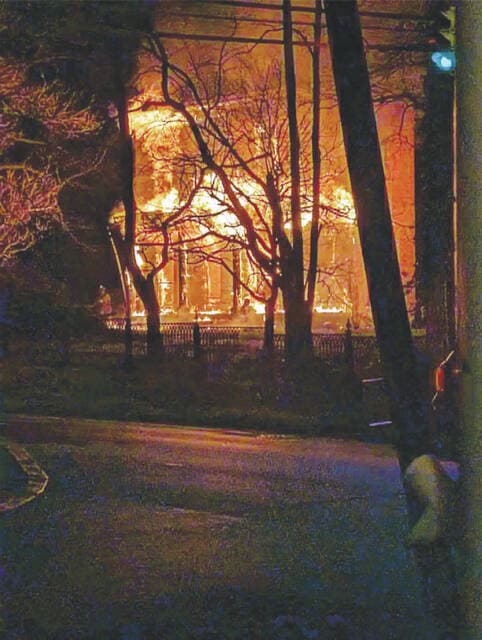
Well before sunrise on April 4, fire crews were called to 503 East Eighth Street in Manchester, where the Francis Ellison House, a 125-year-old structure sited on a hillside overlooking the village and the Ohio River valley, burned through the early morning hours. By daylight, the building locally known as "The Ridge" was in ruins. Four days later, no village or county official has publicly explained what started the fire, whether an investigation is active, or who is accountable for securing what remains.
That silence is itself a governance question. Whether the cause was electrical failure, a deteriorating heating system, deferred maintenance common to aging unoccupied buildings, or something deliberate remains publicly undetermined. Until investigators render a finding, the site at 503 East Eighth Street poses compounding hazards: structures built in the early 1900s frequently contain asbestos and lead paint, materials that become active environmental risks when burned and exposed. No public record confirmed as of April 8 whether the site had been fenced or secured following the blaze that crews spent several hours fighting.
Built in 1901, the Francis Ellison House was traceable in ways most historic properties are not. Probate and county auditor records connected the property to the Ellison family as recently as 1991, a near-century of continuous association that made the house an unusually legible link to Manchester's founding era. The Ellison family first established itself in the Ohio River valley in the late 18th century, meaning the ridge on which the house stands carries a history that predates Ohio statehood. Its elevated position amplified its civic weight: visible from many points throughout the village, the structure functioned as a physical marker of where Manchester began.
That visibility made its destruction particularly abrupt for residents and local historians, who described mourning not just a house but a tangible connection to the village's earliest settlement patterns. No documentation or designation can fully replace what fire removed from that hillside.

The destruction also surfaces a policy gap that extends beyond this property. Adams County, like most rural Ohio counties, has no well-funded mechanism for proactively assessing or protecting privately held structures of historical significance before a catastrophic event forces the question. Whether the county maintains an inventory of at-risk older structures, whether preservation incentives exist for owners, and whether fire codes are consistently applied to unoccupied historic buildings are questions officials will face with greater urgency now that one of Manchester's most prominent landmarks is gone.
If investigators determine the cause was negligence, the case carries civil and potentially criminal dimensions. If accidental, it still demands a harder look at how the county identifies and supports historic structures before the next early-morning call to a street where something irreplaceable is already burning.
This article was produced by Prism’s automated news system from verified source data, official records, and press releases, then run through automated quality and moderation checks before publishing. The system is built and supervised by the people who set the standards it runs under. Read our full AI policy.
Did this article answer your question?