Shawnee descendants take new role in Great Serpent Mound stewardship
Shawnee descendants are taking a direct role in guarding Great Serpent Mound, reshaping how Adams County’s signature landmark is interpreted, protected, and planned for.
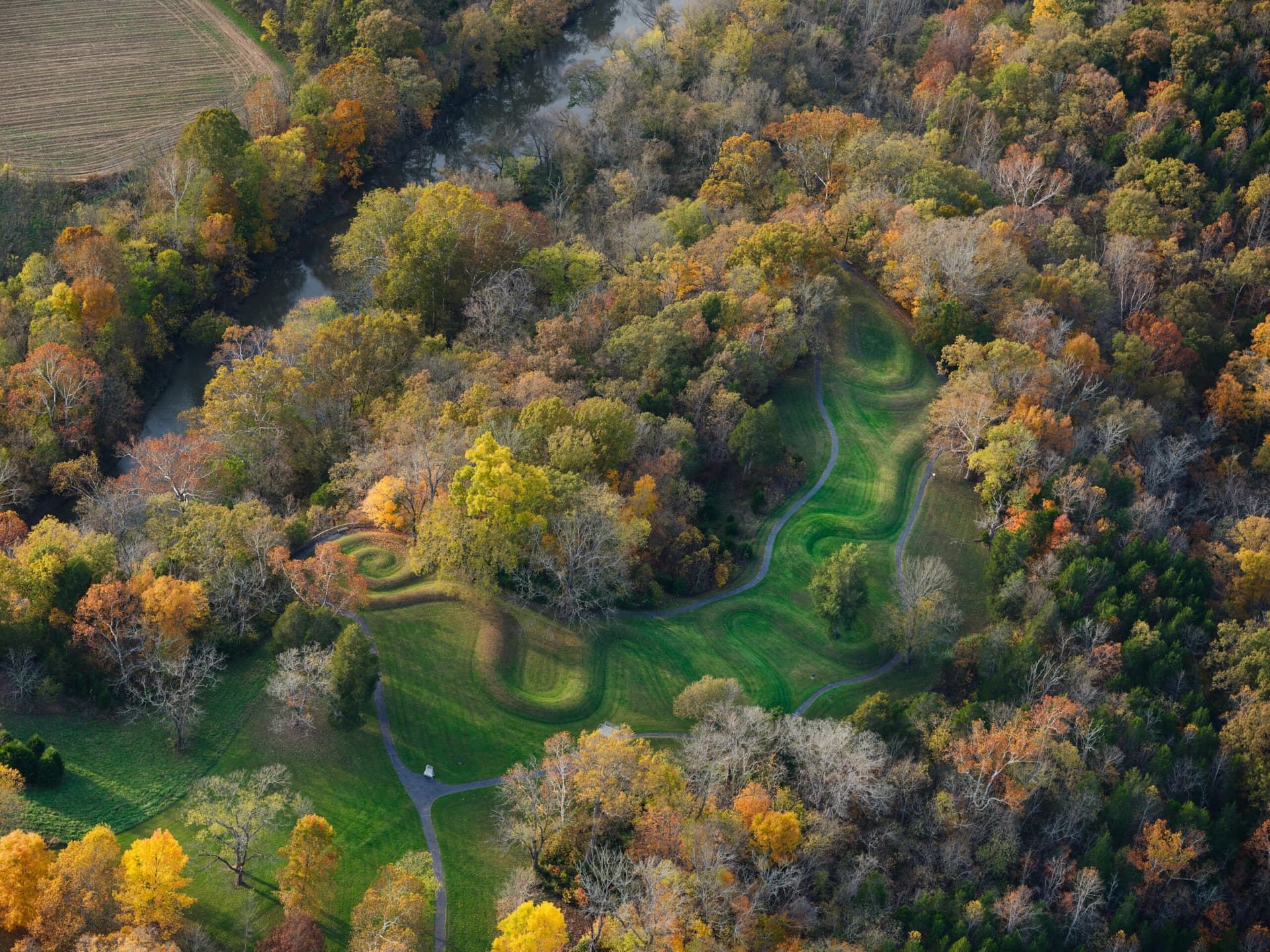
Great Serpent Mound in Peebles is no longer being treated only as a place to visit. With the Shawnee Tribe now holding land that directly borders the mound, stewardship is shifting toward the descendants of the people tied to the site’s deeper cultural story, and that change reaches well beyond tourism.
A new steward beside the mound
The Shawnee Tribe acquired a parcel directly bordering Great Serpent Mound in 2026, a move Chief Ben Barnes said helps protect the sacred site for future generations. The tribe hopes the purchase is the first of several that would build a protective buffer around the earthwork, giving Shawnee leadership a more active role in what happens at the edge of one of Adams County’s most visited landmarks.
That matters because the mound is managed today by the Ohio History Connection, which has long overseen the public-facing side of the site. The new land ownership does not replace that role, but it does add another layer of authority, one rooted in tribal continuity rather than outside interpretation alone. For Adams County, that means the conversation about Serpent Mound is moving from preservation as a museum task to stewardship as a living responsibility.
How the site is meant to be understood
The public message around Serpent Mound is changing along with the ownership map. Shawnee leadership has pushed for the mound to be understood not just as an archaeological landmark, but as a place bound to Indigenous memory, creation stories, and ongoing cultural identity. The Ohio History Connection has already acknowledged that the Shawnee have a Snake Clan and that the mound may connect to stories involving the Great Serpent and First Woman.
That perspective reframes how visitors should think about the site during solstice gatherings and beyond. Chief Barnes, Eastern Shawnee Chief Glenna Wallace, and Ohio History Connection archaeologist Brad Lepper all figured in Stephen Alvarez’s June 26 feature, with Barnes contributing an essay titled “On Coming Home.” The point of that collaboration is plain: interpretation is no longer being left entirely to archaeologists and preservation officials, because Shawnee leadership wants the mound presented as an American Indian story written into the earth itself.
Why the land return changes local planning
The land return is important locally because Serpent Mound sits inside a broader planning conversation about who shapes the future of the site. The tribe has said it is pursuing World Heritage status for Serpent Mound, and the Ohio History Connection says the mound has been on the U.S. Tentative List for UNESCO World Heritage nomination since 2008. If that effort advances, Adams County will be part of a much larger cultural and administrative process that could affect how the site is protected, interpreted, and promoted.
This shift also changes what the county’s most famous landmark stands for. Adams County has often been associated with the mound as a draw for visitors, but the new tribal role pushes the site toward something more than a tourism asset. It becomes a test of whether public history in rural Ohio can make room for cultural authority from the people most directly connected to the land.
The solstice gatherings now sit at the center
Summer solstice programming has become one of the clearest signs of that change. The Shawnee Tribe and the Ohio History Connection have jointly hosted solstice observances at Serpent Mound in recent years, and in 2026 the tribes led cultural programming around the solstice for the first time. A 2024 announcement set solstice celebrations for June 20 through June 23, showing that the site has already become a multi-day gathering place for visitors drawn to its seasonal alignment and spiritual significance.
Those gatherings also bring tension, because not everyone arrives with the same expectations. Spiritual visitors, archaeologists, tribal citizens, and casual tourists do not always agree on how a site like this should be used or interpreted. By taking a more visible role, Shawnee leadership is pushing the public to understand that the mound is not a blank scenic monument, but a sacred place with cultural rules, responsibilities, and limits.
What makes Serpent Mound so significant
Great Serpent Mound remains one of North America’s most important archaeological treasures, and its physical setting helps explain why. The earthwork stretches more than 1,400 feet, making it the largest effigy earthwork in the world. It winds across a ridge above Ohio Brush Creek, and the setting sun lines up with the serpent’s head at the summer solstice, a detail that has drawn generations of visitors to the site in Peebles.
Ohio History Connection identifies Serpent Mound as a National Historic Landmark, and the broader landscape around it is just as important as the serpent itself. The organization says three burial mounds are nearby, two Adena and one Fort Ancient, underscoring that this is not an isolated feature but part of a larger archaeological complex in Adams County. That wider setting is one reason the new Shawnee landholding carries such weight: it can help protect not only the earthwork, but the cultural landscape around it.
The long record of study, and the debate that still matters
Serpent Mound was first formally documented in 1848 by Ephraim Squier and Edwin Hamilton Davis, and later excavated by Harvard archaeologist Frederic Ward Putnam in the late 19th century. Even now, the mound’s age remains part of the story. Ohio History Connection says a 1991 radiocarbon study suggested the mound was about 900 years old and associated with the Fort Ancient culture, while 2014 work pointed to an Adena date around 300 B.C.
That disagreement is more than an academic footnote. It shows why the site still commands attention from archaeologists, tribal leaders, and the public alike. When the date of a monument remains unsettled, the debate over meaning stays open too, and that leaves room for Shawnee leadership to insist that cultural interpretation belongs alongside scientific study.
What Adams County gains from the new arrangement
For Adams County, the return of land to Shawnee hands changes the identity of Serpent Mound from the ground up. It creates a model in which local heritage is not only preserved for outsiders to admire, but stewarded by the descendants of the people whose histories are tied to the place. That can shape everything from future buffer zones to visitor interpretation to the way solstice events are organized on the ridge above Ohio Brush Creek.
The result is a landmark with a clearer cultural center of gravity. Serpent Mound is still a destination, still a protected archaeological site, and still one of the county’s most recognizable places. But with Shawnee descendants taking a new role in its care, Adams County’s most famous earthwork is also becoming a place where stewardship, public education, and tribal authority now move forward together.
This article was produced by Prism’s automated news system from verified source data, official records, and press releases, then run through automated quality and moderation checks before publishing. The system is built and supervised by the people who set the standards it runs under. Read our full AI policy.
Did this article answer your question?