Alamance County, cities diverge sharply on growth assumptions in budgets
Alamance County’s budget counts on an 8.3% sales-tax jump and a 51.65-cent tax rate, while Elon assumes flat sales-tax growth and Haw River budgets on 8% property-value growth.

Alamance County is leaning on a bigger revenue rebound just as its cities split sharply over how much growth they can safely bank on. The county’s recommended FY 2026-27 budget totals $239.1 million in the General Fund and $278.6 million across all funds, with sales-tax revenue projected to rise by $10.9 million, or 8.3%, even as leaders say lower state and federal funding is forcing them to reduce current services and freeze spending tied to one-time fund-balance money.
That county plan is built around a property-tax rate of 51.65 cents per $100 of valuation, up 2.25 cents from the prior year. Budget staff say the county’s property-tax base grew 3.6% in the new budget, but not fast enough to erase the revenue gap left after the last revaluation, when the rate was cut from 65.0 cents to 43.2 cents and revenue growth was not fully captured. County officials say unassigned fund balance has been depleted to cover the shortfall, which makes every assumption about taxes and collections matter more than usual.
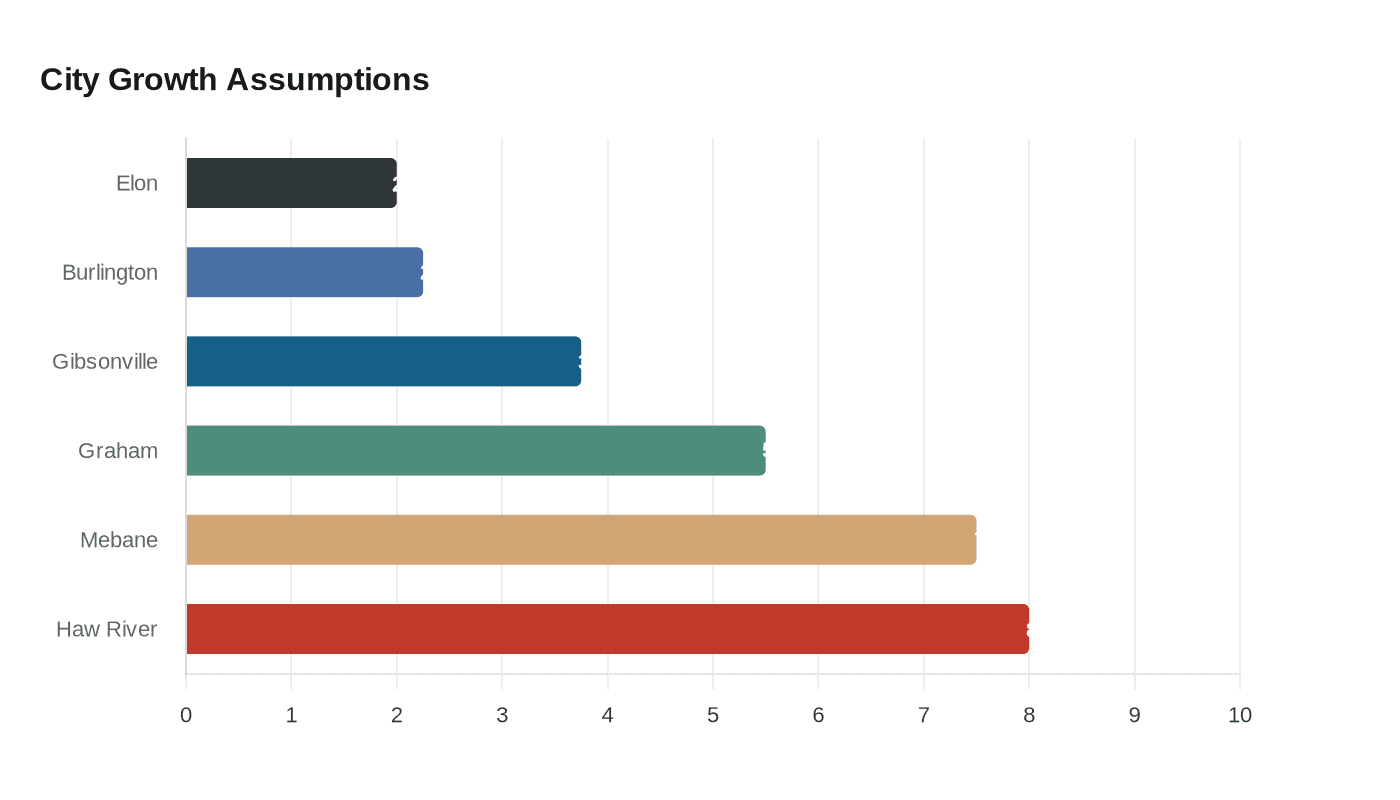
The same tension shows up in the six largest municipalities. Elon is the most cautious, assuming no increase in sales-tax revenue and only 2% natural property-tax growth. Burlington is close behind at 2.25% natural property-tax growth. Gibsonville is budgeting for 3.75% natural growth, while Graham is planning on 5.5%. Mebane is the most aggressive among the cities named in the budget comparisons, with 7.5% natural property-tax growth and a 5.5% increase in sales-tax revenue. Haw River is counting on 8% natural property-tax growth.
Those gaps are not just accounting choices. A stronger-than-expected retail year or a delay in development can quickly decide whether a town keeps tax rates steady, fills open positions, or pushes back road and capital projects. Alamance County lived through that pressure in June 2025, when commissioners adopted a budget with a 2.5-cent tax increase, taking the countywide rate to 49.4 cents per $100. Staff had warned then that a flat budget would have required $4.4 million in cuts, including possible closures of library branches in Graham, Mebane and North Park and the elimination of about 30 nonmandated positions.
The county’s budget calendar and public process now frame the same underlying question for 2026-27: which governments are betting that growth will arrive in time to pay for the plans, and which are bracing for a slower year if it does not.
This article was produced by Prism’s automated news system from verified source data, official records, and press releases, then run through automated quality and moderation checks before publishing. The system is built and supervised by the people who set the standards it runs under. Read our full AI policy.
Did this article answer your question?