Alamance News Publisher Challenges Legality of Elm Street Park Hearing
Tom Boney Jr. challenged the legality of Graham's March 24 HRC hearing on the West Elm Street Park, arguing quasi-judicial notice requirements under state law were not met.
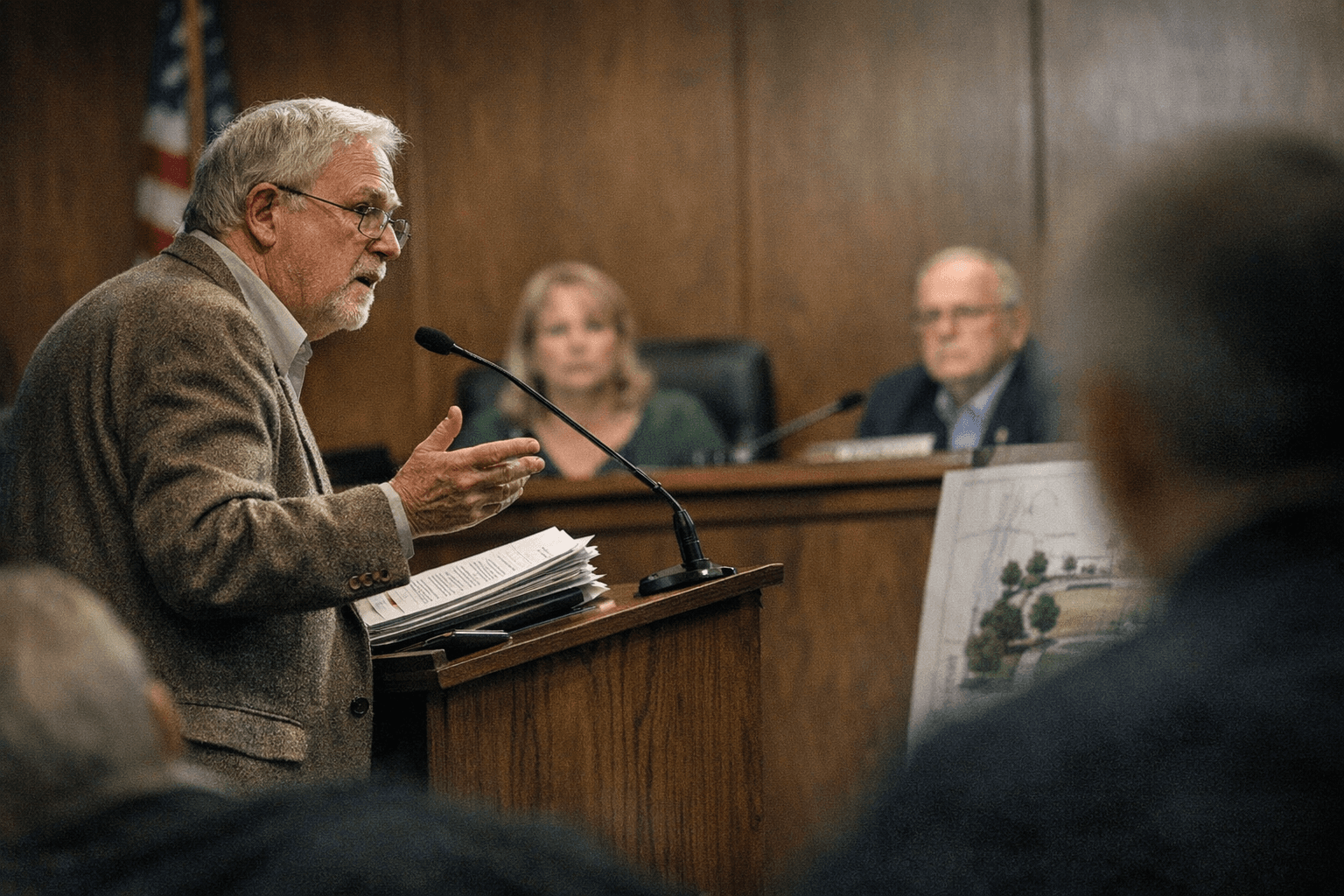
Tom Boney Jr., publisher of The Alamance News at 114 West Elm Street, appeared before Graham's Historic Resources Commission on March 24 to challenge whether the body's special meeting satisfied North Carolina's quasi-judicial notice requirements before the panel voted to approve a Certificate of Appropriateness for the proposed West Elm Street Park at 129 West Elm, directly across the street from his newspaper's office.
The procedural dispute centers on North Carolina General Statute 160D-406, which governs evidentiary hearings for land-use decisions including certificates of appropriateness. The statute requires mailed notice to owners of all parcels abutting the property under review, along with strict ex parte rules and evidentiary standards that distinguish quasi-judicial proceedings from ordinary legislative public hearings. Boney argued the city's scheduling and notice process did not clear that higher bar, calling the legality of the entire proceeding into question.
HRC chairwoman Zipporah Clark-Baldwin declined to allow Boney to address parking concerns during the hearing, the same ruling she applied to Allene Massengill, owner of 131 West Elm Street, whose tenant operates the Roasted Coffee Depot immediately adjacent to the proposed park site. The proposed park would replace the city-owned parking lot at 129 West Elm Street, eliminating roughly 20 spaces along that block. Despite the procedural objection, the commission voted to approve the COA, directing one design change: member Richard Shevlin recommended replacing the A-frame pavilion roof shown in consultant Stewart Inc.'s drawings with a flat roof, which Clark-Baldwin said better matched the surrounding downtown streetscape. Assistant city manager Aaron Holland presented the city's proposal.
The Graham City Council voted 3-2 on March 10 to approve the relocation design, following a 4-1 vote in January to move Sesquicentennial Park from its original site at the northwest corner of Court Square after structural concerns arose at the existing location.
If Boney's procedural challenge is sustained, whether through city staff review, the city attorney's office, or a formal legal appeal, the commission would likely need to re-advertise the hearing and hold a new proceeding, rendering its March 24 approval void. The stakes are concrete: as of April 2 the city was advertising a design-build procurement for the park, with sealed proposals due by 2 p.m. on April 14 at Graham City Hall. A successful challenge would freeze that bid process until a legally defensible COA is in place.
The dispute is procedural, not substantive. No party has challenged the park's design on its historic-district merits, and the HRC's approval indicates the commission found the Stewart Inc. plans consistent with preservation standards for the area. But North Carolina land-use law treats procedural compliance as a threshold requirement: a COA issued without proper notice is vulnerable to challenge regardless of how the underlying design might have fared in a properly noticed hearing. For the city of Graham, the question of whether the March 24 process clears that threshold will determine whether the West Elm Street Park breaks ground on the current timeline or returns to the starting line.
This article was produced by Prism’s automated news system from verified source data, official records, and press releases, then run through automated quality and moderation checks before publishing. The system is built and supervised by the people who set the standards it runs under. Read our full AI policy.
Did this article answer your question?