Burlington’s downtown roots trace back to railroad repair village
Burlington’s core began as Company Shops, a railroad repair village whose layout, buildings, and business district still shape downtown today.
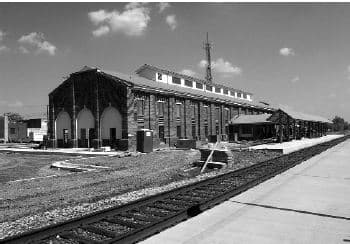
Downtown Burlington still sits on the footprint of a railroad repair village, and that origin explains why the city center feels compact, layered, and deeply tied to rail and industry. The North Carolina Railroad bought land in Alamance County between Graham and Gibsonville and built Company Shops between 1855 and 1859; by 1859, the village already held 57 buildings, including two engine or machine shops, a blacksmith shop, a foundry, a carpentry shop, an engine shed, and a car shed.
From Company Shops to Burlington
Company Shops was never just another railroad stop. NCpedia places it within the broader Piedmont Urban Crescent created by the North Carolina Railroad, a transportation network that helped seed a chain of towns across central North Carolina and gave Burlington its first economic identity as a company-town repair site.
The railroad even briefly renamed the settlement Vance before returning to Company Shops, a small detail that captures how closely the place was tied to corporate purpose. That arrangement changed in 1866, when the railroad moved its repair facilities to Spencer, and the City of Burlington says the departure triggered a serious economic crisis for the community.
Residents then chose the name Burlington, and the city was officially chartered and incorporated in 1893. That sequence matters because it explains why downtown Burlington does not look like a generic courthouse-square town: it began as an industrial village built for railroad mechanics, then had to reinvent itself as the railroad’s original role disappeared.
What the downtown map still shows
The Downtown Burlington Historic District preserves that reinvention in physical form. The City of Burlington describes it as a commercial area of 72 buildings spread across four city blocks and parts of three more, with 45 contributing buildings and 27 non-contributing ones, plus five resources individually listed in the National Register.
The district’s oldest contributing building dates to 1885, and its period of significance runs through the end of World War II. That timeline captures the shift from railroad repair village to commercial center, then to a downtown shaped by later waves of industrial growth and everyday business activity.
Its architecture also reflects that layered history. Burlington identifies locally interpreted examples of Neo-Gothic Revival, Classical Revival, Art Deco, and Art Moderne, styles that mark the decades when downtown moved beyond a single-company settlement and into a broader city center. The district is significant for both railroading and textile production, a combination that tells you almost everything about how Burlington grew.
Walk the district today and the old company-town logic is still visible in the concentration of buildings and the tight commercial core. This is not a scattered preservation zone on the edge of town. It is the heart of downtown, the place where Burlington’s early repair-shop footprint evolved into the city’s central business district.
How preservation keeps the story on the street
Burlington’s preservation program gives the downtown story practical weight, not just historic interest. The city says historic designation is separate from National Register listing, but both can support revitalization in older neighborhoods and commercial corridors. For income-producing contributing buildings in a listed district, Burlington says owners may be eligible for a 20% federal tax credit and a 20% North Carolina state tax credit for approved rehabilitation work.
That matters in a downtown built from older commercial stock, because preservation has to compete with demolition, vacancy, and redevelopment pressure. The tax-credit structure gives property owners a direct economic incentive to keep historic facades and upper floors in use, which helps explain why Burlington’s downtown still has a visible brick-and-mortar core instead of starting over with newer construction.
The city’s historic district network shows that downtown is part of a wider preservation strategy. West Burlington became Burlington’s first locally designated historic district in 1987, and Glencoe Mill Village was listed in the National Register in 1979 before later becoming a local historic district under the city’s preservation program. Burlington’s historic district walking-tour materials also describe another city district as containing 154 houses and buildings from the 1890s through the 1930s, underscoring how much of Burlington’s growth-era fabric still survives.
Oversight runs through the Burlington Historic Preservation Commission, a quasi-judicial body that handles those districts, while the city also works with a Durham-based preservation firm and the North Carolina State Historic Preservation Office on an architectural survey update for another section of Burlington. The tools are bureaucratic, but the result is visible on the street: older commercial blocks, mill-era neighborhoods, and the downtown core remain legible to anyone walking the city.
The merchants and mill owners who filled the gap
Once the railroad moved out, Burlington did not stay stuck in a single-purpose economy. NCpedia notes that the Holt family developed five mills in the Company Shops area between 1883 and 1893, a burst of textile investment that helped turn the former railroad village into the city of Burlington. That shift from rail repair to textile production is one of the clearest reasons downtown still looks like an industrial-era commercial district rather than a postwar business strip.
The town also produced business leaders who moved between rail and retail. James Edward Stagg was born in Company Shops, and William Allen Erwin started in 1874 as a salesman in Holt, Gant, and Holt’s general store there, later worked for the North Carolina Railroad as a bookkeeper, and then opened his own mercantile business in 1878. Those careers show how Company Shops became a training ground for the merchants, clerks, and industrial managers who gave Burlington its next economic chapter.
That is the deeper guide to downtown Burlington: the street grid, the old storefronts, the preservation districts, and the surviving landmarks all point back to the same beginning. The repair village became a commercial center, the commercial center became an industrial city, and the company-town footprint still defines where Burlington’s business heart sits today.
This article was produced by Prism’s automated news system from verified source data, official records, and press releases, then run through automated quality and moderation checks before publishing. The system is built and supervised by the people who set the standards it runs under. Read our full AI policy.
Did this article answer your question?