Albany County’s Wyoming toad recovery marks decades of conservation effort
Albany County’s only-endemic amphibian now shapes land use, water rights and public spending across the Laramie Basin, with 3,000-plus acres and senior water rights in play.
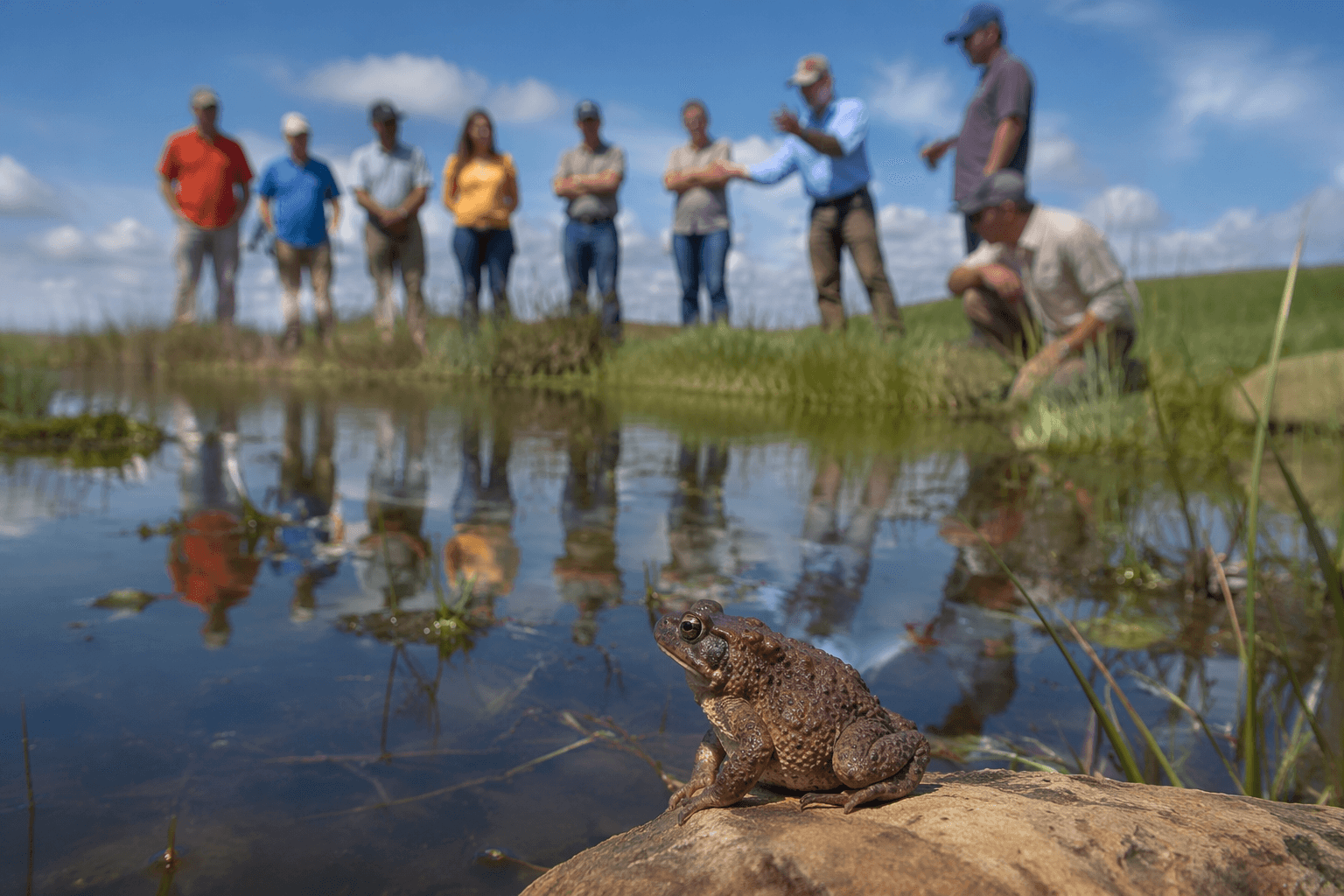
Albany County’s rarest resident now sits at the center of a land, water and funding network that reaches far beyond Mortenson Lake. The Wyoming toad survives only in Albany County, and its recovery has become a practical test of how federal agencies, ranchers and local partners can protect wetland habitat without taking working land out of production. What happens next in the Laramie Basin will continue to influence how the county balances conservation, irrigation and public investment.
How a species found nowhere else became an Albany County priority
The Wyoming toad was federally listed as endangered in January 1984, after it had already become one of the most closely watched species in the state. The U.S. Fish & Wildlife Service says Dr. George T. Baxter discovered it in 1946, and by 1987 a small population had been rediscovered near Mortenson Lake after the species was widely believed to be extinct in the wild.
The turning point came in 1993, when the last 10 known wild toads were captured at Mortenson Lake to start a breeding program. The first successful captive reproduction followed in 1994 at the Sybille Wildlife Research and Conservation Center, and the species remains extinct in the wild today. That history is why every gain in the recovery program matters so much in Albany County: there is no backup population anywhere else.
Mortenson Lake became the anchor, but not the whole plan
Mortenson Lake National Wildlife Refuge was established in 1993 specifically to protect the Wyoming toad, and it remains the species’ best-known stronghold. The refuge story is also a land stewardship story. The Service says a local rancher sold land to The Nature Conservancy, which then donated it to the federal government for Wyoming toad conservation, showing how private land decisions helped create the public refuge footprint.
The recovery effort has never depended on one fenced site alone. The Service says toads are released each year on select private and public lands across Albany County, a sign that the species’ future depends on habitat conditions across the Laramie Basin rather than only on one refuge parcel. That broader footprint makes the recovery program relevant to ranch operations, wetland management and the county’s long-term land-use choices.
Water is the hinge point for both toads and agriculture
The newest major step came on September 22, 2023, when the U.S. Fish & Wildlife Service acquired 1,078 acres to officially establish the Wyoming Toad Conservation Area. The new unit became the 569th in the National Wildlife Refuge System, and the Service says it protects more than 3,000 acres of critical wetland habitat. For Albany County, that is not just a conservation headline: it is a direct statement about how land, water and agriculture now overlap in the basin.
The conservation area depends on senior water rights tied to the Laramie River and Sand Creek, and the Service has said reliable water is fundamental both to conservation and to agricultural viability. The area was assembled with Land and Water Conservation Fund money and developed with The Conservation Fund, the City of Laramie, the Wyoming Game and Fish Department and the Laramie Rivers Conservation District. That mix of public funding and local coordination is the clearest sign that the toad’s recovery is now part of the county’s water infrastructure conversation.

Working ranches are part of the solution
The Wyoming toad recovery effort is not built on removing every acre from use. The Service has used coexistence tools on working ranchland, including a Safe Harbor-style site at the Buford Foundation. That model matters in south-central Albany County because it treats ranching and habitat protection as compatible when wetlands, grazing and timing are managed carefully.
That approach also helps explain why the recovery effort has persisted for decades. Instead of drawing a hard line between wildlife habitat and productive land, the program has created a framework where public agencies, conservation groups and landowners can operate on the same landscape. In a county where water delivery and grazing are part of the economic base, that flexibility is part of the conservation strategy.
What the recovery program actually relies on now
The Wyoming toad recovery effort runs on captive breeding, reintroduction and science coordination. The Wyoming Game and Fish Department, the U.S. Fish & Wildlife Service, the University of Wyoming and zoo partners all remain involved, and the Wyoming Toad Recovery Team continues to coordinate scientific data and studies. Cheyenne Mountain Zoo is among the zoo partners connected to the effort, reinforcing that the species’ survival depends on a network well beyond Albany County.
The scale of the challenge is underscored by one stark measure: by 2011, the Service said only one Wyoming toad could be found in the wild. That number is why the current strategy still emphasizes captive breeding and carefully managed releases rather than relying on natural rebound alone. The species’ progress is measured in years and habitat acres, not in quick population swings.
Why this matters for Albany County now
The Wyoming toad has become a marker for how Albany County handles a rare species that depends on wetland habitat, water rights and landowner cooperation all at once. The recovery work now touches Mortenson Lake, the Laramie Plains, private ranch lands and public conservation units, which means the species has real influence over how the basin is valued and managed.
For county residents, the practical stakes are clear. The conservation area’s 3,000-plus acres, its 1,078-acre land acquisition and its senior water rights tied to the Laramie River and Sand Creek all point to a future in which ecological recovery, irrigation and public funding remain linked. The Wyoming toad is still small enough to fit in a hand, but in Albany County it helps shape decisions that reach far beyond the wetland where it was once nearly lost.
This article was produced by Prism’s automated news system from verified source data, official records, and press releases, then run through automated quality and moderation checks before publishing. The system is built and supervised by the people who set the standards it runs under. Read our full AI policy.
Did this article answer your question?