Laramie house tells Wyoming’s story as first state with women’s voting rights
A downtown Laramie house turns Wyoming’s first-in-the-world women’s voting rights into a visitable story, from Louisa Swain’s 1870 ballot to the first women on a jury.

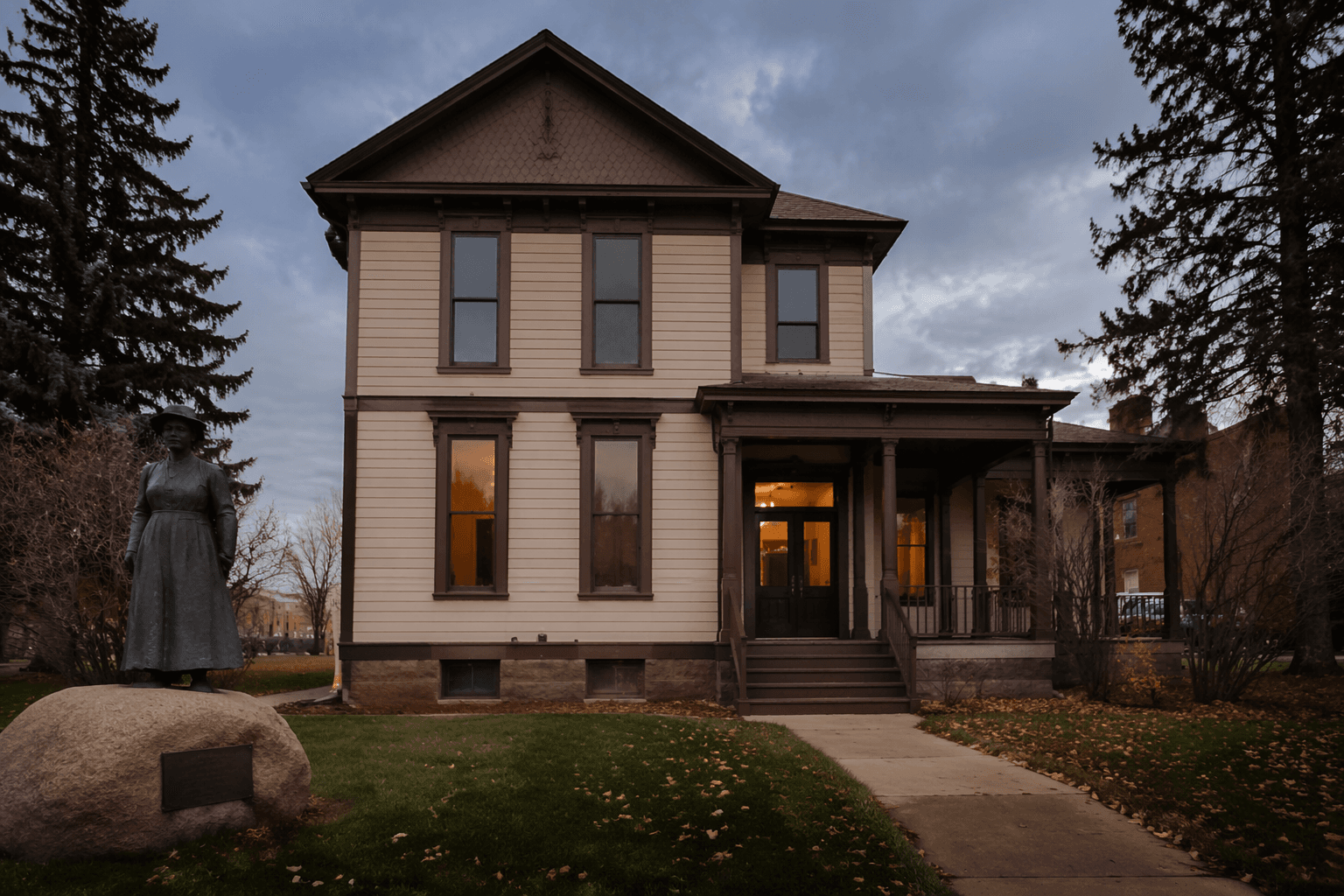
At 317 S. 2nd St. in downtown Laramie, the Wyoming Women’s History House turns a world first into a place you can stand inside. The building explains why Wyoming is called the Equality State, and it gives Albany County a concrete way to show how one territorial law quickly changed civic life.
A downtown address tied to a global first
Wyoming’s women’s suffrage story begins before statehood, while the territory was still young. Wyoming was organized as a U.S. territory in 1868, the territorial legislature passed the women’s suffrage law in December 1869, and Governor John Allen Campbell signed it on Dec. 10, 1869. That made Wyoming Territory the first government in the world to grant women full voting rights and the right to hold public office.
William H. Bright introduced the bill, and the politics around it were more complicated than a simple reform victory. WyoHistory has described the law as shaped by partisan politics, racial fears, an eye for national publicity, and genuine reform impulses. That mix helps explain why the story still carries national weight, even though the physical center of it sits on a downtown Laramie block.
For today’s visitors, that matters because the house is not presenting a distant idea. It is tying a global milestone to a specific address, a specific year, and specific people whose names still anchor the state’s identity.
Louisa Swain’s vote became the state’s clearest symbol
The best-known figure in that history is Louisa Swain, the first documented woman to vote in Wyoming. She cast her ballot in Laramie on Sept. 6, 1870, and the date is now recognized in Wyoming as Louisa Swain Day. Swain was about 70 years old when she voted, and a National Women’s History Museum biography describes her as a grandmother with white hair visible under her bonnet.
Swain’s own life stretches the story beyond Wyoming’s borders. Wyoming History Day says she was born in Norfolk, Virginia, in 1801, which means her vote came more than 60 years after New Jersey effectively removed women’s voting rights in 1807. That contrast makes her act feel even larger than a local milestone, because it shows how far women’s access to the ballot had been narrowed before Wyoming restored it.
She also beat Augusta C. Howe to the polls by about 30 minutes, a detail that keeps the story grounded in a real morning in Laramie rather than in abstract symbolism. In a state that still uses the Equality State label, Swain remains the single most recognizable face of the law that made that nickname believable.
The jury box changed almost immediately
Wyoming’s suffrage law did not stop at voting. Three months after the law passed, women were called to serve on a grand jury in Laramie in March 1870, the first time in history. Stephen Downey, then Albany County attorney, objected to women serving, and Chief Justice John Howe overruled him.
WyoHistory identifies the first six women jurors as Eliza Stewart, Amelia Hatcher, G. F. Hilton, Mary Mackel, Sarah Pease, and Annie Monaghan. Local accounts place the proceedings before Laramie had a courthouse, at the Trabing Brothers store, which makes the episode feel even more immediate. This was not a ceremonial gesture in a finished civic building. It happened in the rough, provisional setting of a frontier town that was still assembling its institutions.
Visit Laramie also notes that six women were summoned to sit alongside 10 men on the first female jury. Taken together, the accounts show how quickly women’s legal standing moved from paper to practice in Albany County. The point of the house is not just that women won the vote, but that the vote immediately reshaped how courts, juries, and public authority worked.
Martha Symons Boies shows the next step
Another name from that same year helps widen the story beyond ballots and juries. Martha Symons Boies was selected as a bailiff for the 1870 grand jury and is described as the first woman in the world to be appointed a court bailiff of record. Visit Laramie says that fact belongs inside the same history as Louisa Swain’s vote because it shows women not only entering the electorate, but also carrying responsibility inside the legal system.
Boies is also identified in some sources as Martha Symons Boies Atkinson. A biographical sketch says she and her husband were later remembered as among the first settlers of Laramie, which ties her not just to a courtroom role but to the town’s earliest period of settlement. That connection matters in a place like Albany County, where the civic history and the town-building history overlap so closely.
Her role adds a practical dimension to the women’s rights story. Voting was only the start. Women were also serving, supervising, and participating in the administration of justice, which is exactly the kind of lived change a downtown history house can help visitors understand.
What the house gives Laramie now
The Wyoming Women’s History House gives residents and visitors a compact way to read the state’s larger story through one walkable place. From 317 S. 2nd St., the narrative opens to Sept. 6, 1870, March 1870, Dec. 10, 1869, and the still-visible names of the people who made Wyoming’s record possible. That makes it useful not only as a heritage stop, but also as a civic landmark for school groups, families, and anyone trying to understand why Laramie matters nationally.
A visit works best when you connect three things:
- the address, 317 S. 2nd St.
- the date, Sept. 6, Louisa Swain Day
- the sequence, the 1869 suffrage law followed by the first women jurors and Martha Symons Boies’s court role
That combination gives downtown Laramie a stronger claim than a simple museum label. It is a place where the evidence of a territorial experiment still sits in plain view, and where Wyoming’s national first becomes part of everyday local identity.
This article was produced by Prism’s automated news system from verified source data, official records, and press releases, then run through automated quality and moderation checks before publishing. The system is built and supervised by the people who set the standards it runs under. Read our full AI policy.
Did this article answer your question?