Downtown Laramie murals turn the city center into an open-air gallery
Downtown Laramie’s mural trail links more than 20 works to coffee stops, footbridges and a self-guided route that keeps visitors moving through the city center.
Downtown Laramie’s murals do more than brighten walls. They turn the city center into a walkable route that pushes visitors past coffee counters, storefronts and footbridges, then brings them back through the block with a reason to linger. The Laramie Mural Project now spans more than 20 works, and the route is set up to be followed in one outing from a brochure, a map or even a winter drive.
A downtown route built on local partnership
The project began in 2011 as a collaboration among the University of Wyoming Art Museum, the Laramie Main Street Alliance and local Laramie artists. That original partnership funded more than 20 murals across downtown, and the work has since shifted into a longer-term civic effort co-hosted by Main Street and the Laramie Public Art Coalition.
LPAC now raises money for future murals and for maintenance of the original pieces, which is one reason the route still feels current more than a decade later. The organization describes the murals as large-scale works in the heart of downtown that reflect Laramie’s cultural assets, and its broader public-art work is built around experiences that can reflect or challenge community values.
Where to pick up the route
The easiest way to treat the mural walk as a downtown outing is to start with the printed materials. Walking tour brochures are available at the Main Street office at 207 Grand Avenue, the tourism board at 210 Custer Street and the UW Art Museum at 211 E. Willett Drive.
That matters because the route is not isolated from the rest of downtown commerce. The brochures point people into the same blocks where they are likely to buy coffee, step into a shop or pause for lunch, and the self-guided format makes the mural trail work as a flexible part of a shopping day or a weekend visit.
A one-outing loop through the downtown core
1. Start at 2nd and Custer
Hollyhock Haven by Travis Ivey is one of the first murals completed for the project, and it sits at 2nd and Custer. LPAC describes it as a year-round bloom of hollyhocks, which makes it a strong opening stop for a walk that is meant to be repeated in different seasons.
From there, the downtown grid makes it easy to keep moving without leaving the center. The point is not to chase art in a scattered pattern, but to trace a route that keeps feet on the sidewalks around the main commercial blocks.
2. Continue to Gill Street and the fish mural
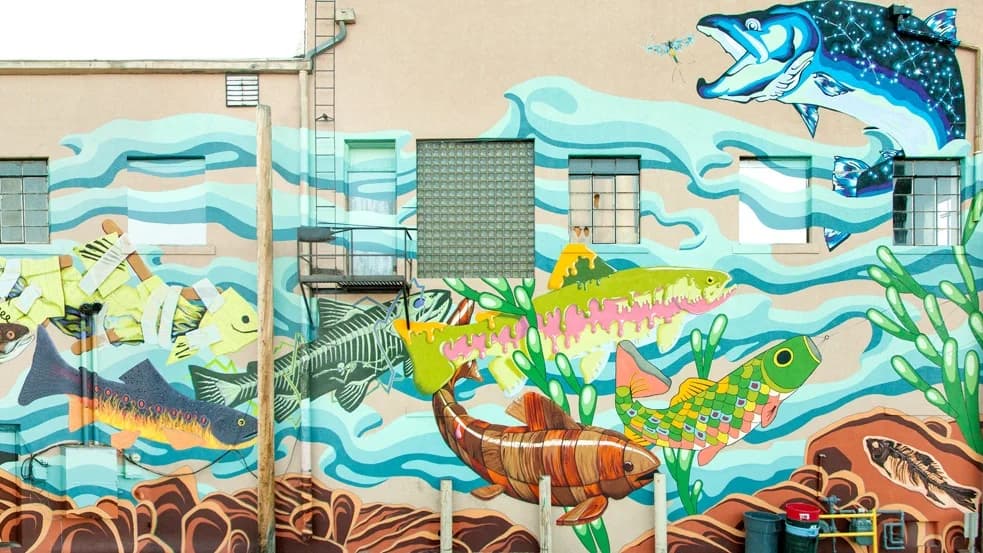
The Gill Street collaborative fish mural is one of the project’s most recognizable stops, and LPAC says it was dedicated on June 13, 2014. The extension on Gill Street was completed in July 2018 and brought together a long list of participating artists: Colleen Friday, Jeff Hubbell, Travis Ivey, Evan Levi, Chelsea Lowry, Meghan Meier, Lindsay Olson, Dan Toro and Adrienne Vetter.
LPAC says the mural can be viewed from the parking lot behind Coal Creek Coffee and Altitude’s Chophouse or from the Garfield Street Footbridge. That placement is what gives the route its economic value: the art does not sit apart from downtown life, it pulls people toward places where they are already likely to stop, look and spend time.
3. Let the walk stay inside the business district
The murals are placed to be seen from alleys, parking lots, footbridges and main streets, which makes the route feel like part of the downtown circulation system rather than a detached attraction. A reader can move through the core, pass by intersections like First and Grand and First and Garfield, and keep the outing compact enough to finish in a few hours.
That compactness is part of the draw for Albany County residents and for visitors already downtown for University of Wyoming events. As Laura McDermit, executive director of the Laramie Public Art Coalition, put it: “The identity, I think, of Laramie is really shaped by the murals that are present in our downtown.”
4. Add LaBonte Park if you want a longer stop
The mural project also reaches beyond the central blocks. LPAC highlights Salamander Stink and the Haunted Handshake at the LaBonte Park skatepark, where the design was shaped through a community-informed process with an advisory team that included Feeding Laramie Valley, Laramie Interfaith, Laramie Youth Crisis Center, Friends of the Laramie Skatepark and the City of Laramie Parks and Recreation.
That extension shows how the project works as a broader public-art system, not just a downtown beautification effort. For a longer outing, LaBonte Park adds another layer to the same story: public art as a reason to move across town, not simply past it.
Why the route still works in Wyoming weather
Visit Laramie added an artist-video public art tour in 2022, giving the route a more interpretive layer beyond the brochure and map. The same tourism guide notes that the mural walk can also be driven in adverse weather, which makes it one of the few downtown activities that still works when wind, snow or cold make a full walking loop less appealing.
That flexibility is important in Laramie, where a visit can change quickly with the season. A visitor can do the route as a walk in summer, break it into short stops in shoulder season or treat it as a slow drive when conditions make the sidewalks less inviting.
What keeps the project moving
LPAC’s public-art resources point readers to a Laramie Public Art Plan and a mural project hub, underscoring that the downtown trail is still being maintained rather than left to age on its own. The coalition says it works with artists, community members and partner organizations on public-art experiences across the city.
That ongoing structure is what keeps the downtown mural route useful for shops, coffee stops and weekend visitors. It gives Albany County a self-guided attraction that is easy to repeat, easy to extend and rooted in the same blocks where downtown commerce already happens.
This article was produced by Prism’s automated news system from verified source data, official records, and press releases, then run through automated quality and moderation checks before publishing. The system is built and supervised by the people who set the standards it runs under. Read our full AI policy.
Did this article answer your question?