Hutton Lake refuge offers year-round wildlife watching near Laramie
Just 10 miles southwest of Laramie, Hutton Lake packs five lakes, 2.6 miles of trails and a strong spring birding window into a quick Albany County escape.
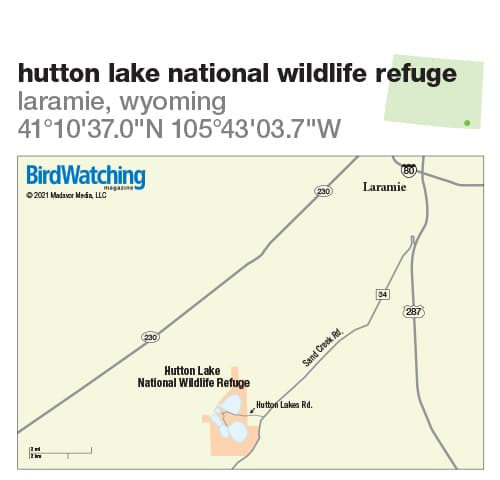
Hutton Lake National Wildlife Refuge gives Albany County a compact wildlife stop 10 miles southwest of Laramie, with five lakes, 2.6 miles of trails and a landscape that shifts from wetlands to prairie in a single visit. The refuge spans 1,928 acres in the high-plains Laramie Basin, where open water, alkali flats and sagebrush uplands pull in birds and mammals across the seasons. It works best as a short, self-guided outing, especially when migration puts the lakes to work.
A refuge shaped for birds
Hutton Lake was established by executive order on January 28, 1932, primarily as a resting and breeding ground for migratory birds and as a haven for other native wildlife. It is a satellite of Arapaho National Wildlife Refuge, but its setting feels distinctly local: the southern Laramie Plains, a dry, high-elevation grassland ringed by mountains. The refuge’s habitat mix includes open-water wetlands, upland brush and grasslands, alkali flats, shallowly flooded wet meadows, alkali-greasewood flats, shortgrass prairie and sagebrush uplands, and many different species use the same small area.
The lakes pull birds; the grassy and brushy edges draw mammals; and the open flats leave enough visibility to scan for movement without a long hike.
What you are most likely to see
Visit Laramie lists 34 species of water birds, and the refuge remains manageable for a half-day stop. Waterfowl are the clearest draw, with mallards, redheads, teal and pintails moving through the lakes, while great blue herons, black-crowned night-herons, phalaropes, western grebes, bitterns and black terns add variety for patient viewers. On the ground and in the open flats, pronghorn, white-tailed prairie dogs and coyotes are among the more likely mammals to show up.
Wildlife watching is the refuge’s most popular activity. Birds use the wetlands during migration, and some nest in uplands or over water depending on the species, so a single stop can produce different sightings from one stretch of trail to the next. For photographers, the mix of open sight lines and water gives you enough space to frame birds without needing to push close.
When to plan the drive
March through October is the strongest window for most visitors, with better viewing and more reliable conditions. From November through February, frozen ponds and cold, snowy weather limit both access and wildlife watching, so the lakes are far less productive than they are in spring and summer. Spring migration is especially valuable because moving birds stack onto the wetlands before some settle to breed and others keep pushing north.
In spring, the refuge can feel busiest with water birds working the lakes and marsh edges. In summer, the breeding season gives the wetlands a steadier rhythm. By fall, the open flats and grasslands still hold enough activity to reward a short drive out of town, even as the pace slows.

What first-time visitors need to know
The refuge has no facilities, so plan it as a walk-in, low-amenity visit rather than a stop with services. Because access is built around trails and foot travel, the experience is best for people who want to slow down, scan water and grassland edges, and leave the car behind for a while. Hunting access is walk-in only.
A first visit goes more smoothly if you think in practical terms:
- Plan around the March-through-October window if you want the best odds of seeing birds and mammals.
- Treat winter as a limited-access season, when frozen ponds and snow can shut down much of the viewing.
- Expect a quiet, self-reliant outing with no facilities on site.
- Use the trails as the core of the visit, since the refuge is set up for observation on foot.
Why this small refuge matters
Across the National Wildlife Refuge System, wildlife observation is the top visitor draw and roughly 40 million people come each year. The broader refuge network protects waterfowl production areas that support breeding, resting and nesting habitat for waterfowl, shorebirds, grassland birds and other wildlife, and Duck Stamp funds have helped conserve more than 3 million acres of that habitat nationwide.
This article was produced by Prism’s automated news system from verified source data, official records, and press releases, then run through automated quality and moderation checks before publishing. The system is built and supervised by the people who set the standards it runs under. Read our full AI policy.
Did this article answer your question?