Allendale County schoolhouse preserves rural education history
Little Miss Arnold’s SchoolHouse shows how Allendale County families once built schooling around short distances, local teachers and roadside landmarks that still anchor memory.
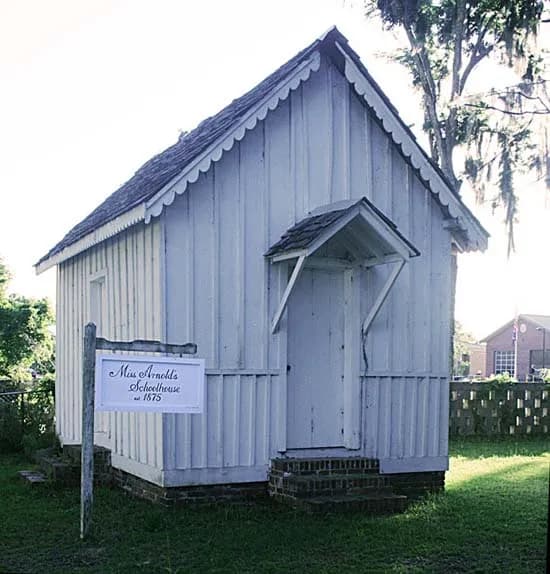
Little Miss Arnold’s SchoolHouse stands at 609 Georgia Avenue in Allendale as a small building with a large story: it shows how rural children in Allendale County learned close to home, how one teacher could shape a community for decades, and how travel, labor, and family life were organized around the nearest school rather than a distant campus. The county now lists the site among its historic places, and that recognition preserves more than architecture. It preserves evidence of an older county economy built on scattered settlements, local self-reliance and the daily need to make education fit farm country distances.
A roadside landmark on Georgia Avenue
The county’s visitor listing names Little Miss Arnold’s SchoolHouse as one of Allendale County’s historic sites, while Thoroughbred Country identifies the building as Miss Arnold’s Schoolhouse at 609 Georgia Avenue in Allendale. That listing describes it as "an authentic one room school house used in Allendale circa 1875," and says it is "currently on private property" and "may be viewed from the road." Those details matter because the schoolhouse is preserved not as a museum with a front desk and admissions counter, but as a visible marker along an ordinary road in town.
That roadside setting fits the way rural school buildings functioned in earlier South Carolina. In a county made up of small towns, crossroads and farm country, a schoolhouse had to be close enough for children to reach without a long, complicated trip. The building’s survival on Georgia Avenue gives Allendale a rare physical record of that geography, when education depended on the shape of the land as much as on the shape of the school day.
The teacher whose name lasted longer than the classroom
The schoolhouse is tied to Miss Selena Arnold, whom Thoroughbred Country describes as a beloved teacher who taught for more than fifty years. Other local-history references identify her as Augusta Salena Arnold, and a web-posted historical description says the schoolhouse was built in 1875 for teacher Augusta Salena Arnold. The different name forms point to the same local figure, a teacher remembered strongly enough that the building came to carry her identity long after formal schooling changed around it.
That long teaching career helps explain why the schoolhouse remains part of county memory. In a one-room setting, the teacher was not just an instructor but the central organizer of learning, discipline, attendance and the pace of the day. One teacher managing multiple grades would have been a practical necessity in a sparsely populated county, where a full staff and separate classrooms would have been impossible to support for a small neighborhood school.
What one-room schooling meant in rural Allendale
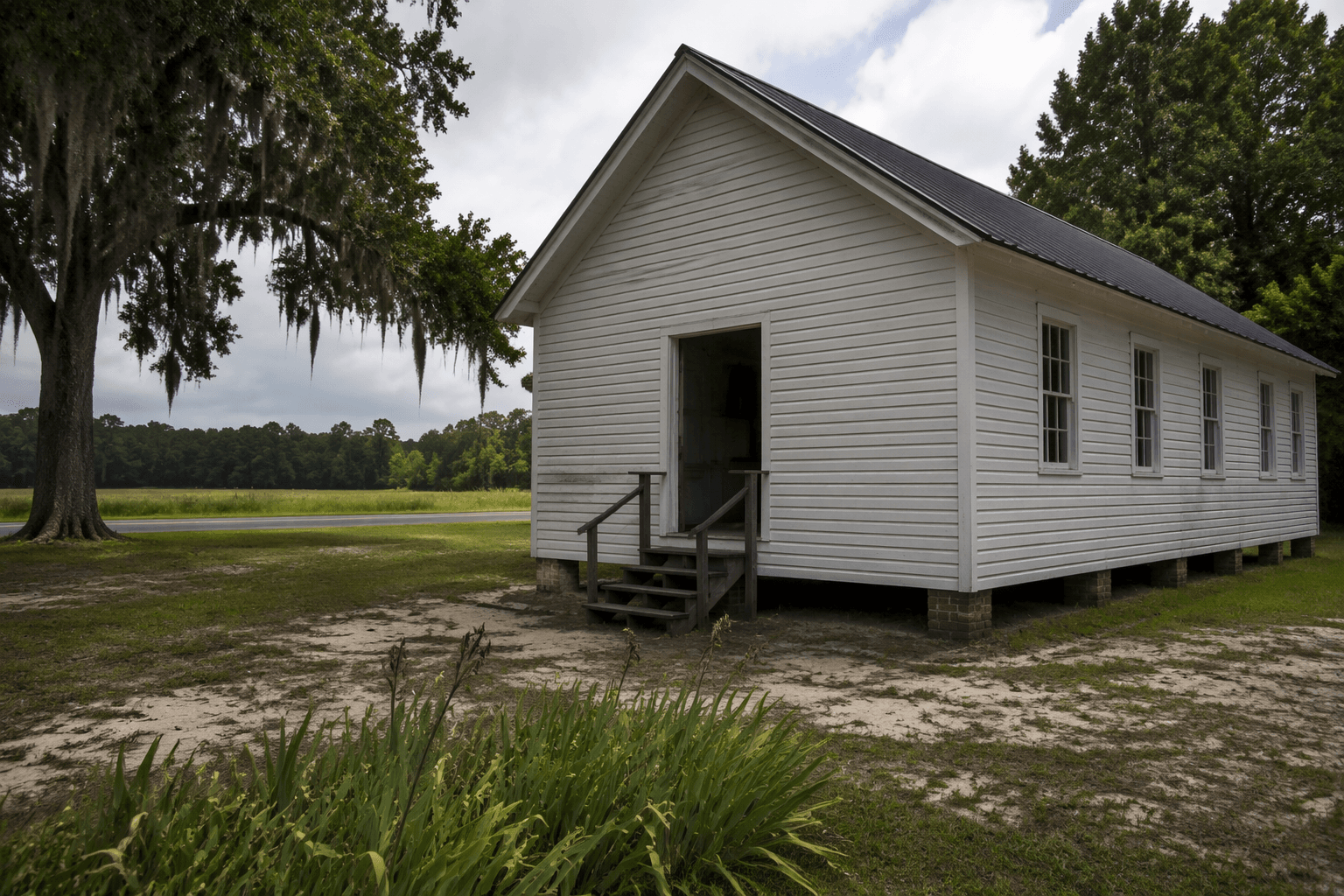
The schoolhouse makes the old education system visible in a way that statistics alone cannot. Before consolidation, rural education in South Carolina was shaped by locally organized schools that served children living far apart from one another. In Allendale County, that meant families arranged routines around distance and transportation, with school attendance depending on whether a child could get to a small building near home instead of traveling to a larger center.
That older model also reveals a lot about family life and work. When a school served a compact rural neighborhood, children could move between home duties and class without the hours of travel that later bus routes demanded. The building was likely part of the same social network that connected farms, churches and kin networks, so schooling was not separated from community life. It was woven into it, with the teacher, the parents and the children all part of the same local system of survival.
The schoolhouse therefore tells the story of labor as much as learning. Rural families needed children to spend part of the day, and often part of the year, balancing school with the realities of farm work and household responsibility. A one-room school was an answer to that economy: modest, local and efficient, built to serve a thinly settled county where every trip cost time and energy.
From scattered schoolhouses to a centralized district
South Carolina school-history material in the search results emphasizes that rural school consolidation later reshaped public education across the state. Allendale County shows that shift clearly. Today, Allendale County Schools operates from district offices in Fairfax and includes Allendale-Fairfax Elementary School, Allendale-Fairfax Middle School and Allendale County High School. That modern structure reflects a very different approach from the one-room school model represented by Little Miss Arnold’s SchoolHouse.
The district’s current bus-information documents underline how much transportation now matters in rural education access. Where a neighborhood school once shortened the trip to class, consolidation made longer routes and centralized campuses the new norm. That change is not just administrative. It shows how population patterns, road access and school funding reshaped the county’s daily geography, moving children out of tiny local schoolhouses and onto buses that cover much wider areas.
Why the building matters beyond nostalgia
Little Miss Arnold’s SchoolHouse is valuable because it holds together several parts of Allendale County history at once. It points to a period when education was local, teachers could become long-term civic figures, and a single schoolroom served multiple ages under one roof. It also shows why modest buildings deserve preservation: they preserve the ordinary places where a county’s working life actually happened, not just the grand sites of formal history.
The broader historic landscape around Allendale County includes churches, cemeteries, plantation sites, courthouse-era civic buildings and roadside landmarks. This schoolhouse belongs in that same landscape because it captures the everyday side of county life, where children, parents and teachers adapted to distance and limited resources with a level of community self-reliance that later generations often take for granted. The fact that the county itself recognizes the schoolhouse on its historic sites list confirms that its meaning extends beyond one family or one teacher.
A visitor who stops at 609 Georgia Avenue sees more than a preserved one-room building. The site opens a view into how children in a sparsely populated county actually learned, how much of schooling depended on a beloved teacher like Miss Selena Arnold, and how Allendale moved from neighborhood schools to a centralized district with buses, campuses and offices in Fairfax. The schoolhouse remains one of the clearest reminders that local education once began at the edge of the road, close to home and close to the lives that sustained it.
This article was produced by Prism’s automated news system from verified source data, official records, and press releases, then run through automated quality and moderation checks before publishing. The system is built and supervised by the people who set the standards it runs under. Read our full AI policy.
Did this article answer your question?