Allendale County’s prehistoric sites reveal thousands of years of history
Allendale County’s oldest story sits under everyday roads and woods. Three National Register sites trace thousands of years of toolmaking, settlement, and ceremonial life.
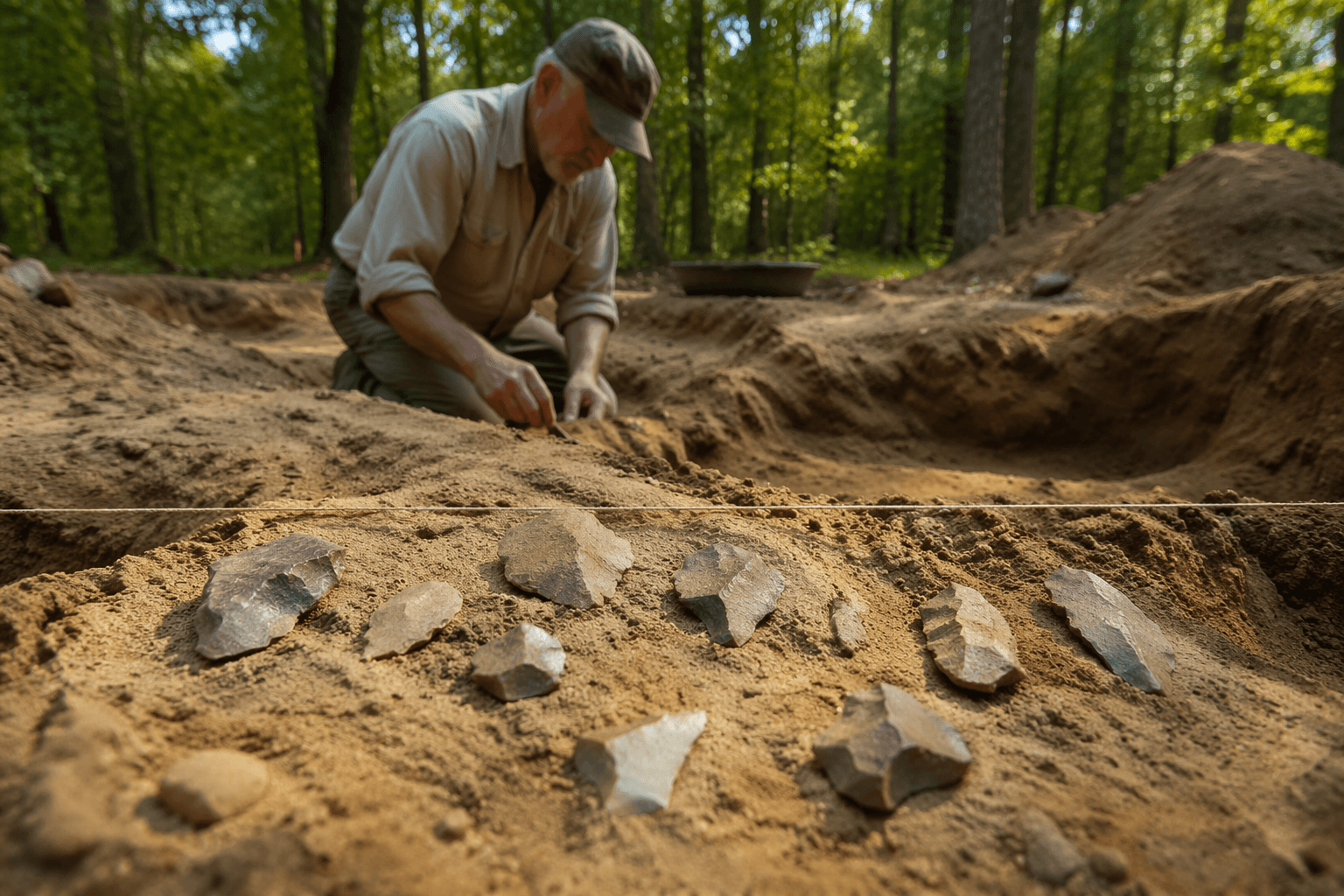
The oldest history in Allendale County is not tucked into a museum case or marked by a single roadside plaque. It lies across river bluffs, floodplains, and wooded uplands, where prehistoric people quarried stone, built villages, and shaped ceremonial landscapes long before the county was created in 1919. Three National Register sites, the Allendale Chert Quarries Archaeological District, Red Bluff Flint Quarries, and Lawton Mounds, show that the Savannah River corridor was a place of work, movement, and settlement for thousands of years.
The landscape beneath the county line
What makes these sites so important is not just their age, but their variety. Together, they map a complete story of prehistoric life in Allendale County: where people got raw material, where they processed it, and where they lived in organized communities. The state archive’s county register page treats them as the clearest archaeological anchors in the county, and that matters because so much of the local landscape still looks ordinary to a passing driver.
That invisibility is part of the story. The quarry sites are spread through river-bottom woods and upland tracts, not arranged as a single park or historic district with easy public access. The mounds sit in a landscape that can be easy to miss unless you know what you are looking for. In a county better known for later-era landmarks, these prehistoric places are the oldest story beneath residents’ feet.
Allendale Chert Quarries: a working landscape spread across the river corridor
The largest of the three anchors is the Allendale Chert Quarries Archaeological District, which the state archive describes as 14 prehistoric sites spread across about 1,500 acres along the eastern edge of the Savannah River in Allendale County. The quarry and processing areas are scattered up to a mile and a half from the river, a detail that shows how people used the broader landscape rather than a single fixed point.
Today, the district’s setting is split between floodplains in mature hardwoods and uplands in planted pines. That mix matters because it helps explain why the sites have remained out of everyday sight even as the land around them changed. The district is valuable not just as a place where stone was taken from the ground, but as evidence for how hunter-gatherers organized technology, work, and movement over long periods of time.
The archive says the district contains considerable anthropologically relevant data for studying hunter-gatherer technology and the cultural organization of tool production. In plain terms, this is one of the clearest places in the county to understand how prehistoric people made tools, managed labor, and used a river corridor as an economic resource. The district turns a stretch of forest and field into a record of repeated human activity.
Red Bluff Flint Quarries: the raw material behind regional toolmaking
Red Bluff Flint Quarries shows the other side of that system. The site consists of two outcrops of marine chert, also called Brier Creek Flint, that were heavily used by Indigenous people for tool raw material. Unlike a single occupation site, this is a source point, the kind of place that fed a much larger network of daily life across the region.
The state archive notes that the chert was used for thousands of years and that stone tools made from it are found throughout South Carolina and Georgia. Raw material from the quarries traveled hundreds of miles away, which gives the site significance far beyond Allendale County’s borders. It is a local place with regional reach, tied to both the practical demands of survival and the long-distance movement of goods and knowledge.
That scale is part of what makes Red Bluff so revealing. A quarry is easy to overlook because it may not look dramatic from the road, but it connects Allendale County to a much larger prehistoric economy. The stone underfoot was not just used nearby, it helped equip communities across two states.
Lawton Mounds: village life and ceremonial space
Lawton Mounds presents a different kind of evidence altogether. The site includes two flat-topped earthen mounds, a surrounding village area, a ditch and parapet, and remains dated to the Savannah II period, roughly AD 1200 to 1300. This is not just a place where raw material was taken from the earth. It is a built landscape, shaped to support settlement and communal life.
The archive identifies Lawton Mounds as the only known Savannah-period village site in South Carolina and the state’s best-preserved mound site of its kind. That makes it one of the most important prehistoric places in the state, not only in the county. The combination of mounds, village area, and defensive or boundary features points to a community with structure, planning, and continuity.
For Allendale County, Lawton Mounds is the clearest reminder that the region’s deep history was not limited to passing travel or isolated activity. People lived here in organized settlements, created earthen architecture, and left a site that still carries enough archaeological value to stand out at the state level. It is a rare survival, and one that deserves to be understood as part of the county’s identity.
Why these sites matter now
Allendale County’s formal history as a county begins in 1919, but these sites push the timeline back thousands of years. They show a place shaped first by Indigenous toolmaking, then by village life, and only much later by the county boundaries that residents know today. That deeper timeline changes how the county is read.
It also points to a practical public-awareness gap. The county’s prehistoric sites are not the kinds of places most people stop at on the way to somewhere else, even though they hold some of the most important evidence in the region. The river corridor, the quarries, and the mounds are all still there in one form or another, but their significance is easy to miss without better interpretation and stronger public recognition.
For anyone driving through Allendale County, the lesson is simple. The visible landscape may look modern, but the ground beneath it holds a record of toolmaking, settlement, and ceremonial life that stretches back millennia. That is the county’s oldest story, and it is still in place.
This article was produced by Prism’s automated news system from verified source data, official records, and press releases, then run through automated quality and moderation checks before publishing. The system is built and supervised by the people who set the standards it runs under. Read our full AI policy.
Did this article answer your question?