Lyman Lake State Park Offers High-Country Recreation in Apache County
At 6,000 feet above sea level, Lyman Lake draws snowmelt from Mount Baldy and Escudilla Mountain into one of Apache County's most versatile recreation destinations.
At 6,000 feet elevation in the high desert of northeastern Arizona, Lyman Lake State Park sits 11 miles south of St. Johns on Highway 191, quietly earning its reputation as one of Apache County's most accessible and well-rounded outdoor destinations. The reservoir at its center is a human-made body of water fed by snowmelt from two of the region's defining landmarks: Mount Baldy and Escudilla Mountain. According to a third-party campground guide, the lake was created in 1912 when the Little Colorado River was dammed and covers roughly 1,500 acres, though those historical specifics have not been independently corroborated by Arizona State Parks materials and are worth confirming directly with park staff. What the official agency does confirm is that the park offers cabins, camping, fishing, boating, wildlife watching, and hiking trails that pass ancient petroglyphs.
A Lake Built for Boating
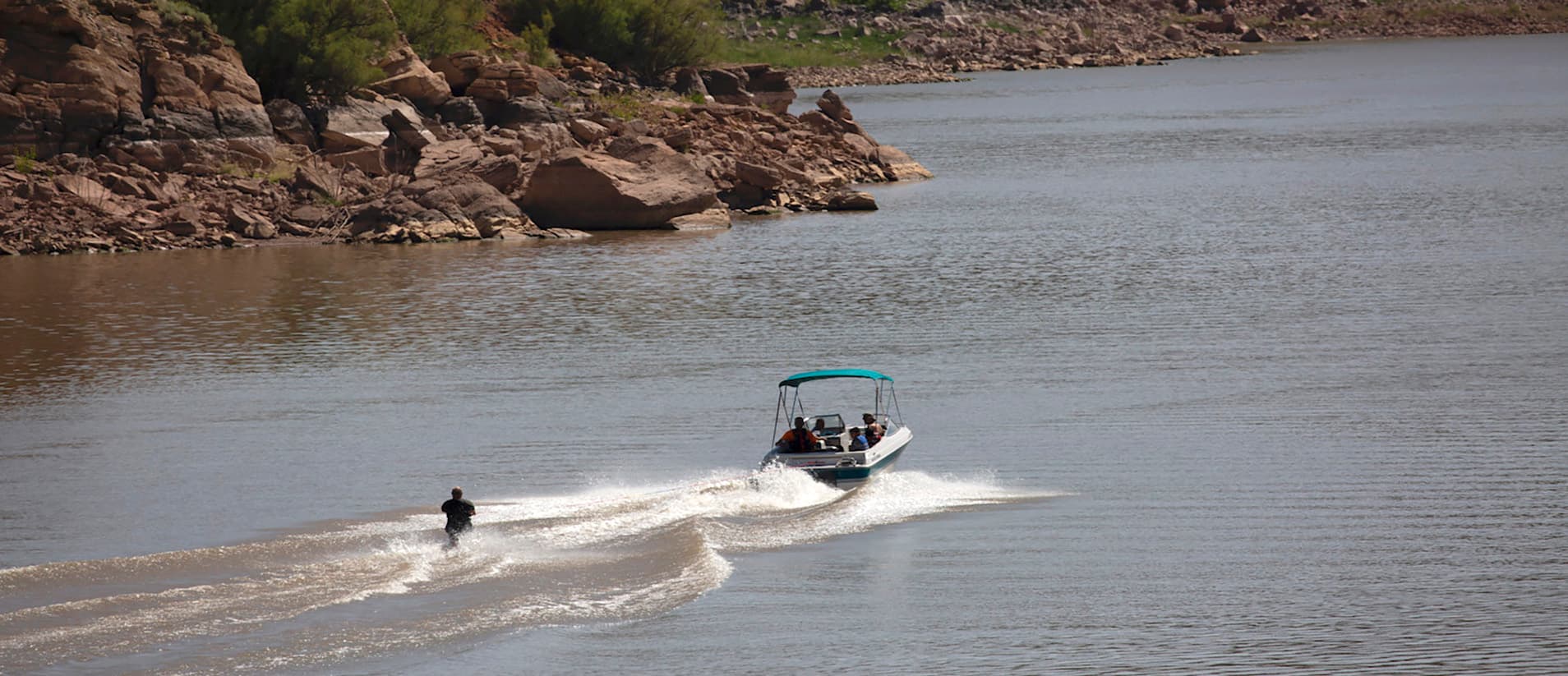
One of Lyman Lake's most practical distinctions in this part of the state is that it imposes no restriction on boat size, making it one of the few lakes in northeastern Arizona where larger vessels can operate without limitation. That openness to all boat types, combined with the lake's expanse, positions it as a draw for anglers and watersports enthusiasts who might otherwise have to travel significantly farther west or south. Whether you're launching a bass boat or a personal watercraft, the absence of size caps removes a planning obstacle that limits options at comparable high-country lakes.
Camping and Facilities: What to Know Before You Go
A critical advisory from Arizona State Parks applies to anyone planning an overnight stay: there is currently no drinking water at the park. Restrooms and showers, however, are fully functional. Bring sufficient water for your entire stay, and plan accordingly for cooking and hydration.
The park offers both cabins and developed camping areas. A third-party RV guide lists a range of campground amenities for Lyman Lake that includes fire rings, picnic tables, flush toilets, showers, a boat ramp, an RV dump station, a playground, electrical hookups, sewer hookups, water hookups, and no maximum RV length restriction. However, those specific utility and amenity claims conflict directly with the official site's advisory about no potable water on-site and are not corroborated by Arizona State Parks materials. Before booking, call the park directly at (928) 337-4441 or reach the statewide camping reservations line at (877) MY-PARKS, which is (877) 697-2757, to confirm current hookup availability, campsite types, and any seasonal facility changes. Online reservations can also be made through AZ.gov.
The park's mailing address is P.O. Box 1428, St. Johns, AZ 85936. For anyone driving from town, it's a straightforward 11-mile trip south on Highway 191.
Ecology: A Woodland at the Edge of the Basin
The landscape surrounding Lyman Lake is classified as Great Basin Conifer Woodland, a vegetation community dominated by pinyon pine (Pinus spp.) and juniper (Juniperus spp.), with oaks (Quercus spp.) adding canopy in places. Shrubs woven through the understory include threadleaf groundsel (Senecio longilobus) and snakeweed (Gutierrezia sarothrae). The grassland component is anchored by native bunch grasses: galleta grass (Hilaria jamesii), ricegrass (reclassified from the former Oryzopsis hymenoides to Achnatherum hymenoides), and western wheatgrass (Pascopyrum smithii).
Come spring and early summer, the wildflower display adds considerable color. Numerous penstemon species are joined by sego lily (Calochortus nuttalli), several globemallow species (Sphaeralcea spp.), and various lupines (Lupinus spp.). The park's trails also pass through areas designated for wildlife watching, though Arizona State Parks does not provide a formal animal species inventory in its current materials.
Petroglyphs and the Human Story of the High Desert
Among the most compelling reasons to hike the park's trails is direct access to the Lyman Lake Petroglyphs, rock carvings that place this reservoir within a much longer arc of human habitation in the region. Arizona State Parks identifies the petroglyphs as a feature of the park's hiking trail system, though specific trail lengths, difficulty ratings, and interpretive resources are best confirmed with park staff before visiting, as current access and conditions can vary.
Area Attractions: Archaeology and Local History
The cultural context around Lyman Lake extends well beyond the park boundary. Ten miles away in St. Johns, the Apache County Historical Society Museum preserves the region's layered past. The museum is open from 9 a.m. to 5 p.m. and offers guided tours upon request. Reach them at (928) 337-4737.
At 18 miles from the park, Casa Malpais National Historic Landmark in Springerville offers a direct encounter with ancestral Pueblo history. The pueblo was built around A.D. 1250 and occupied for approximately 120 years; both the Hopi and Zuni peoples claim cultural affinity with the site. Tours of Casa Malpais run daily year-round, fees apply, and the site can be reached at (928) 333-5375.
For those interested in extending a trip into a wider loop of Arizona State Parks, Fool Hollow Lake Recreation Area lies 61 miles from Lyman Lake, and Homolovi State Park sits 99 miles out. Nearby communities that serve as supply stops and lodging bases include St. Johns, Springerville, Show Low, and Holbrook.
Climate and Timing
Lyman Lake's high-desert elevation produces warm summers and cold winters. The climate tends toward low precipitation across the year, with freezing temperatures a real factor in the colder months. Spring and fall typically offer the most temperate conditions for camping and outdoor exploration, while summer draws the largest crowds to the water. Winter camping is possible for those equipped for freezing overnight temperatures.
Planning Your Visit
Prospective visitors should treat the no-drinking-water advisory as firm until confirmed otherwise with park management, since third-party sources have listed amenities that do not align with the current official advisory. Call (928) 337-4441 before departure to ask about potable water status, campsite hookup availability, and any changes to trail or facility access. The park's reservation and general information infrastructure runs through Arizona State Parks and Trails, and the AZ.gov reservations portal is the most direct path to booking a campsite or cabin.
Lyman Lake occupies a geographic and cultural crossroads that few parks in Apache County can match: a high-country reservoir ringed by petroglyph trails, a woodland ecology rich in native grasses and wildflowers, and day-trip proximity to two of the region's most significant archaeological sites. The elevation and the snowmelt-fed water together make it a destination that rewards both the day visitor and anyone willing to spend a few nights under a high-desert sky.
This article was produced by Prism’s automated news system from verified source data, official records, and press releases, then run through automated quality and moderation checks before publishing. The system is built and supervised by the people who set the standards it runs under. Read our full AI policy.
Did this article answer your question?