Petrified Forest National Park preserves 200 million years of history
Petrified Forest is Apache County's rare year-round draw, where Route 66, ancestral Puebloan sites and a 200-million-year landscape keep visitors coming.

Petrified Forest National Park sits in Apache and Navajo counties about 100 miles east of Flagstaff, turning a stretch of badlands near Interstate 40 into steady traffic for nearby towns, museums, restaurants and lodgings. It gives the county a destination that still matters after the day trip ends.
Apache County's long-running draw
What keeps people coming is not a single season or event, but a mix of geology, history and road culture that works all year. The landscape preserves more than 200 million years of geologic history, and the National Park Service puts annual visitation at about 800,000.
Petrified Forest is the only unit in the National Park System that contains a section of Historic Route 66. Route 66 was established in 1926, and the park gives that highway story a place to land in a county shaped by long-distance travel, roadside stops and the steady movement of people between communities.
The landscape visitors come to see
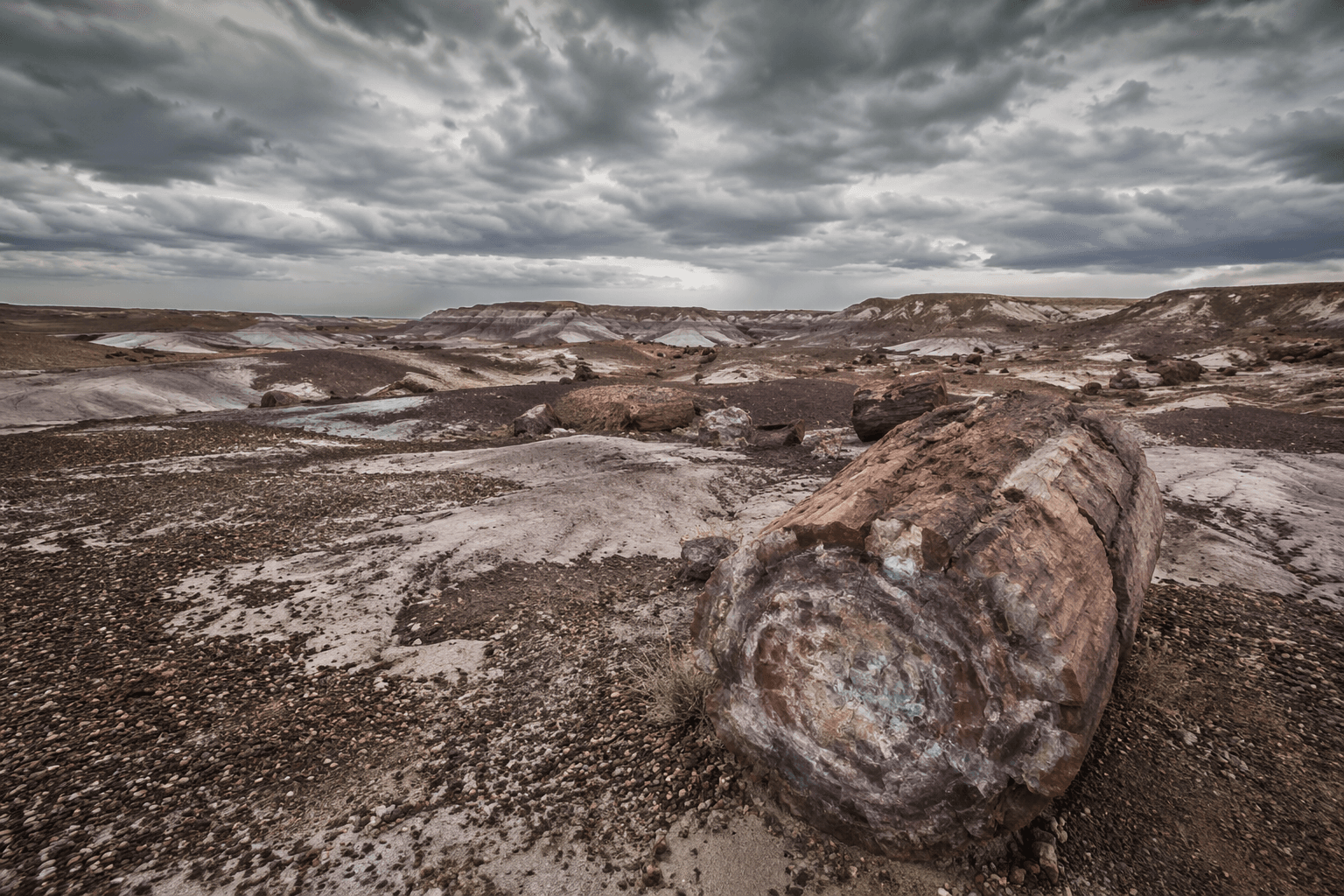
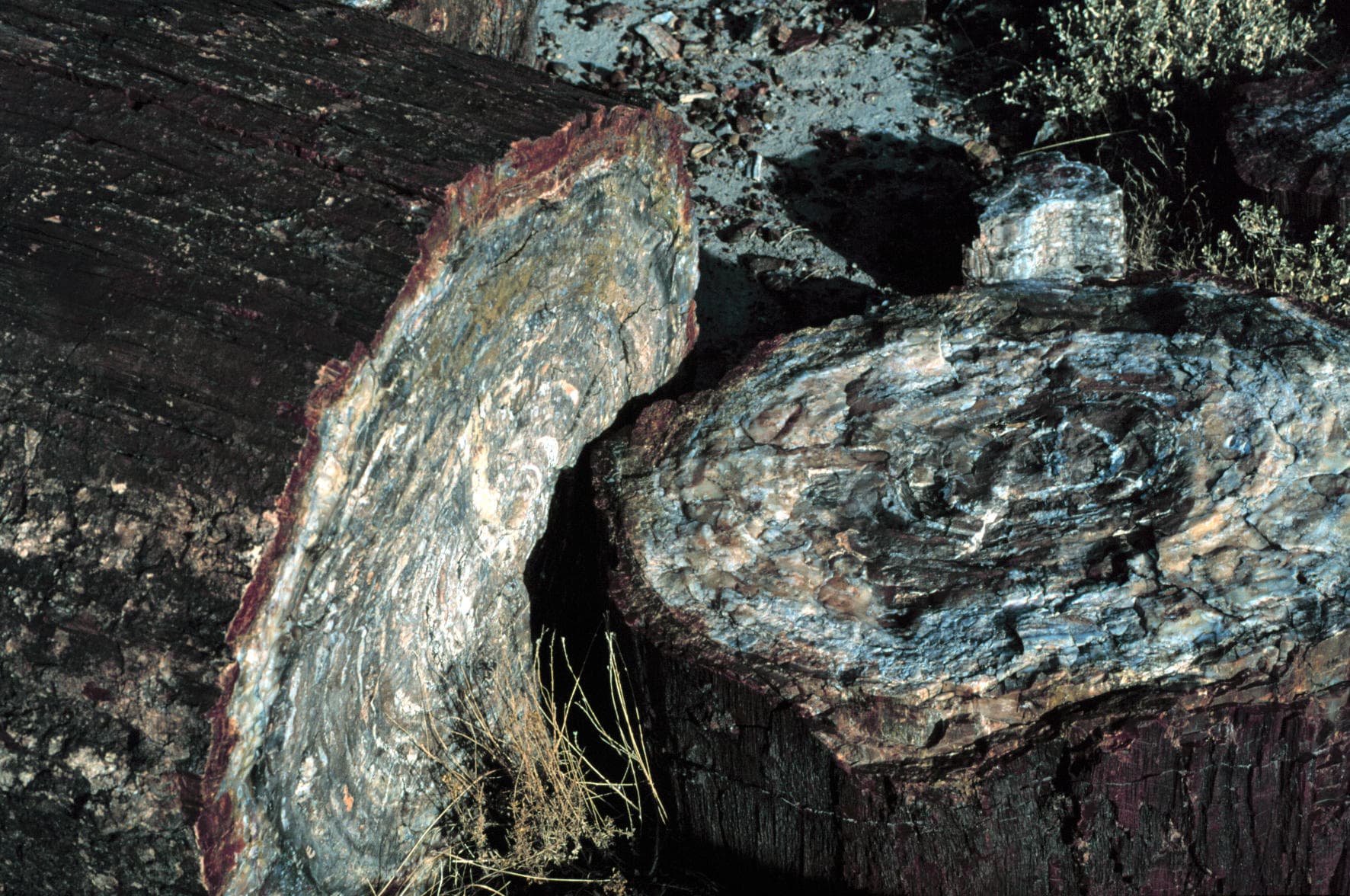
The park’s most recognizable features are the badlands, the broad grasslands and the stone forest itself. The colors in petrified wood come from trace minerals, with manganese oxides creating blue, purple, black and brown tones, and iron oxides producing yellows through reds, browns and black.
Blue Mesa and Jasper Forest are among the signature viewpoints, and Jasper Forest exposes petrified log segments eroding from a 216-million-year-old bed. The Long Logs and Agate House trail adds another layer, showing some of the longest and most colorful petrified logs in the park alongside a partially reconstructed pueblo built from petrified wood.
The human history runs just as deep
Petrified Forest does not preserve only ancient trees. The park’s archeology record reaches back more than 13,000 years, and more than 800 archeological and historic sites have been recorded there. Many of those sites date from roughly A.D. 1000 to 1350, when people built above-ground rooms and kivas and used both local and traded materials.
Puerco Pueblo is one of the clearest stops for that story. It is a more than 100-room ancestral Puebloan village near the Puerco River corridor, occupied between A.D. 1200 and 1400. Agate House tells a different part of the same story: it was occupied about A.D. 1100 to 1150 and built from pieces of petrified wood.
The Painted Desert Inn brings the modern chapter into view. Herbert David Lore built it by 1924, the Civilian Conservation Corps reconstructed it in the late 1930s, it was listed on the National Register of Historic Places in 1976, and it became a National Historic Landmark in 1987.
Why the park matters after dark
Petrified Forest’s appeal does not end at sunset. The park is now an International Dark Sky Park, and it offers a Dark Sky Viewing Permit for staying past closing to stargaze or do astrophotography. When the park earned that designation, it also announced a fall star party and an expansion of night-sky programming by partner Petrified Forest Field Institute.
Dark-sky tourism gives visitors another reason to remain in the area after the daytime crowds thin out, which can mean more time in nearby communities and more value for businesses that depend on travelers who do more than drive through. Backcountry campers in wilderness areas have long had access to the night sky, but the permit now makes that experience available in a more structured way for visitors who want to linger.
How the park became this large
The park’s current shape is the result of more than a century of protection, revision and expansion. President Theodore Roosevelt proclaimed Petrified Forest National Monument on December 8, 1906, under the Antiquities Act to protect the mineralized remains of Mesozoic forests. It became Petrified Forest National Park on December 9, 1962.
The footprint changed again in 2004, when Congress authorized expanded boundaries that more than doubled the park from 93,533 acres to 218,533 acres. The park lists the current boundary at 221,390 acres, showing that the modern park is the product of expansion, not a fixed 1906 outline. Lieutenant Amiel Whipple documented petrified wood in 1853, a congressional protection bill failed in 1895, and more than 50,000 acres were later designated wilderness in 1970.
What Apache County gains when visitors stay longer
For Apache County, Petrified Forest works best when it is treated as a full-day or overnight stop rather than a drive-by. The park’s mix of Route 66 history, ancestral Puebloan sites, dark skies and fossilized wood gives travelers multiple reasons to split their time between the park and the communities around it, especially along the Interstate 40 corridor.
This article was produced by Prism’s automated news system from verified source data, official records, and press releases, then run through automated quality and moderation checks before publishing. The system is built and supervised by the people who set the standards it runs under. Read our full AI policy.
Did this article answer your question?