Atchison County preserves remnants of historic Black business district
Atchison’s surviving Black business district preserves a missing map of local Black enterprise, from the 1892 core on North 7th Street to Winrow Bros.’ 1929 businesses.
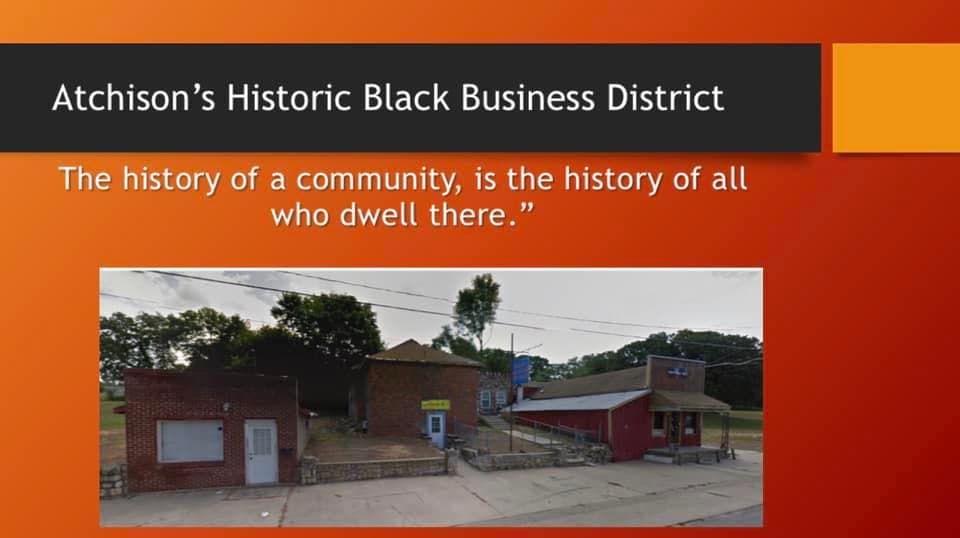
The surviving buildings of Atchison’s Black Business District do more than keep old walls standing. They give the city a fuller, more honest map of where Black residents worked, traded, and built community, and the Atchison County Historical Society is treating those remnants as part of Atchison’s living identity.
What survives on North 7th Street
The historical society’s mission is plain: preserve the only remaining buildings of a once prosperous all-Black business district in the City of Atchison. That makes the district less a decorative relic than a physical record of Black enterprise, segregation-era geography, and the businesses that served daily life in a town that often failed to preserve that history on its own.
The Kansas Historic Resources Inventory places the district’s original block at 1892, with changes made in 1912. That date range matters because it shows the district was not a one-time collection of storefronts, but a place that evolved across generations. One surviving address tied to the district, 1118 North 7th Street in Atchison, stands as part of that last visible footprint.
Local memory around the district has sharpened the stakes even further. A community overview describes the buildings as the last of their kind, with every other structure from the district torn down. In a city where so much of Black commercial life once had to survive outside the main historical record, the fact that any buildings remain is the difference between a remembered neighborhood and an erased one.
A business district, not just a row of old buildings
The names attached to the district make clear that this was an economy, not just an address. One community overview says there were at one time 96 Black-owned businesses in Atchison, Kansas, while another says the historic structures housed a total of 29 businesses through the years. Those figures do not describe the same thing in the same way, but together they point to a dense commercial life that reached well beyond a single storefront or one family’s trade.
By 1929, the Winrow Bros. had built out a business mix that would have anchored a neighborhood: a grocery store, cafe, barbershop, pool hall, and real estate agency. That combination tells a larger story about how Black business districts functioned in small Midwestern towns. They were not only places to buy food or get a haircut, but places where property, information, social life, and local money circulated together.
That is why preservation in Atchison matters now. If the remaining buildings disappear or are left to decay, the city loses more than architecture. It loses a visible reminder that Black residents created their own commercial institutions, served their own neighborhoods, and left behind a street-level history that can still be read in brick, block by block.
Why the preservation effort is urgent
The Atchison County Historical Society has said in a 2021 Facebook post that the purpose of the Historical Black Business District Project is to preserve and celebrate the history of the district. That framing goes beyond archiving. It is about making sure the city’s present-day residents can see that Black life in Atchison included ownership, entrepreneurship, and resilience, not only struggle.
The work has faced a practical barrier: an All Aboard Atchison listing says the county commissioner discontinued the society’s annual support through the county tax system, leaving a large hole in its financial support. The same listing says the society is trying to generate support for rehabilitation of the Black Business District and Farmington Christian Church, linking two preservation projects that carry both architectural and community value.
Funding at the scale of the district has been thin. A Giveth project page for the Atchison County Historical Society-ABBD listing showed a total of $7.19 raised from one contributor at the time of the posting. That tiny figure underlines how dependent preservation in smaller cities can be on a narrow base of support, even when the historical stakes are substantial.
There is still movement. An Atchison Globe item says work began on a future Historic Black Business District Museum building, and a June 11, 2026 MSC News item says Atchison’s black-owned business history was a highlight of a coming weekend event. Those developments suggest the district is becoming more visible in public life, not just in local memory.
The city’s Black-history landscape also includes remembrance beyond the district itself. In 2021, community members in Atchison gathered to dedicate a historical marker and sculpture remembering the 1870 lynching of George Johnson. That public memorial, together with the Black Business District effort, shows a community trying to tell a more complete account of its past, one that includes both violence and the institutions Black residents built in response.
How the district fits into Atchison’s wider historic map
Atchison’s preservation story is bigger than a single block, but the Black Business District gives it a necessary center. The city was founded in 1854, and the City of Atchison says it has more than 47 buildings listed on the National Register of Historic Places. Kansas history sources also place Atchison’s early development in a pro-slavery context before it became a free-state town, a history that helps explain why Black institutions had to build their own economic spaces.
The historical society’s broader offerings help connect that past to the present. Its website lists a Downtown Walking Tour, Independence Creek, Farmington Christian Church, and the Santa Fe Depot Museum, placing the Black Business District inside a larger network of local history rather than isolating it as a specialty project. Those sites, along with places such as Commercial Street and Lincoln School, help fill in the city’s historical geography.
For residents who want to see the district within that wider story, the society lists gowest1854@gmail.com and 913-367-6238. The point of preservation here is immediate and local: to keep Atchison’s Black commercial past visible enough that the city can still recognize itself in it.
This article was produced by Prism’s automated news system from verified source data, official records, and press releases, then run through automated quality and moderation checks before publishing. The system is built and supervised by the people who set the standards it runs under. Read our full AI policy.
Did this article answer your question?