Atchison County's lost towns reveal early settlement and river history
Oak Mills, Arrington, and Mormon Grove still mark Atchison County's map, showing how river landings, rail lines, springs, and migration routes made some places survive and others fade.
Oak Mills, Arrington, and Mormon Grove show how river travel, railroad routes, settlement politics, and mineral springs decided where people stayed, where commerce moved, and which names still matter on local maps.
A county formed before the map settled
Atchison County was established in 1855, but its human history runs much farther back. The first recorded French expedition to the region came in 1724 under Etienne de Bourgmont, followed by Perin du Luc in 1802-03 and the Lewis and Clark expedition in 1804. Paschal Pensoneau, also spelled Pensinau, became the first permanent white settler in the county in 1839, settling along Stranger Creek and opening a trading post and farm five years later.
Its closeness to Missouri put it inside the political and transportation struggles that shaped northeastern Kansas. Atchison itself was founded in 1854 and dedicated on July 4, 1854, while Sumner, twelve miles south, tried to replace Atchison as county seat in 1858 and failed.
Sumner and the county-seat fight
County-seat contests determined where roads led, where officials worked, and where trade concentrated. Atchison kept the courthouse-centered momentum after Sumner failed to replace it as county seat in 1858.
Oak Mills and the river corridor
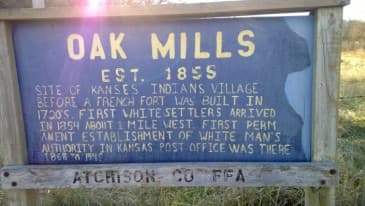
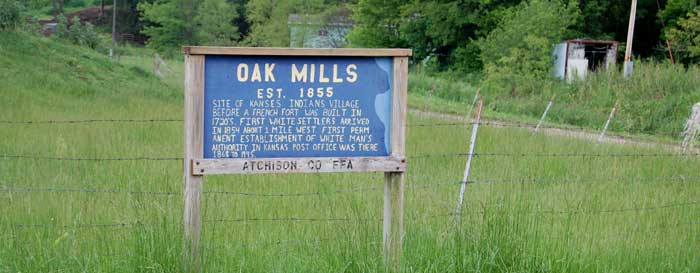
Oak Mills sits in Walnut Township along the Missouri River in southeast Atchison County, and its layered origin story shows how many different eras passed through one place. The site traces back to a Kanza village, later ties to French fur traders, and then American settlement from Iatan, Missouri, in June 1854. The town gained a post office in January 1868 and later served as a station on the Missouri Pacific Railroad.
By 1880, Oak Mills had a blacksmith, general store, physician, grain and wood shipments, and a population of 70. Its population rose to 86 by 1910, and it still had several stores then. The post office closed in March 1945, and the town’s visible remains are spare: a sign erected by the Future Farmers of America, one crumbling stone building, and the sound of trains.
Railroad service outlasted the post office, and descendants have continued tracing connections there, including an ancestor in the 1880 census and a grandfather born in Oak Mills in 1898.
Arrington, where mills and springs remade the town
Arrington, also called Arrington Springs, followed a different path. It was founded in 1855 on the Delaware River by Ransom A. Van Winkle, who built a sawmill, a farmhouse, and the town’s first school. Van Winkle was an abolitionist from Kentucky who took part in Free-State efforts even as pro-slavery sentiment remained strong in the county; he later served as a county officeholder and a member of the Kansas Legislature.
Arrington received a post office in June 1862, with Van Winkle as the first postmaster. Its growth accelerated after the Leavenworth, Kansas & Western Railroad arrived, and by 1880 the town supported three general stores, a blacksmith, two sawmills, a flour mill, three builders, three restaurants, a wagon maker, three liveries, two barbers, two hotels, a grocery store, a meat market, a druggist, a shoemaker, and a wine manufacturer.
The second life of Arrington began in 1881, when David S. Heneks discovered the first mineral spring near the mill dam and then two more. The resort that followed covered 40 acres and included twelve cottages, a bathhouse, and an engine house with a steam pump.
Mormon Grove and the road west
Mormon Grove, about four miles west of Atchison, became one of the county’s most important temporary places. In 1855 and 1856, it served as an outfitting station for thousands of Latter-day Saint travelers heading west. The site included fencing, crops, a cemetery, and temporary dwellings, making it a practical stopping point rather than a permanent town.
Atchison gained labor and commerce, while the migrants gained a place to earn money and buy supplies before continuing toward the Salt Lake Valley. During the peak emigration year of 1855, eight companies totaling 2,041 people and 337 wagons left Mormon Grove. The Kansas Historical Society also counts nearly 2,000 Latter-day Saints with 337 wagons in the same season.
That year turned brutal for many of the travelers. A cholera epidemic killed hundreds, leaving about 15 people at Mormon Grove to wait for the following year’s immigrants. By 1856, only one company of 97 Mormons left from the site, and the overland pattern had already begun shifting toward rail and Iowa City as a major jumping-off point. The cemetery site still marks the place today.
How to read the lost map now
- At Oak Mills, look for the Future Farmers of America sign, the remaining stone structure, and the railroad presence that kept the place on the map after the post office closed.
- At Mormon Grove, the cemetery site is the most direct physical link to the brief but intense migration era.
- In and around Atchison and Sumner, the county-seat fight still explains why civic power settled where it did.
For deeper tracing, the Kansas Historical Society’s Dead Town List is a statewide index for extinct and declining communities, with entries that often include legal descriptions, post-office dates, first postmasters, and town-site notes. The society’s digital newspaper program also gives access to nearly 12 million pages of historic Kansas newspapers, which helps connect land names, family lines, and vanished settlements back to specific dates and places.
This article was produced by Prism’s automated news system from verified source data, official records, and press releases, then run through automated quality and moderation checks before publishing. The system is built and supervised by the people who set the standards it runs under. Read our full AI policy.
Did this article answer your question?