Atchison museum blends rail history with world’s smallest presidential library
Atchison’s old Santa Fe depot packs rail history, thousands of artifacts and the World’s Smallest Presidential Library into one downtown stop.
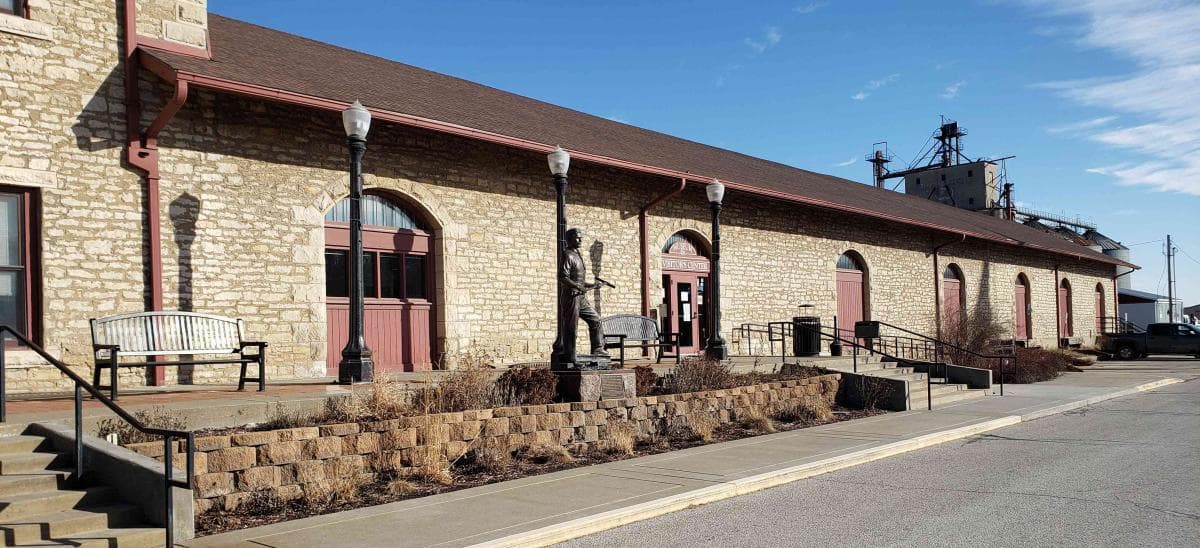
Inside the 1880 Santa Fe Freight Depot at 200 S. 10th Street, the first thing you notice is how much Atchison history fits into one building. A visitor can move from rail-era architecture to the World’s Smallest Presidential Library in the same walk, which makes the Atchison County Historical Society Santa Fe Depot Museum one of the city’s most distinctive downtown stops.
A depot museum that tells Atchison’s bigger story
The museum is built to do more than display objects behind glass. The historical society says the space is dedicated to telling the story of Atchison County, Kansas, and the early years of Kansas state history, which gives the building a countywide role rather than a narrow one. That matters in Atchison because the depot itself still carries the memory of a rail town, and the museum uses that setting as part of the experience.
The building is described as an 1880 Santa Fe Freight Depot Museum, and the historic shell is part of the appeal. Instead of separating local transportation history from local collections, the museum blends them together, so the depot is both the artifact and the container for the artifacts. For a family, a weekend visitor, or a longtime resident, that means the visit starts before the exhibits do.
What you find inside the 6,000-square-foot space
The historical society describes the museum as 6,000 square feet packed with thousands of artifacts, and that scale shapes the visit. It is large enough to hold a broad collection but still intimate enough that the railroad setting remains visible. The result is a museum that feels grounded in place rather than arranged like a generic gallery.
The museum also includes a research library for public use, which makes it useful beyond a quick stop. A visitor interested in family names, county history, or the early years of Kansas can use the library as part of a deeper visit, while casual travelers can simply explore the exhibits. That mix is one reason the site works for different kinds of audiences at the same address.
The historical society also offers a short tour video on its website, which adds a helpful preview before a trip downtown. That is especially useful for anyone deciding whether to pair the museum with other stops in central Atchison. The museum’s location on South 10th Street makes it easy to fold into a broader walk through the city’s historic core.
The World’s Smallest Presidential Library is the museum’s oddest and best-known draw
The exhibit that gets the most attention is the World’s Smallest Presidential Library, an “unofficial” attraction tucked inside the depot museum. It is not a formal federal library, and that is part of the point. The playful label turns local lore into a museum feature, and the society says the exhibit explains the unusual story behind David Rice Atchison’s 24-hour presidency claim.
That connection gives the museum a distinctly Atchison angle. David Rice Atchison is part of the city’s identity, and the exhibit turns a quirky piece of presidential folklore into something visitors can actually experience on site. The attraction is described as a special exhibit where “you make the decisions,” which gives it an interactive feel instead of a purely observational one.
That matters for children and adults alike. A child may see the smallest library as a novelty, while an adult may see it as a clever way to frame a disputed or legendary chapter of American political history. In both cases, the exhibit gives the museum a memorable hook that reaches beyond rail enthusiasts or local-history specialists.
Why the museum works so well for Atchison County
The museum’s strength is that it links three strands of the county’s identity in one place: rail history, county history and civic storytelling. The depot setting preserves the memory of Atchison as a transportation town, the collection preserves local artifacts and documents, and the presidential exhibit turns a hometown claim into an accessible story. That combination is hard to duplicate anywhere else in the county.
The Atchison County Historical Society has been preserving, promoting, recording and sharing the history of Atchison County, Kansas since 1967, and the museum reflects that long-running mission. It is not just a display space; it is a county archive with a public-facing personality. The fact that the society has maintained that role for decades helps explain why the depot remains a working part of the community’s historical memory.
For anyone planning a downtown visit, the museum is easy to place on a day around Atchison’s historic blocks. It is a straightforward stop for rail history, a useful stop for researchers, and a memorable stop for anyone curious about the city’s presidential claim. Few places in Atchison County bring those threads together as neatly as the Santa Fe Depot Museum at 200 S. 10th Street.
Planning a visit
The museum lists seasonal hours that make it easiest to plan around a weekday or a summer weekend trip.
- Summer hours: 9 a.m. to 5 p.m. Monday through Saturday, and noon to 5 p.m. Sundays
- Winter hours, November through March: 9 a.m. to 5 p.m. Monday through Friday, 10 a.m. to 4 p.m. Saturdays, and noon to 4 p.m. Sundays
- Closed in January and February
The historical society can be reached at 913-367-6238 or gowest1854@gmail.com. For a town that built so much of its identity around the railroad and the people who passed through it, the depot museum remains one of the clearest ways to see Atchison’s history in a single stop.
This article was produced by Prism’s automated news system from verified source data, official records, and press releases, then run through automated quality and moderation checks before publishing. The system is built and supervised by the people who set the standards it runs under. Read our full AI policy.
Did this article answer your question?