Autauga County guide highlights Prattville’s role, Millbrook’s growth
Prattville anchors county services, Millbrook rides the River Region’s growth, and Autaugaville keeps a rural pace that still shapes daily life in Autauga County.
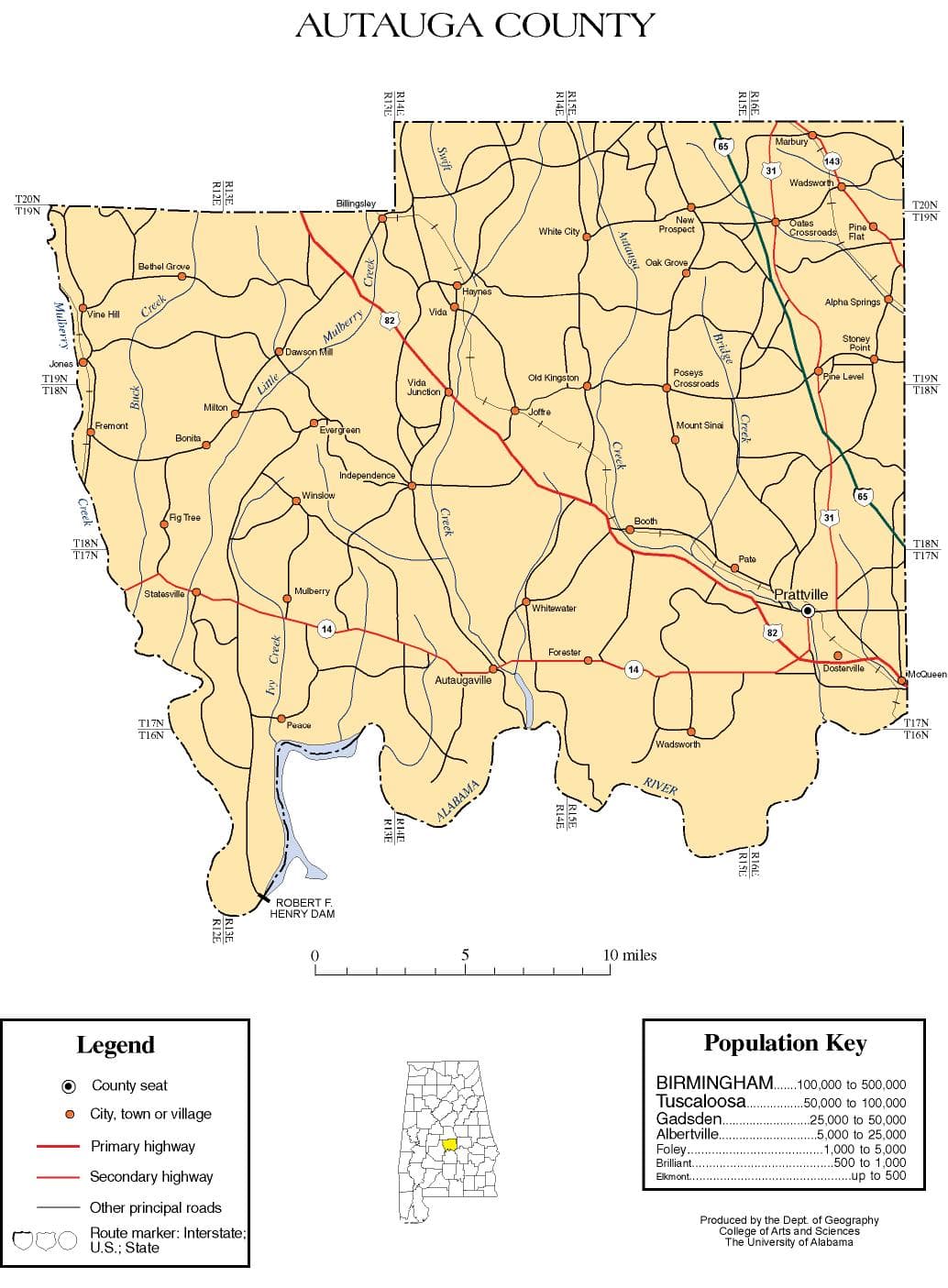
The quickest way to understand Autauga County is to see how its three best-known places do very different jobs. Prattville draws shoppers, patients, and job-seekers from across the county, Millbrook has become the north-end growth engine, and Autaugaville still gives the county its open, rural character. Together, they show why one county line can contain such different daily rhythms.
Prattville: the county’s main service center
Prattville is the place most Autauga County residents turn to first when they need to get things done. It is the county seat and the county’s most prominent commercial hub, with residents from across Autauga County traveling there for shopping, professional services, dining, and other routine needs. That mix of older neighborhoods and newer development gives Prattville a different feel from the county’s smaller communities: it is both established and still expanding.
Its identity reaches back to 1839, when Daniel Pratt founded the city as a self-sufficient manufacturing center. That industrial start still matters because it explains why Prattville grew into a place where work, commerce, and civic life are tightly linked. Prattville’s long-running nickname, “The Fountain City,” comes from the artesian wells that have helped define the city’s image and everyday utility for generations.
That history is not just a talking point. The Historic Prattville Redevelopment Authority was created in 1988 by an act of the Alabama State Legislature to revitalize the Daniel Pratt Historic District, which shows how the city’s industrial roots continue to influence redevelopment and preservation decisions today. In Prattville, the past is still visible in the way the city balances heritage, growth, and county services.
Prattville’s scale also matters. The 2020 census counted 37,781 residents there, making it by far the largest of the county’s named communities. It is also where major county services are located, including the Autauga County Health Department, which reinforces Prattville’s role as the practical center of county life.
Millbrook: growth, commuting, and the north-side gateway
Millbrook tells a different Autauga County story. It is a growing community with higher-density suburban development and a strong connection to the River Region’s expansion, which has made it an important gateway for families and commuters moving through the northern side of the county. In plain terms, Millbrook is where growth has been most visibly tied to transportation and access.
That pattern has deep roots. The Encyclopedia of Alabama links much of Millbrook’s progress to Interstate 65, which was completed in the mid-1970s and helped accelerate development before the city incorporated in 1977. The city’s own planning emphasis still reflects that transportation advantage. Main Street, Highway 14, the Alabama River Parkway, and access to Interstates 65 and 85 all support residential development and make Millbrook easy to reach from surrounding areas.
Millbrook also carries a layer of history that can be easy to miss if you only look at its subdivisions and road network. William Wyatt Bibb, Alabama’s first territorial governor, and Thomas Bibb, the state’s second governor, both lived there. That gives the city a place in Alabama’s political history even as today’s Millbrook is known more for growth than for old landmarks.
The 2020 census counted 16,564 people in Millbrook, a reminder that it is smaller than Prattville but still large enough to shape countywide patterns. Its role is not to replace Prattville, but to absorb growth, housing demand, and commuting pressure on the north end of the county.
Autaugaville: rural pace and local identity
Autaugaville sits at the other end of the county’s character spectrum. It is a lighter-density rural town with open space and a slower pace of life, and that setting helps preserve a very different sense of place inside the same county boundary. If Prattville is the place for services and Millbrook is the place for expansion, Autaugaville is the place that keeps Autauga County tied to its agricultural and small-town roots.
The town’s history reaches back to around 1820, when the first settler in what is now Autaugaville arrived and built a gristmill and sawmill on Swift Creek, about three miles upriver from the Alabama River. That origin story matters because it shows how early settlement in this part of the county was shaped by water, milling, and land use rather than by commercial corridors or suburban sprawl.
Autaugaville also has a mayor-council form of government, which gives it its own local civic structure even as it remains part of the broader county system. The 2020 census counted 795 residents there, a small population that helps explain why the town feels more intimate and less built up than Prattville or Millbrook.
The town’s cultural identity is also marked by the fact that it is the birthplace of blues musician George “Wild Child” Butler. That detail adds another layer to a community that is often defined by what it is not, not suburban, not urban, not a service center, but which still carries a distinctive local history of its own.
What the county line really means day to day
Autauga County covers 594.5 square miles of land, so the difference between these places is not just a matter of personality. Distance, road access, and government structure all affect where people shop, seek health care, send children to school, and handle county business. The county’s 2020 census population was 58,805, and the July 1, 2025 estimate put it at 61,920, showing steady growth across a county that still contains both suburban and rural terrain.
Autauga County Schools adds another layer to that everyday geography. The system serves roughly 9,000 students across 14 campuses, which means families are making choices not just about where to live, but also about where school lines, traffic patterns, and daily commutes fit best. Those choices are closely tied to the county’s internal structure, with Prattville handling many county services, Millbrook drawing growth-related development, and Autaugaville offering a quieter rural setting.
The county’s place in the Montgomery metropolitan area also helps explain the pressure points. Autauga County is not isolated, and neither are its communities. People move in and out of Prattville for work and errands, Millbrook benefits from highway access and regional expansion, and Autaugaville preserves a slower pace that many residents still value. That mix is what makes the county practical to live in and complicated to summarize.
For newcomers, business owners, and longtime residents alike, the lesson is simple: Autauga County is not one uniform place. Prattville concentrates services and commerce, Millbrook channels growth and transportation, and Autaugaville keeps a rural identity alive. Those boundaries shape where life happens, and they still define how the county works every day.
This article was produced by Prism’s automated news system from verified source data, official records, and press releases, then run through automated quality and moderation checks before publishing. The system is built and supervised by the people who set the standards it runs under. Read our full AI policy.
Know something we missed? Have a correction or additional information?
Submit a Tip