Boggs Pottery endures as Autauga County's oldest living craft tradition
Boggs Pottery still works from an 1830 family tradition, making Autauga County's oldest living craft more than a museum piece. Its survival traces a line from North Carolina clay to Prattville today.
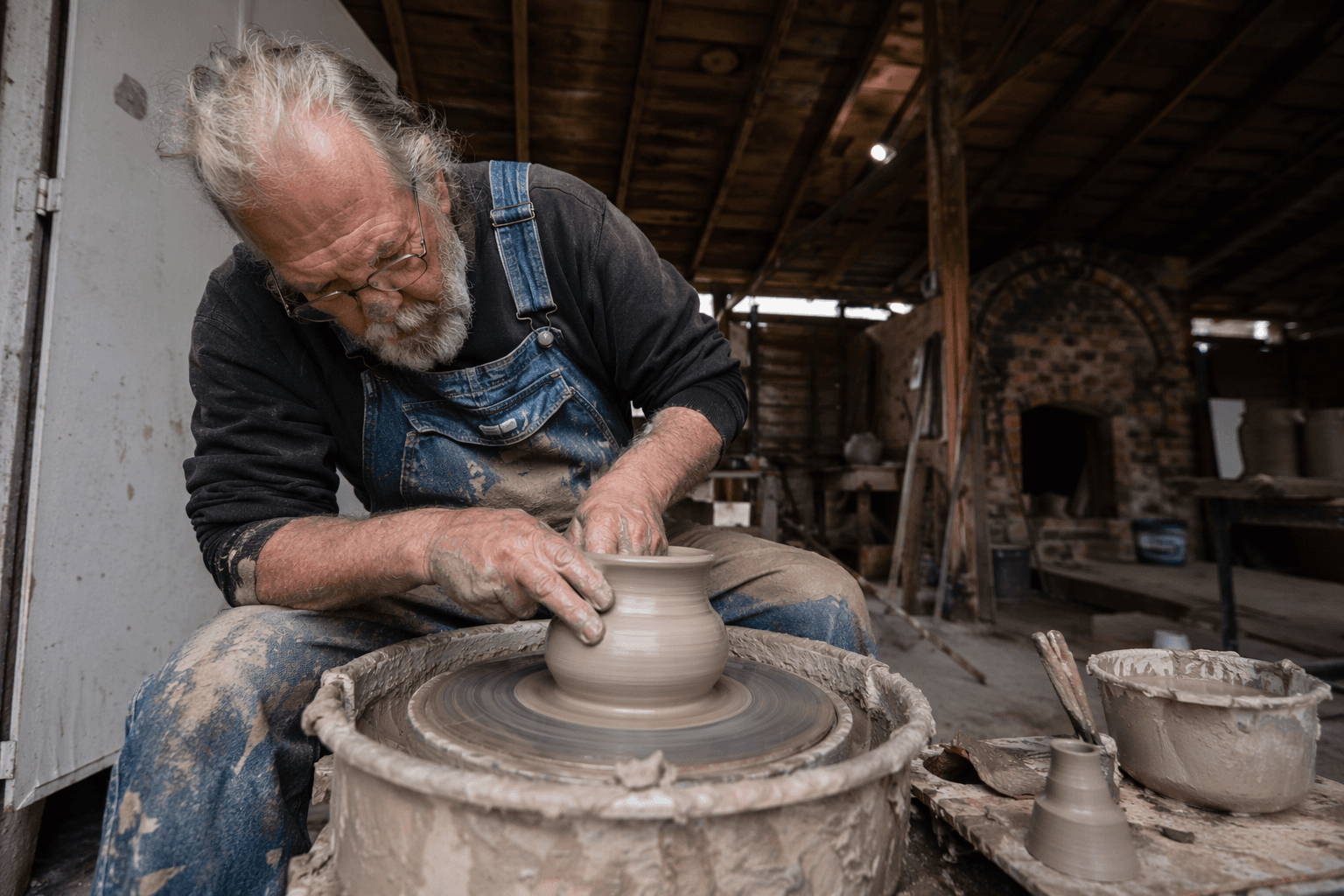
Boggs Pottery has outlasted county-seat moves, industrial change, and the near-disappearance of traditional pottery across Alabama. Founded in 1830 and still operating under the same family, it remains one of Autauga County’s clearest examples of a living craft tradition that is still tied to local work, local memory, and local identity.
A family craft that came south and stayed put
The Boggs family’s pottery roots begin in Alamance County, North Carolina, where the family came from a long line of potters before migrating southwest in the 1830s and settling in Autauga County, Alabama. That movement fits a larger Southern pattern in which potters followed clay resources and family connections as they moved from place to place. In Autauga County, the family established Boggs Pottery in 1830, and the business has continued for more than 180 years.
That longevity matters because it turns Boggs Pottery into more than an old name on a local-history list. It is a working inheritance, carried forward through generations of the same family and still connected to practical production rather than display alone. In a county where history is often told through buildings, roads, and industrial roots, the pottery adds a different kind of continuity: one made by hand, shaped by clay, and sustained by family labor.
What the pottery made, and why people needed it
For much of Alabama’s history, folk potters supplied the everyday household goods that electrification and mass production would later replace. Their shops made crocks, churns, chamber pots, storage jars, pitchers, and similar utility pieces that were essential in kitchens, barns, and storage rooms. Boggs Pottery belonged to that world, serving a regional market that valued sturdy wares with clear use.
After World War II, Horatio Boggs ran the pottery and helped make it one of the leading producers of unglazed gardenware in the region. He and his son Wayne also made small glazed pieces, showing how the shop balanced tradition with the kinds of wares customers still wanted. That mix of unglazed utility pieces and smaller glazed work is part of why the pottery survived when so many other rural craft shops faded away.
Ralph Miller, a second cousin, also carried that continuity inside the shop. He began working at Boggs Pottery in 1945, and a Knowitall collection page places him there again in 1981. Those dates show a business that was not preserved as a relic, but lived through ordinary labor across decades.
How Alabama’s pottery tradition shaped Boggs Pottery
Boggs Pottery belongs to a much wider Alabama craft history. By the early twentieth century, hundreds of folk potters had worked across the state, but by the 1980s only five traditional potteries were still active. Boggs was among the best known survivors, which tells you something important about its resilience and reputation.
The state’s pottery tradition was shaped by migration and geography. Potters often moved from South Carolina into Georgia and then into Alabama or Mississippi, setting up near clay deposits that could support their work. Alabama developed several important pottery centers, including places such as DeKalb County on Sand Mountain, Rock Mills in Randolph County, Perry County, Oak Level in Cleburne County, and Bibb County.
The wares themselves reflected long-standing American stoneware traditions. Alabama potters worked in both salt-glazed and alkaline-glazed forms, with Albany slip especially favored in Alabama and Mississippi throughout much of the twentieth century. Boggs Pottery emerged from that technical and regional mix, which is part of what makes it meaningful as a living example rather than a standalone curiosity.
Why Autauga County is the right place for this story
Autauga County was founded in 1818, and its county seat moved with the county’s growth. The first seat was Washington in 1819, then Kingston in 1830, and later Prattville in 1868. Prattville itself was founded by Daniel Pratt and incorporated on February 19, 1872.
That history helps explain why Boggs Pottery still resonates locally. Prattville grew around industry, and Daniel Pratt’s gin enterprise became one of the city’s defining early engines. He purchased nearly 2,000 acres in 1838 for $20,000, employed as many as 175 workers, and produced up to 1,500 gins annually. Against that backdrop, Boggs Pottery fits Autauga County’s broader pattern: businesses that took root early, worked with local materials, and helped shape the county’s economy and identity over time.
The pottery also predates the modern county seat’s rise, which gives it a special place in the county’s story. It is not a decorative afterthought from the past. It is one of the businesses that helped establish the county’s long-term habit of making things that last.
Where preservation meets everyday community life
Autauga County’s preservation culture gives Boggs Pottery an especially strong local setting. The Autauga County Heritage Association was established in 1974 after community concern over the loss of historic structures. Today it operates the Prattaugan Museum and Heritage Center in downtown Prattville, where archives, exhibits, and preservation work keep local memory active rather than frozen.
That matters because Boggs Pottery is strongest when it is understood as part of a living local system. The same county that preserves old buildings and documents also still has a craft tradition that never fully disappeared. Residents do not have to treat the pottery as something distant or finished. It is a working part of the county’s present, rooted in family knowledge, shaped by local demand, and tied to the kind of practical making that once defined much of rural Alabama.
Why it still matters now
Boggs Pottery endures because it combines three things that are rare together: family continuity, practical usefulness, and deep local roots. It is one of the few surviving traditional potteries in Alabama, still associated with the Boggs family line that came south in the 1830s, still linked to the work of Horatio Boggs, Wayne Boggs, and Ralph Miller, and still part of the county landscape more than 180 years after it began.
That makes it one of Autauga County’s most important living craft traditions. It is a place where the county’s past still has a working form, and where the story of local industry is not finished, only carried forward.
This article was produced by Prism’s automated news system from verified source data, official records, and press releases, then run through automated quality and moderation checks before publishing. The system is built and supervised by the people who set the standards it runs under. Read our full AI policy.
Did this article answer your question?