Prattville’s Fountain City nickname traces back to artesian wells
Prattville's Fountain City nickname comes from artesian wells that still feed fountains and taps across town. Daniel Pratt's creekside industry left landmarks residents can still visit.
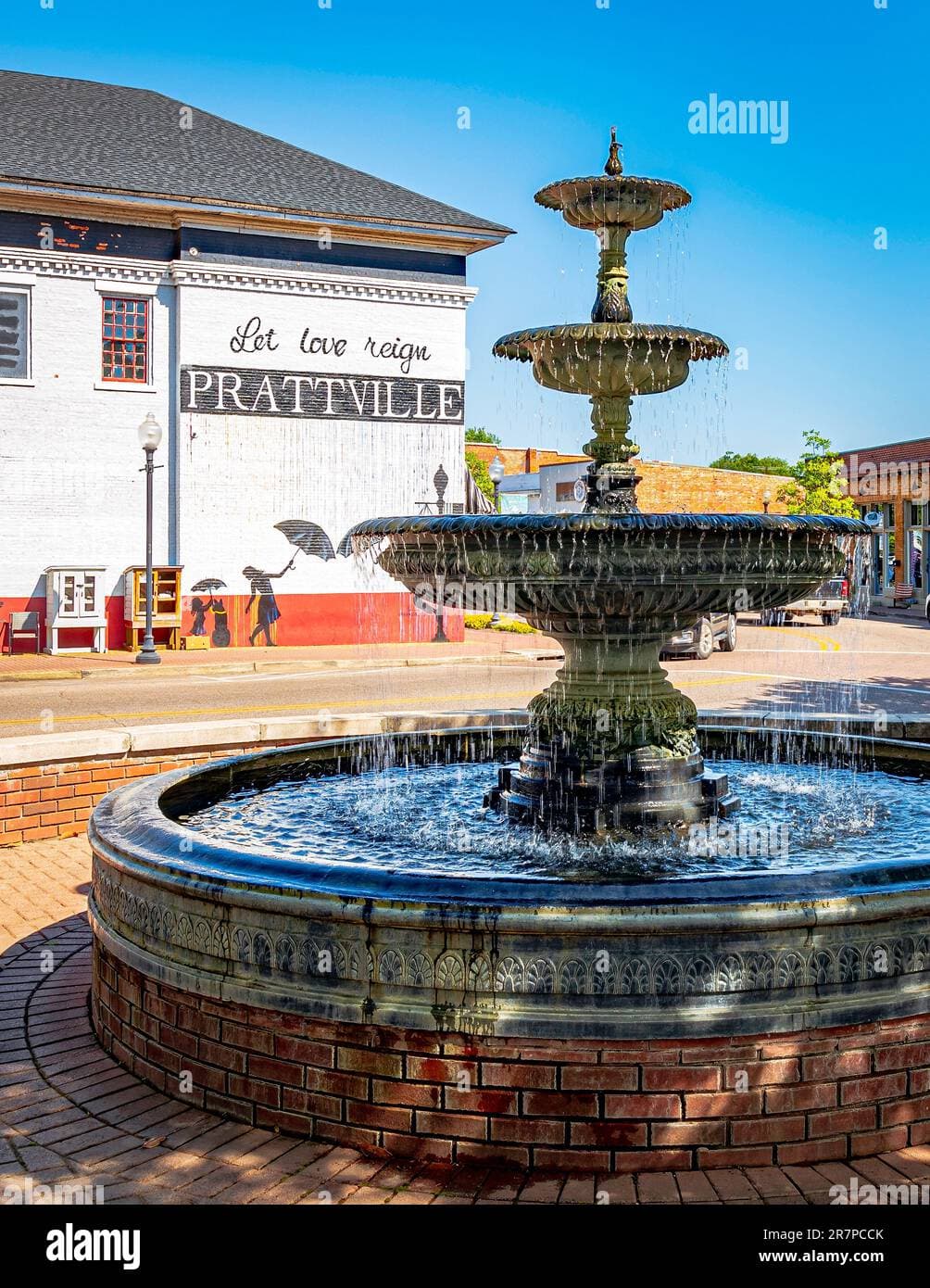
Prattville's Fountain City nickname is not a decorative slogan. It comes from scores of artesian wells, and many of those wells still feed decorative and drinking fountains in places people can see today. The city’s water story sits alongside Autauga Creek on the Fall Line in south-central Alabama, where Daniel Pratt built an industrial town that still shapes how Prattville looks and brands itself.
How the Fountain City name took hold
Prattville earned the name because free-flowing artesian wells were spread throughout the city. That is what gives the nickname its staying power: the wells are not gone, and they are not confined to a museum label. They remain part of the city’s public landscape, which is why Fountain City still feels attached to real places rather than old memory.
The downtown setting deepens that identity. Explore Prattville describes the core as “New England styled in the south,” a fitting phrase for a town that grew around creekside industry instead of a courthouse square. The result is a city form that looks different from many Alabama county seats, with its oldest growth tracking water, mills and the businesses that followed Daniel Pratt.
Daniel Pratt’s town on Autauga Creek
Daniel Pratt was already a skilled builder-architect before he became Alabama’s first major industrialist. He began building cotton gins around 1833, and the Daniel Pratt Gin Company opened a temporary production site around 1836 at McNeil’s Mill on Autauga Creek. In 1838, Pratt bought the land that became Prattville and built the permanent factory that anchored the town.
The business grew into one of the state’s defining early industries. Historical accounts say Pratt’s company employed as many as 175 workers and produced up to 1,500 cotton gins a year, with machines shipped worldwide. Pratt later expanded into railroad construction, grist and flour mills, and finance, which helped make Prattville Alabama’s first major industrial center.
By 1860, the town had about 1,500 residents. It also had churches, schools, a public library, a town hall and professional services, all tied to a settlement pattern that followed the creek rather than a traditional central square. That is why historians still describe Prattville as a “New England Village of the South,” a label that matches both its built form and its industrial origins.
Where the water story still shows up
The easiest way to understand Fountain City is to go find the wells. The Prattaugan Museum and Heritage Center, housed in the McWilliams-Smith-Rice House from the 1840s, sits on grounds that include one of Prattville’s artesian wells. The same site also holds a small house that served as the first meeting place of the Prattville Dragoons in 1861, which ties the water story to the city’s wartime history as well.
Other wells remain visible across town. City and tourism materials point visitors to the Doster Road Artesian Well, while additional wells can be found at Pratt Park, behind the Prattaugan Museum and at Heritage Park. That makes the nickname practical as well as historic: it points to actual landmarks residents can visit, not just a legend.
The broader historic district carries the same kind of physical evidence. The Daniel Pratt Historic District, listed on the National Register of Historic Places, includes more than 200 properties. Its earliest industrial buildings cluster around Autauga Creek, and the district contains structures from roughly 1840 to 1930, with a heavy concentration built between 1880 and 1920.
Why the nickname still matters now
Prattville’s Fountain City identity still works because it connects preservation, tourism and daily civic life to visible features of the city. The wells, the creek, the old factory sites and the surviving buildings all give residents a way to trace the same story across different blocks and parks. That is a stronger local brand than a slogan alone, because the evidence is still on the ground.
The preservation network helps keep that story legible. The Autauga County Heritage Association and the Heritage Center Museum are housed in a Greek Revival home built around 1830, while the Prattaugan Museum collects artifacts tied to Pratt, the Pratt Gin Company, the cotton industry and later military and family records. Together, those places turn Prattville’s industrial past into a map people can still follow through the city.
The city also formalized the historic core. The Prattville Historic District was established by Ordinance 2008-002 in January 2008, giving the old townsite an official frame inside the modern city. That is why Fountain City still matters in Prattville’s self-image: the nickname describes a living landscape of wells, mills, streets and landmarks that still define Autauga County’s county seat.
This article was produced by Prism’s automated news system from verified source data, official records, and press releases, then run through automated quality and moderation checks before publishing. The system is built and supervised by the people who set the standards it runs under. Read our full AI policy.
Did this article answer your question?