Baltimore Begins Foundation Work on New Francis Scott Key Bridge
Test piles driven 200 feet into the Patapsco riverbed are confirming the ground can hold Baltimore's next Key Bridge, as costs surge to $5.2 billion and the opening shifts to late 2030.
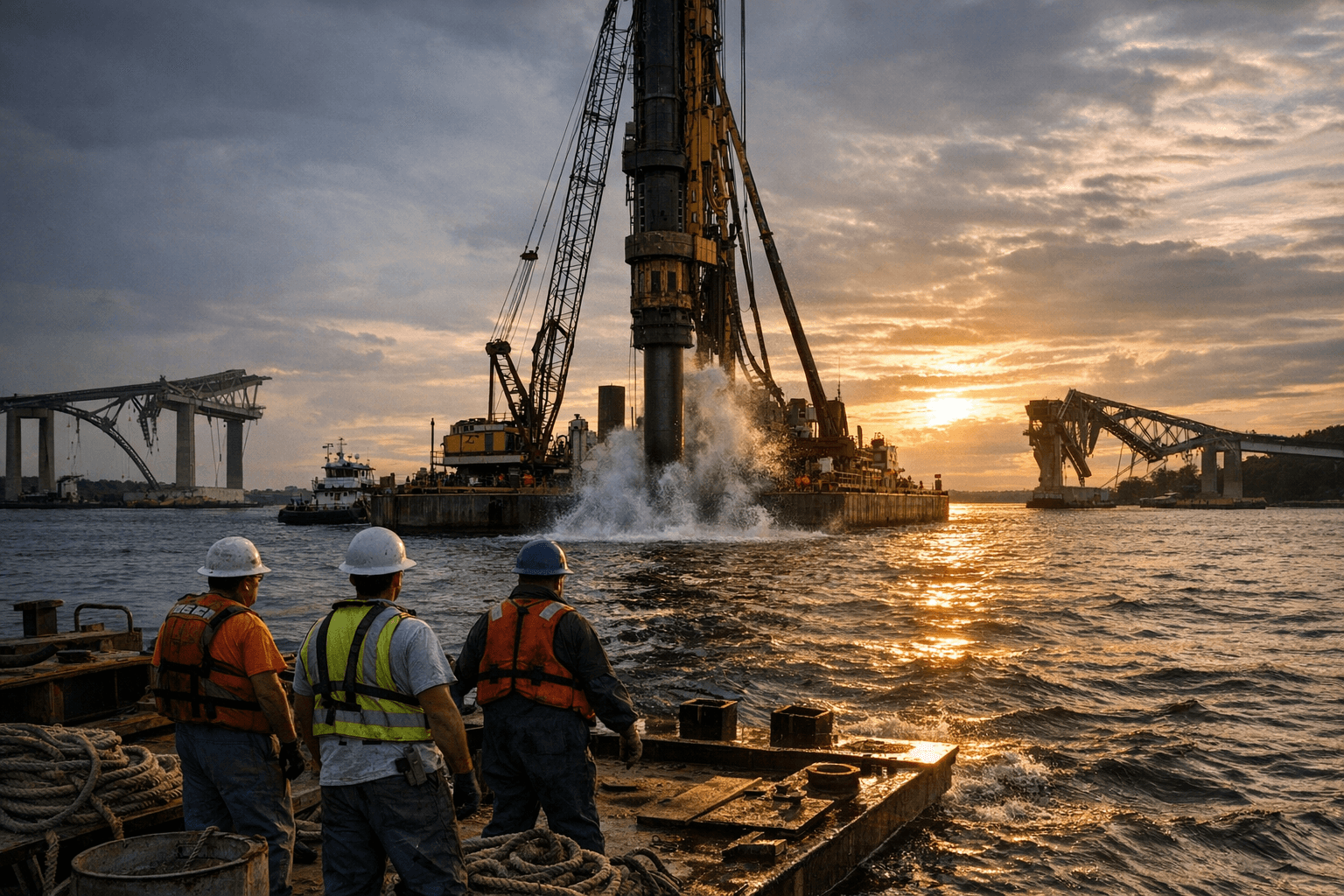
Two years after the M/V Dali killed six construction workers and sent the Francis Scott Key Bridge into the Patapsco River, the steel piles now being driven into that same riverbed are the first physical sign of what replaces it. The Test Pile Program, launched in early October 2025, involves driving twelve massive steel test piles, roughly eight feet in diameter and over 220 feet long, into the riverbed to validate the foundation's design. The results so far are encouraging: the installation has essentially confirmed what engineers anticipated from the boring program, with the piles passing through a soft upper sediment layer and reaching the hard rock strata below.
During a sampling effort in the Patapsco, engineers discovered that a substantial upper layer of the riverbed, the first 60 to 70 feet, is too soft to support an enormous cable-stayed bridge. Beneath that muck, however, is an extremely hard layer, and the piles must burrow deep into it to hold up the structure. A barge-mounted hydraulic hammer is doing that work, eventually reaching a maximum force of about 10 million pounds, according to Brian Wolfe, the Maryland Transportation Authority's director of project development. Load tests at the southern main span pier were successful, confirming the strength and performance of the foundation design, with identical testing scheduled at the northern main span pier.
Demolition of the original structure is running alongside the foundation work. Crews have removed 20,000 tons of concrete decking, and steel girder removal is underway. Workers have removed all steel girder spans on both the north and south sides of the old bridge structure and demolished the land-side concrete columns using extended-boom excavators equipped with mechanical demolition hammers. To protect aquatic life during pile driving, crews deployed an air bubble curtain system that releases compressed air around the piles to dampen underwater sound waves.
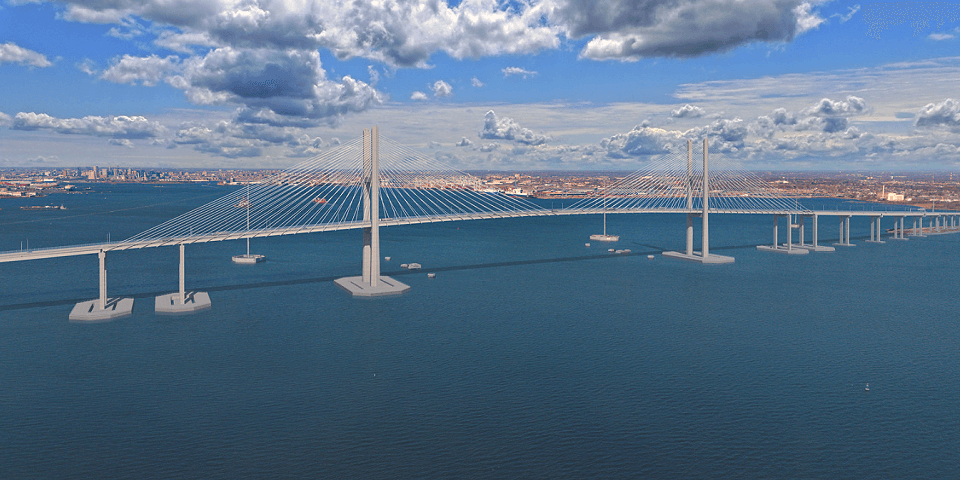
Based on months of field investigations and engineering analysis, the new bridge alignment was determined to be slightly east, or downriver, of the original structure. The replacement will be Maryland's first highway cable-stayed bridge: twin pylons rising more than 600 feet above the Patapsco, supporting a main span exceeding 1,600 feet, significantly wider than the original. The new Key Bridge will be more than two miles long with two 12-foot lanes going in each direction, a 230-foot clearance above the federal channel, and an expected lifespan of 100 years.
To move workers and equipment to mid-river pier sites efficiently, the project includes two temporary trestle structures: one extending from Hawkins Point on the south side and another from Sollers Point to the north, providing over-water platforms for cranes, pile-driving equipment, and material transport.
The project's price tag is where the news turns harder for Baltimore commuters and Port traffic already absorbing 24 months of rerouting. The MDTA Board updated its financial forecast to a cost estimate range of $4.3 billion to $5.2 billion, with an anticipated open-to-traffic date in late 2030. That figure is more than double the initial $2 billion estimate Maryland used to secure emergency federal relief funds in the days after the March 26, 2024, collapse. MDTA attributed the increase to the advanced pier protection system, a taller and wider main span, and rising inflation, with the state spending $1 billion on pier protections alone to guard against another ship strike. According to the Federal Highway Administration, highway construction costs have increased 72 percent in the last five years, which also contributed to an uncertain construction and bonding market nationwide.
After negotiations with the progressive design-builder Kiewit are complete, MDTA anticipates the final cost will fall within the estimated range. MDTA Executive Director Bruce Gartner noted that a preliminary cost estimate was needed less than two weeks after the collapse to request federal emergency relief funding, explaining that a cost estimate would not normally be provided on a project of this size until much later in the design process. The Key Bridge Rebuild achieved 70 percent design in 14 months, compared to other projects that have averaged seven years, while also progressing construction.
Acting Transportation Secretary and MDTA Chair Samantha J. Biddle said the cost increase was driven by the advanced pier protection system, making the bridge wider and taller over the federal channel, and rising inflation, with the state spending $1 billion on pier protections alone. Maryland continues to pursue the Dali's owner and manager for all damages caused by the collision, and the American Relief Act of 2025 provides that if additional funds are required beyond any compensation recovered, the federal government will provide that funding.
The formal start of construction, when the agreement for the second phase is reached with Kiewit, was expected in spring 2026. The original span carried roughly 11 million vehicles annually and served as a critical link for commuters and freight moving to and from the Port of Baltimore, a reality that will not change with the structure now rising from the riverbed to take its place.
This article was produced by Prism’s automated news system from verified source data, official records, and press releases, then run through automated quality and moderation checks before publishing. The system is built and supervised by the people who set the standards it runs under. Read our full AI policy.
Did this article answer your question?