Baltimore budget deficit hits $64.4 million after winter storms, overtime costs
Baltimore's snow and overtime bill erased a projected surplus, pushing the city to a $64.4 million deficit and sharper pressure on core services.

Baltimore City Hall is staring at a much tighter cash picture after winter storms and public safety overtime wiped out a projected surplus and pushed the current fiscal year into a $64.4 million deficit.
City officials told the Baltimore City Council on Tuesday that the city’s second-quarter expenditure deficit reached $129.8 million, about $101.3 million worse than projected. What had looked like a $19.6 million surplus earlier in the year disappeared under the cost of cleaning up after four snowstorms, plus overtime spending in the police and fire departments.

Deputy Finance Director Bob Cenamme said emergency winter operations were a major driver of the shortfall, underscoring how quickly a weather hit can overwhelm even a carefully built budget. Baltimore had already set aside more than $7.3 million for winter-weather readiness before the 2025-2026 season, but Mayor Brandon M. Scott still declared a State of Emergency on Jan. 23 as severe winter weather approached, followed by additional storm management updates on Jan. 25 and during February snow events.
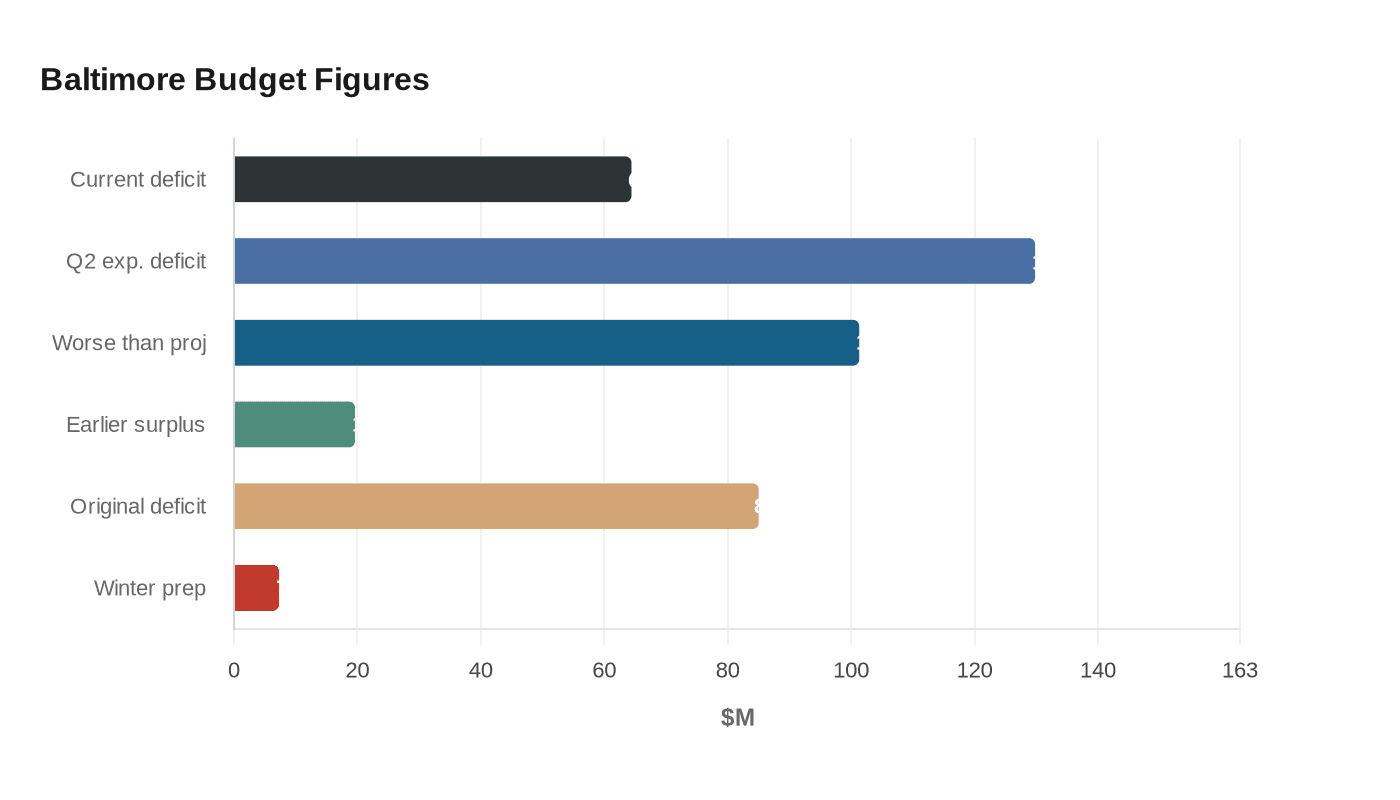
The gap lands in a city budget that was already built on a difficult assumption. Baltimore’s Fiscal 2026 adopted budget totaled $4.63 billion, including a $3.7 billion operating budget and a $932.0 million capital budget. Council approved the plan by a 13-2 vote on June 16, 2025, and Scott signed it on June 23. That budget was originally designed around an $85 million deficit that city leaders said they would close without raising property or income taxes.
Now the city is confronting a larger midyear hole, with reserve funds suddenly part of the conversation. Baltimore’s Budget Stabilization Reserve policy says the rainy day fund is meant to be the last line of defense when a budget is hit by an uncorrectable revenue shortfall or an unexpected emergency expense. For council members and budget officials, that raises the stakes around staffing, overtime controls, and how much cushion remains for core services that run around the clock.
The pressure point is straightforward: police, fire, snow removal, and other basic operations are already expensive to keep moving in a city with long-running staffing strain. If the deficit holds, the next budget cycle could force harder trade-offs on hiring plans, service levels, and other spending priorities, even if revenue comes in stronger than expected. The storm damage showed how fast those gains can vanish when emergency operations take over.
This article was produced by Prism’s automated news system from verified source data, official records, and press releases, then run through automated quality and moderation checks before publishing. The system is built and supervised by the people who set the standards it runs under. Read our full AI policy.
Did this article answer your question?