Baltimore drops remaining opioid lawsuits after state court ruling
Baltimore walked away from its last opioid cases after the state high court cut off its legal theory, keeping $402.5 million but losing a chance at more.
Baltimore abandoned its remaining opioid lawsuits after the Maryland Supreme Court wiped out the city’s $152 million McKesson and Cencora verdict, closing off the chance to win more money from the last defendants and leaving officials to rely on the $402.5 million already secured for treatment and overdose response.
The decision came after the high court’s April 24 order vacated the Baltimore City Circuit Court judgment and sent the case back for further proceedings consistent with its earlier Express Scripts ruling. That earlier opinion held that the licensed dispensing of opioids and the administration of benefit plans for controlled substances do not amount to an actionable public nuisance under Maryland law, undercutting the theory Baltimore had used to pursue the case at circuit court.
For Baltimore, the practical consequence is immediate: the city keeps the settlement money already banked, but it gave up the possibility of pressing ahead against the remaining defendants, including Johnson & Johnson, McKesson and AmerisourceBergen. The city’s opioid litigation had been one of its largest potential funding sources for addiction treatment, harm reduction and overdose-response work, so the dismissal marks a shift from courtroom recovery to managing what has already been collected.
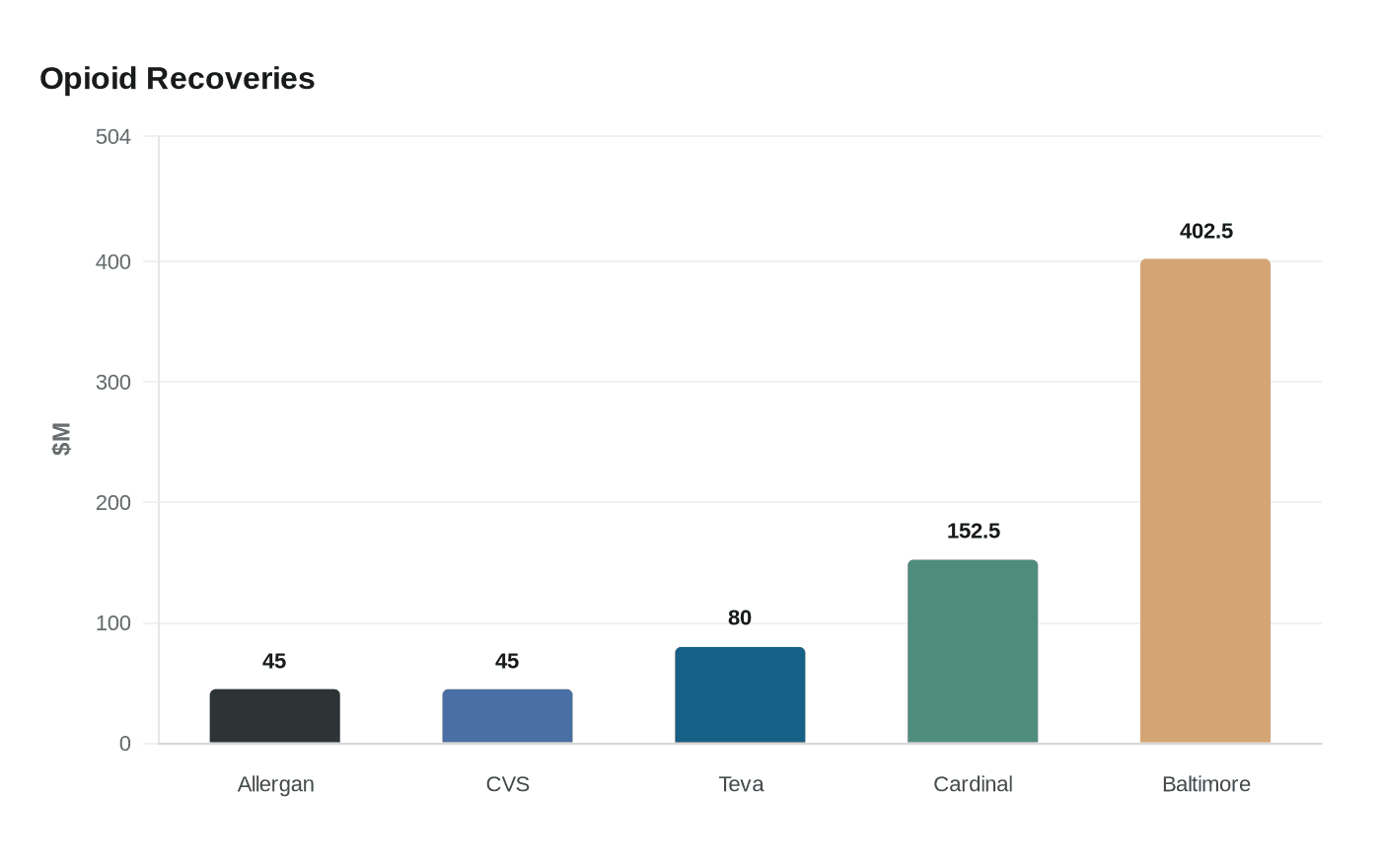
Baltimore had said in September 2024 that its opioid recoveries had reached $402.5 million after its fifth settlement, with Walgreens joining earlier deals with Allergan for $45 million, CVS for $45 million, Teva for $80 million and Cardinal Health for $152.5 million. At the time, the city said the remaining defendants were headed to trial. Instead, the state court ruling changed the legal ground beneath the case and left no viable path forward, according to the mayor’s office.
The city had accepted a $152 million jury award against McKesson and Cencora in August 2025, but that award was later vacated. That loss matters not only because it erased a major verdict, but because it narrowed Baltimore’s leverage in future negotiations over opioid damages and abatement.
Mayor Brandon Scott had said in 2024 that the litigation money would help support and grow the city’s overdose-response work. That spending plan still matters in a city where overdose deaths remain a central public-health measure, even as the broader epidemic has eased. Maryland recorded 1,405 fatal overdoses in 2025, the lowest level in a decade, while Baltimore reported 776 overdose deaths in 2024, down from 1,043 the year before.
Baltimore’s lawsuit, filed in Baltimore City Circuit Court as case no. 24-C-18-000515, has now reached its end point in court. What remains is how far the city can stretch the $402.5 million it already won, and how much of the response to Baltimore’s opioid crisis can still be financed without another verdict to chase.
This article was produced by Prism’s automated news system from verified source data, official records, and press releases, then run through automated quality and moderation checks before publishing. The system is built and supervised by the people who set the standards it runs under. Read our full AI policy.
Did this article answer your question?