Baltimore Renters United educates tenants outside District Court
Outside District Court’s new Calvert Street home, Baltimore Renters United tried to turn rent court confusion into tenant power as eviction filings kept climbing.

Baltimore Renters United took its first Day of Action straight to the place where many Baltimore renters face the most immediate pressure: outside Baltimore City District Court, as tenants walked into and out of hearings at 500 North Calvert Street. The group spent the day talking with renters, gathering information, and trying to make the landlord-tenant process easier to understand for people who often arrive with little sense of what the court will do next.
The setting mattered. Baltimore City District Court moved from 501 East Fayette Street to 500 North Calvert Street on Oct. 14, 2025, and the judiciary said all services previously provided at the East Fayette Street courthouse and the North Charles commissioner’s station moved to the new site. Maryland Courts says Baltimore City has four district court locations, and the public can email BaltimoreDCmove@mdcourts.gov with questions about the relocation. By focusing its outreach at the new courthouse, Baltimore Renters United placed itself at the center of the daily flow of renters, landlords, attorneys, sheriffs, and court staff that now converges there.

Detrese Dowridge, the group’s executive director, joined other advocates in speaking with tenants and explaining what can happen once a case reaches rent court. The effort was not just about handing out flyers. Baltimore Renters United used the day to collect stories and data from renters directly, part of a broader push to build tenant power by translating a system that often favors repeat players who know the process better than the people facing possible displacement.
The stakes are large across Baltimore and Maryland. The state’s housing needs assessment says Maryland has 765,237 renter households, a 47% cost-burdened renter rate, and a shortage of more than 275,000 affordable homes for renters earning below 80% of area median income. In Baltimore City, 52% of households rented in 2024, and 54% of renters had unaffordable housing costs, according to the Baltimore City Housing Indicator Tool. Those numbers help explain why courthouse outreach can matter so much: for many families, a confusing hearing is not an abstract policy problem but a possible turning point.
.png&w=1920&q=75)
The legal imbalance is just as stark. Before Maryland’s Access to Counsel in Evictions law took effect in 2021, more than 90% of landlords and housing providers had legal representation while more than 90% of tenants did not. Baltimore Renters United’s own materials say that in 2020 landlords were represented in 96% of Baltimore cases while tenants had representation in just 1%. Maryland’s Office of Tenant and Landlord Affairs, created by the Renters’ Rights and Stabilization Act of 2024, can refer tenants to legal help and housing counseling, but it cannot give legal advice or representation.
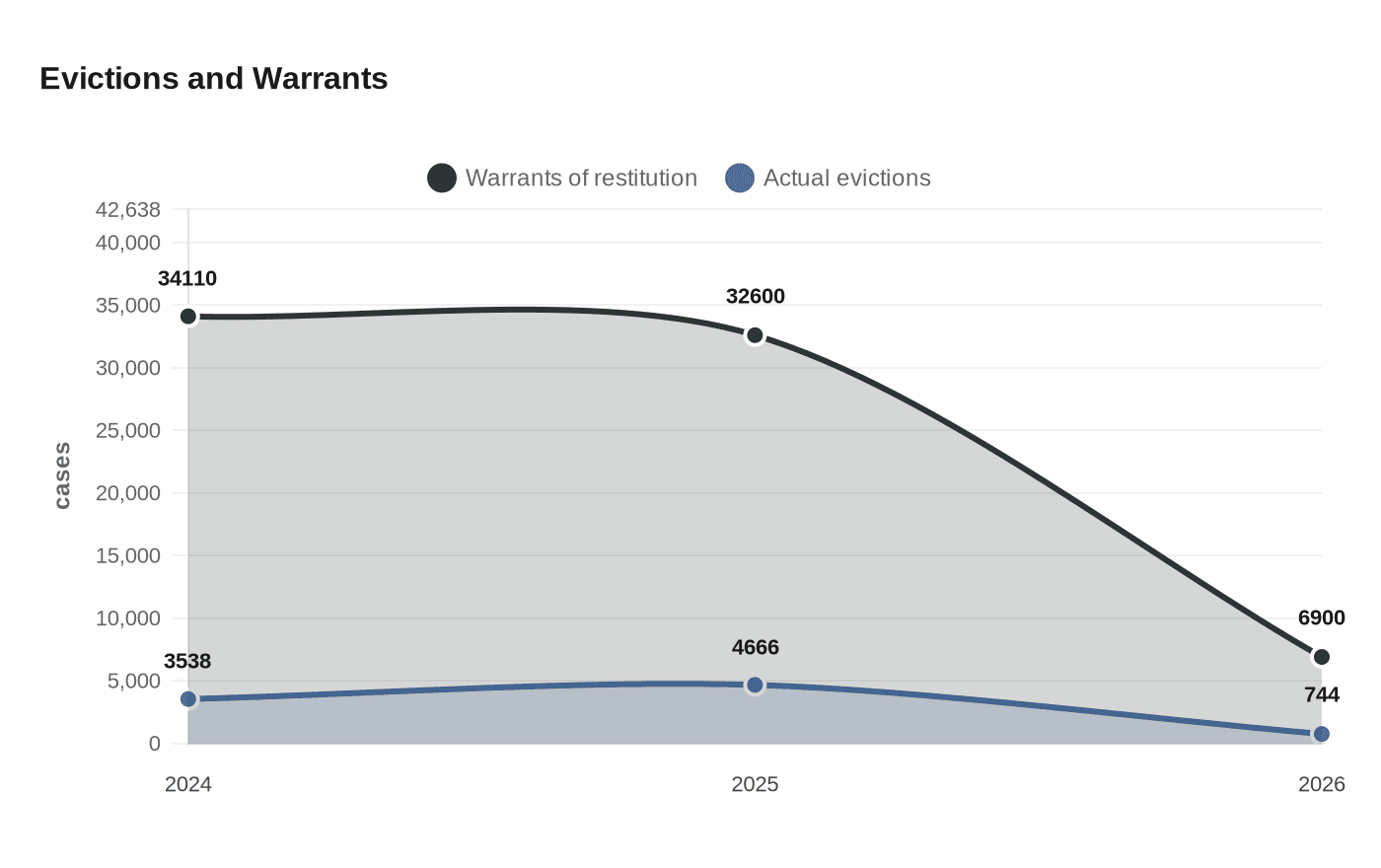
The eviction numbers show why the outreach landed in a city still under intense housing strain. Baltimore Brew reported 32,600 warrants of restitution and 4,666 actual evictions in Maryland in 2025, compared with 34,110 warrants and 3,538 evictions in 2024. More than 6,900 warrants and 744 evictions had already been recorded in 2026 at the time of publication. Baltimore Renters United estimates about 25% of people evicted wind up homeless. In a system where Black evictions have been found to run three times higher than white removals, and Black woman-headed households are removed at nearly four times the rate of white man-headed households, the group’s court-side organizing is aimed at a blunt goal: give renters more information before a bad hearing becomes a lost home.
This article was produced by Prism’s automated news system from verified source data, official records, and press releases, then run through automated quality and moderation checks before publishing. The system is built and supervised by the people who set the standards it runs under. Read our full AI policy.
Did this article answer your question?


