Baltimore TV Stations Settle for $2.2 Million Over Lead Paint Tower Contamination
Paint chips from a TV tower owned by WBAL, WJZ and WMAR rained on Woodberry in 2022. Here's what the $2.2M settlement pays for, and what neighbors within a half-mile should do now.
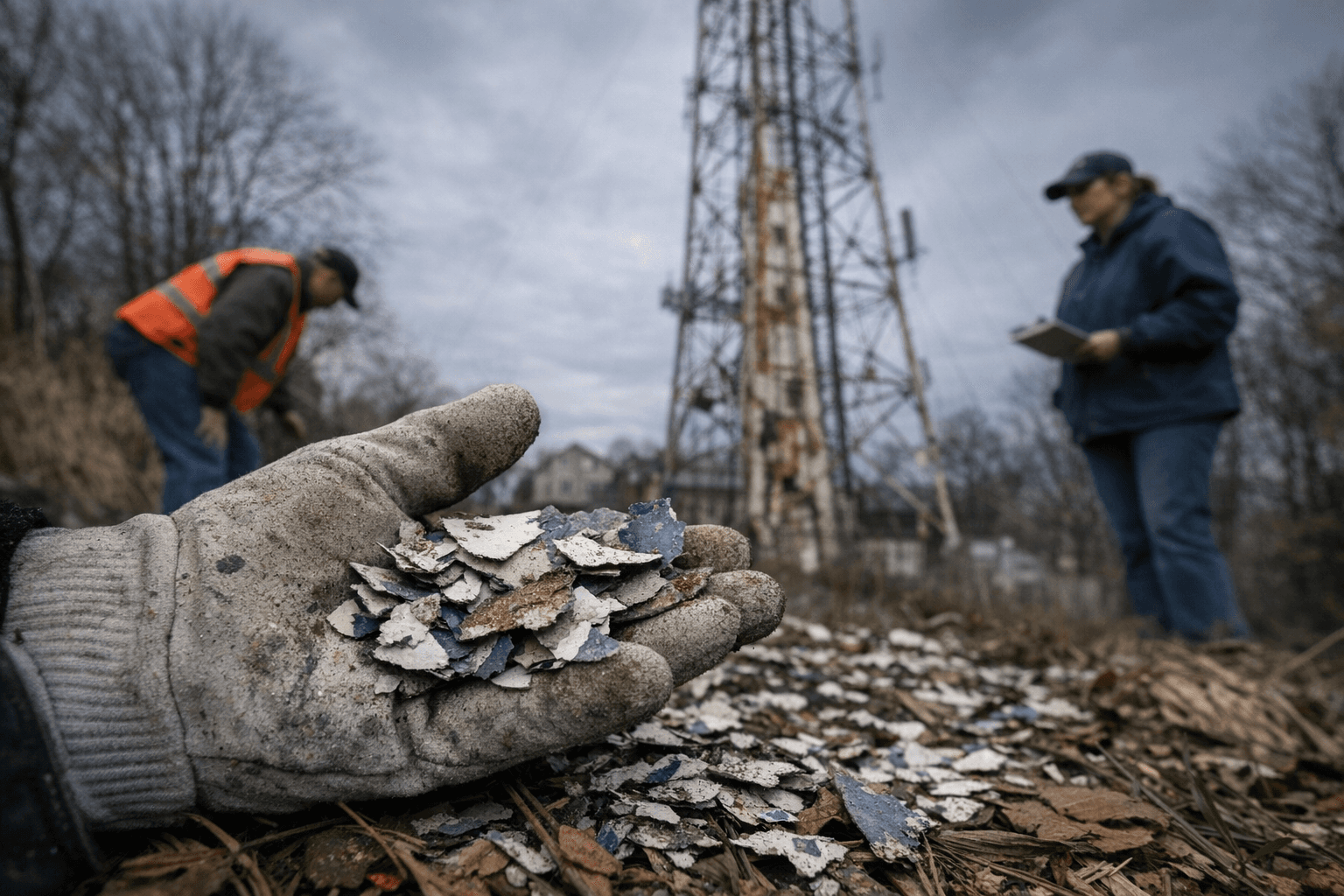
Tracey Brown collected paint chips from her Woodberry yard in June 2022, fragments that had rained down from a 1,000-foot broadcast tower on Television Hill where a Nebraska contractor was stripping decades-old lead-based paint using power washers with no containment. Chips and debris spread as far as a quarter to half a mile from the base at 3723 Malden Avenue, reaching yards, streets, and playgrounds across north Baltimore.
The civil reckoning arrived Wednesday when the Maryland Attorney General's Office and the Maryland Department of the Environment announced a $2.2 million settlement with Television Tower, Inc. (TTI), the company jointly owned by WBAL, WJZ and WMAR, and Nebraska-based Skyline Tower Painting, Inc. The consent decree, filed in Baltimore Circuit Court, resolves allegations that the three-week project violated multiple state environmental and public health laws.
What the $2.2 million does not do is pay directly to Tracey Brown or any of her neighbors. The money goes toward state remediation costs, environmental monitoring, and other expenses tied to MDE's response. Under the consent decree, TTI must complete all future tower repainting using proper containment systems and only Maryland-accredited contractors by June 30, 2026.
Court filings revealed TTI had known since 2012 that the tower contained lead-based paint. The original project scope called for an accredited abatement process, including a "lead neutralizer." Instead, TTI hired Skyline Tower Painting, which was not accredited to do lead work in Maryland. Skyline scraped and power-washed the structure with no containment barriers. State officials announced the settlement at Hooper and Rockrose Park in Woodberry, one of the playgrounds directly in the fallout zone.
"Our expectation is clear: work that risks public health must be done safely and in full compliance with the law. That did not happen here," Attorney General Anthony Brown said. Skyline had already entered criminal environmental pleas in December through the AG's Environmental and Natural Resources Crimes Unit; the civil settlement addresses TTI's liability separately.
Baltimore has fought lead poisoning for decades. The Baltimore City Health Department's Childhood Lead Poisoning Prevention Program reports a 97 percent decrease in children testing positive for elevated blood-lead levels since 1992, but lead in soil remains a persistent hazard near older painted structures. For blocks within a half-mile of 3723 Malden Avenue, the 2022 incident created a specific exposure risk that still warrants action.
If your property falls within that radius, submit a soil sample for testing through MDE's Lead Poisoning Prevention program. Children under six are especially vulnerable, and should be tested for blood-lead levels regardless of whether symptoms are visible: lead accumulates silently, and exposure has been linked to learning and behavior problems, slow growth and development, and hearing and speech problems that often surface only months after contact. Baltimore City Health Code mandates blood-lead testing for all children at 12 and 24 months; parents seeking off-schedule testing can call Johns Hopkins Bayview's Medical Care-A-Van at 410-913-5126 for a reduced-cost appointment. Do not grow vegetables in potentially contaminated soil until testing confirms it is safe; MDE guidance calls for removing six inches of topsoil, covering the exposed subsurface with water-permeable textile fabric, and replacing it with eight inches of clean soil before gardening resumes.
Anyone considering a claim beyond what the state settlement covers should document everything now: photographs of contamination, dates of soil and blood tests, cleanup receipts, and any correspondence with TTI or MDE. The consent decree creates no private right of recovery, but that paper trail is the foundation of any future action.
A nearby stretch of Baltimore, down Falls Road from Woodberry, has recently seen a shower of lead paint from a city-owned bridge that spans the Jones Falls, a reminder that the 2022 settlement, though significant, reflects a hazard pattern that extends well past Television Hill.
This article was produced by Prism’s automated news system from verified source data, official records, and press releases, then run through automated quality and moderation checks before publishing. The system is built and supervised by the people who set the standards it runs under. Read our full AI policy.
Did this article answer your question?