Baltimore upgrades public safety dashboard with neighborhood data
Baltimore’s dashboard now adds neighborhood home ownership, victim demographics, arrest data and violence-prevention sites, giving residents a clearer public safety scorecard.
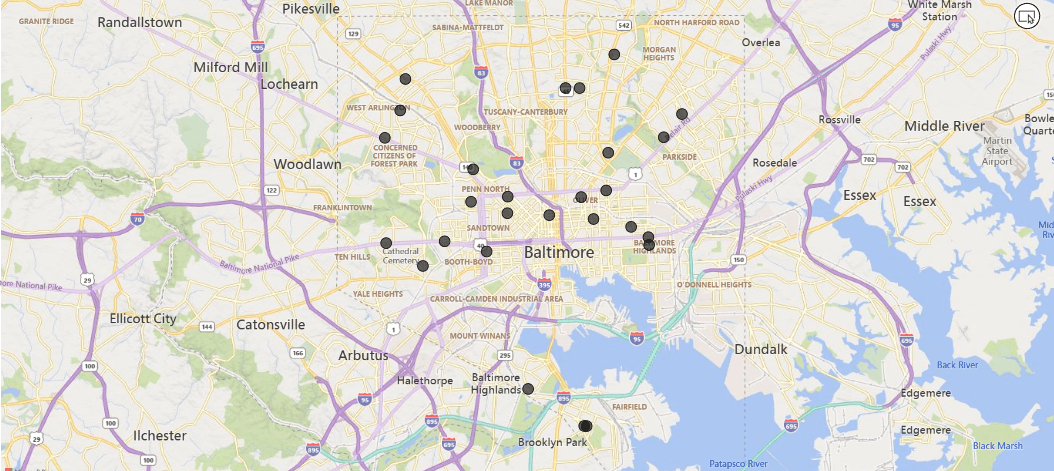
Baltimore residents can now see more than crime counts when they open the city’s Public Safety Accountability Dashboard. The June 17 upgrade adds neighborhood-level home ownership rates, the demographics of violence victims and arrest data, giving the public a sharper view of where City Hall says its anti-violence strategy is working and where it is not.
The revamped dashboard also maps Baltimore’s Community Violence Intervention network, including all ten Safe Streets sites, hospital-based violence intervention programs, MONSE neighborhood stabilization work and the Group Violence Reduction Strategy. The system was built through cooperation among the Mayor’s Office of Neighborhood Safety and Engagement, the Baltimore Police Department, city and state partners, the Baltimore City Office of Information Technology, the Chief Data Officer and the Mayor’s Office of Performance and Innovation. Stefanie Mavronis said the dashboard is meant to be a “one-stop shop” for public safety data and trends over time.
First published in February 2023, the dashboard was already a notable experiment in public access. City officials described the original version as the first and only public-safety dashboard of its kind in the United States, and it let users search crime by type, neighborhood and disposition. But the early rollout also had limits: the data lagged reality by at least a week or two, and it did not include all arrests or all agencies, which left residents with an incomplete picture of what was happening on their blocks.
The new layout and visuals are designed to make the information easier to read for people who are not data specialists. Mayor Brandon M. Scott said the goal is to give residents a clear view of public safety progress and to make that progress measurable, not just a matter of broad claims about crime. For Baltimore, where public safety remains one of the city’s defining political issues, the dashboard is now being used as a public report card on whether the city is delivering on its promises.
The update also lands as Scott continues to defend his broader violence-reduction strategy. On June 3, the city cited a University of Pennsylvania Crime and Justice Policy Lab paper saying Baltimore’s targeted approach helped drive a 60% drop in homicides between 2022 and 2025, with the city’s homicide rate about 25% below comparable cities and the social value of averted violence estimated at roughly 35 times first-year program spending.
A separate May 27 study from Johns Hopkins researchers found Safe Streets was associated overall with a 42% reduction in homicides involving youth ages 15 to 24 and a 21% reduction in youth nonfatal shootings at the neighborhood level, although the effects varied widely by site across 11 locations studied from 2007 to 2023. The dashboard upgrade arrives amid renewed scrutiny of Baltimore’s violence-intervention network after reports that a Safe Streets worker was charged in a shooting, making the city’s promise of transparency more than a slogan.
This article was produced by Prism’s automated news system from verified source data, official records, and press releases, then run through automated quality and moderation checks before publishing. The system is built and supervised by the people who set the standards it runs under. Read our full AI policy.
Did this article answer your question?