Baltimore’s community violence strategy drives lowest homicide rate in 50 years
Baltimore’s homicide decline is real, but the harder test is whether neighborhood-level prevention can hold as the city rolls into a new five-year plan.
Baltimore’s public-safety numbers now point to a city that has moved well past crisis management and into the harder question of durability. A National Urban League article says the city is posting the lowest homicide rate in 50 years, but the more important story is how much of that drop is tied to sustained neighborhood work, targeted outreach, and a strategy built to be measured.
The numbers behind the headline
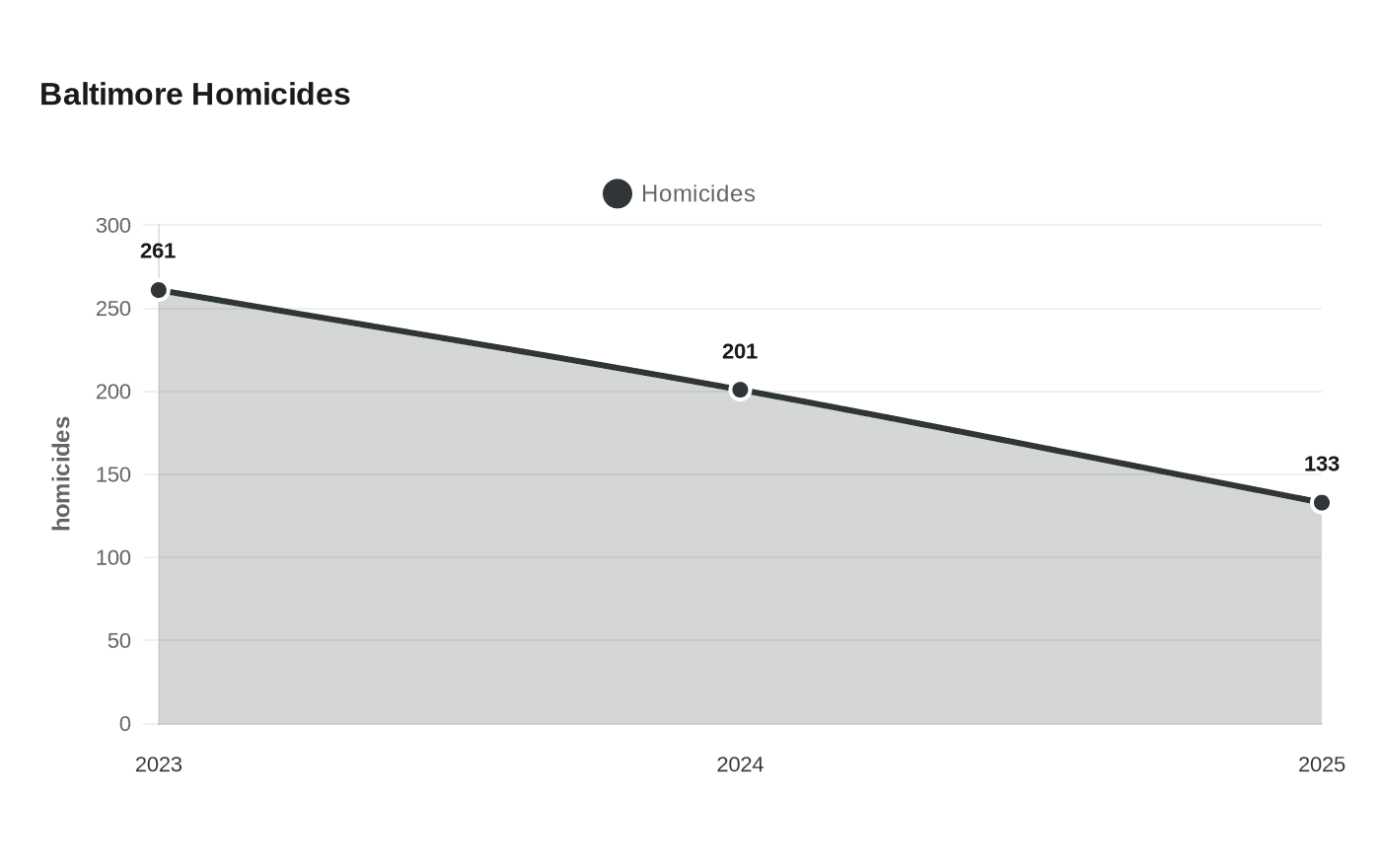
The clearest marker is the city’s own record. Mayor Brandon Scott said on January 5, 2026, that Baltimore closed 2025 with 133 homicides, the fewest in nearly 50 years, and city materials said homicides and shootings were down nearly 60 percent since he took office in 2021. Baltimore Police also said 2024 ended with 201 homicides, down 23 percent from 261 in 2023, while non-fatal shootings fell 34 percent to 414 from 635.
The pace of decline has continued into 2026. On April 1, the city reported 28 homicides and 61 non-fatal shootings through that point in the year, compared with 32 homicides and 66 non-fatal shootings at the same point in 2025. By June 1, Baltimore said the total had reached 40 homicides and 120 non-fatal shootings through early June, compared with 52 homicides and 121 non-fatal shootings during the same period last year.
That is why the National Urban League framed Baltimore as a national example of community-based violence prevention. Its June 25 article said homicides were down 22 percent and non-fatal shootings were down 19 percent over the first six months of the year, a pace that already exceeded the city’s own 15 percent annual reduction goal for gun violence.
Where the gains are showing up
The city’s progress is not spread evenly across Baltimore, and that unevenness matters. By the end of 2024, six communities had gone a full year without a homicide: Belvedere, Woodbourne McCabe, Park Heights, Penn North, Franklin Square, and Brooklyn. Those neighborhoods are proof that the city’s gains can be sustained in specific places, but they also show how concentrated the remaining violence has been in others.
That pattern is central to how Baltimore now talks about public safety. The city’s logic is that violence does not move uniformly across every block or every neighborhood, and the highest-risk groups for victimization are narrow enough to reach with focused intervention. In practice, that means Baltimore has leaned into violence interrupters, outreach workers, and neighborhood prevention initiatives instead of applying the same response everywhere.
The result is a citywide decline that still needs neighborhood-level scrutiny. A falling homicide count does not erase the reality that some communities have benefited earlier and more deeply than others. Baltimore’s own record suggests that the strongest gains are coming where prevention workers, trusted messengers, and community partners are most embedded.
What the strategy is built to do
Baltimore’s 2021-2026 Comprehensive Violence Prevention Plan gives the framework for that approach. The plan runs from July 1, 2021 through June 30, 2026, and its three pillars are a public health approach to violence, community engagement and inter-agency coordination, and evaluation and accountability. That structure matters because it ties the city’s performance to a plan with dates, milestones, and measurable outcomes.
The public-health model is the biggest break from Baltimore’s older reputation as a city that relied mainly on arrest and punishment. The National Urban League article described Scott’s approach as treating violence as a public health problem, and that is consistent with the city’s long-term investment in prevention workers and neighborhood outreach. The premise is simple: if violence is driven by identifiable patterns, then targeted interruption and support can reduce it before it becomes a homicide or shooting.
That argument has also drawn support outside City Hall. Maryland Office of the Public Defender Natasha Dartigue praised the programs because, in her view, they address violence at its roots and engage directly with the communities most affected. LifeBridge Health’s Adam Rosenberg called the city’s progress an “all-of-the-above approach,” a description that fits the range of actors now involved, from city agencies to health systems and neighborhood-based partners.
The political and institutional reset
Scott inherited a city that was still defined nationally by violence, and Baltimore’s image was still shaped by old narratives like The Wire when he took office in 2021. Johns Hopkins Bloomberg School of Public Health has said Baltimore’s homicide rate fell 60 percent from 2021 to 2025 and that the decline preceded the national drop, which places the city’s turnaround in a broader public-safety context instead of treating it as a one-year anomaly.
The next test is already underway. On June 22, 2026, Scott announced a public engagement process for Baltimore’s second Comprehensive Violence Prevention Plan, which will guide violence-prevention efforts from 2026 to 2031. Public listening sessions and a survey are underway in June, and the city is using that process to carry the work beyond the current plan’s expiration.
Baltimore has also tried to make the strategy more visible to residents through public-facing violence-prevention tracking and neighborhood-based outreach tied to the broader plan. That visibility matters because the city is asking communities to trust not just the headline numbers, but the machinery underneath them: the outreach, the coordination, the data, and the accountability that have to survive into the next five-year cycle.
This article was produced by Prism’s automated news system from verified source data, official records, and press releases, then run through automated quality and moderation checks before publishing. The system is built and supervised by the people who set the standards it runs under. Read our full AI policy.
Know something we missed? Have a correction or additional information?
Submit a Tip