Fake Court Texts Target Baltimore Residents Over Bogus Traffic Violations
Scammers are texting Baltimore residents fake court summons for toll violations, directing them to a courthouse at 501 E. Fayette St. that is actually closed.
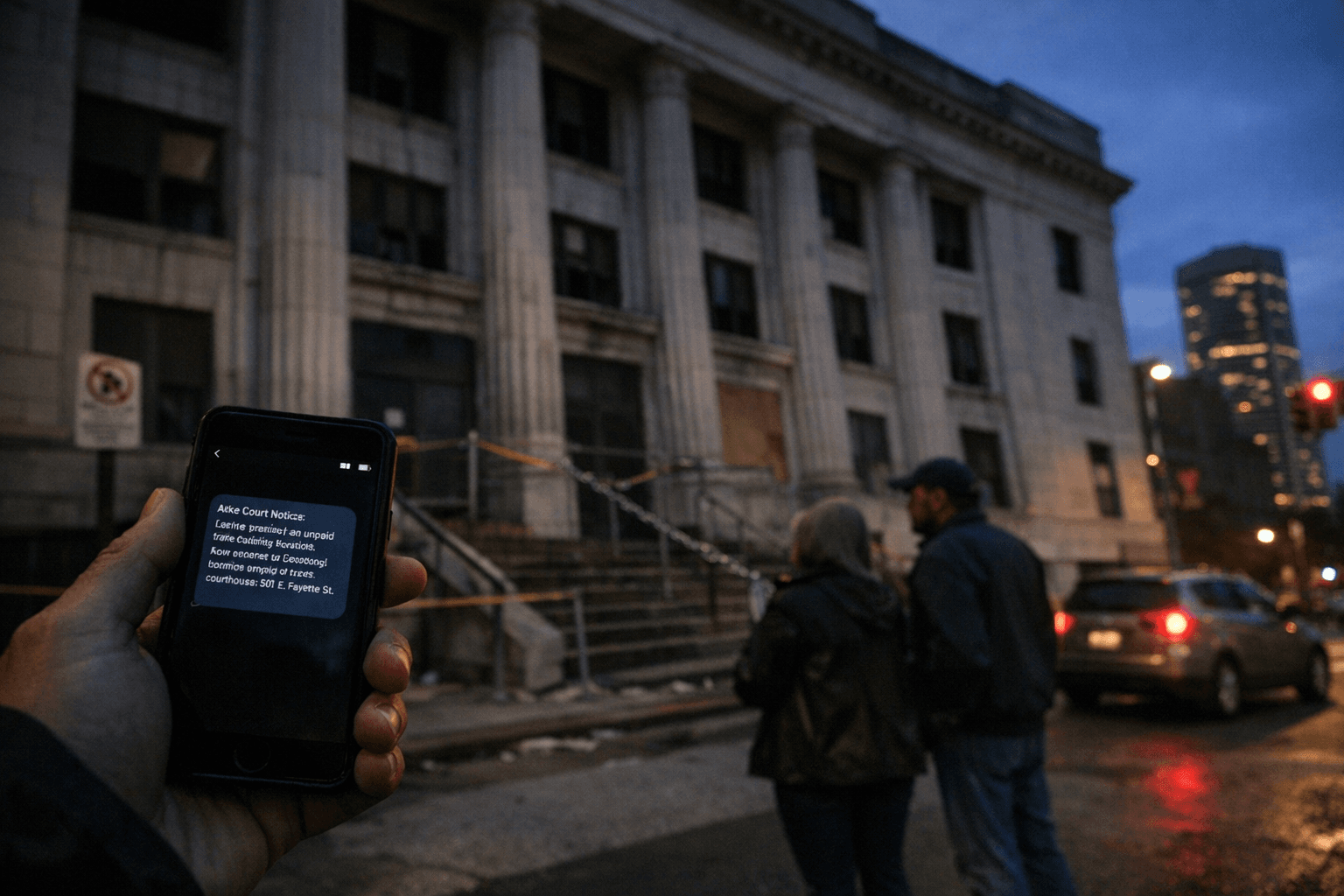
A text message landing on Baltimore phones this week claims recipients must appear before a judge at 9 a.m. today at 501 E. Fayette St. for an unpaid toll violation. The Maryland Judiciary says every word of it is a lie, and the courthouse the scammers named has been closed.
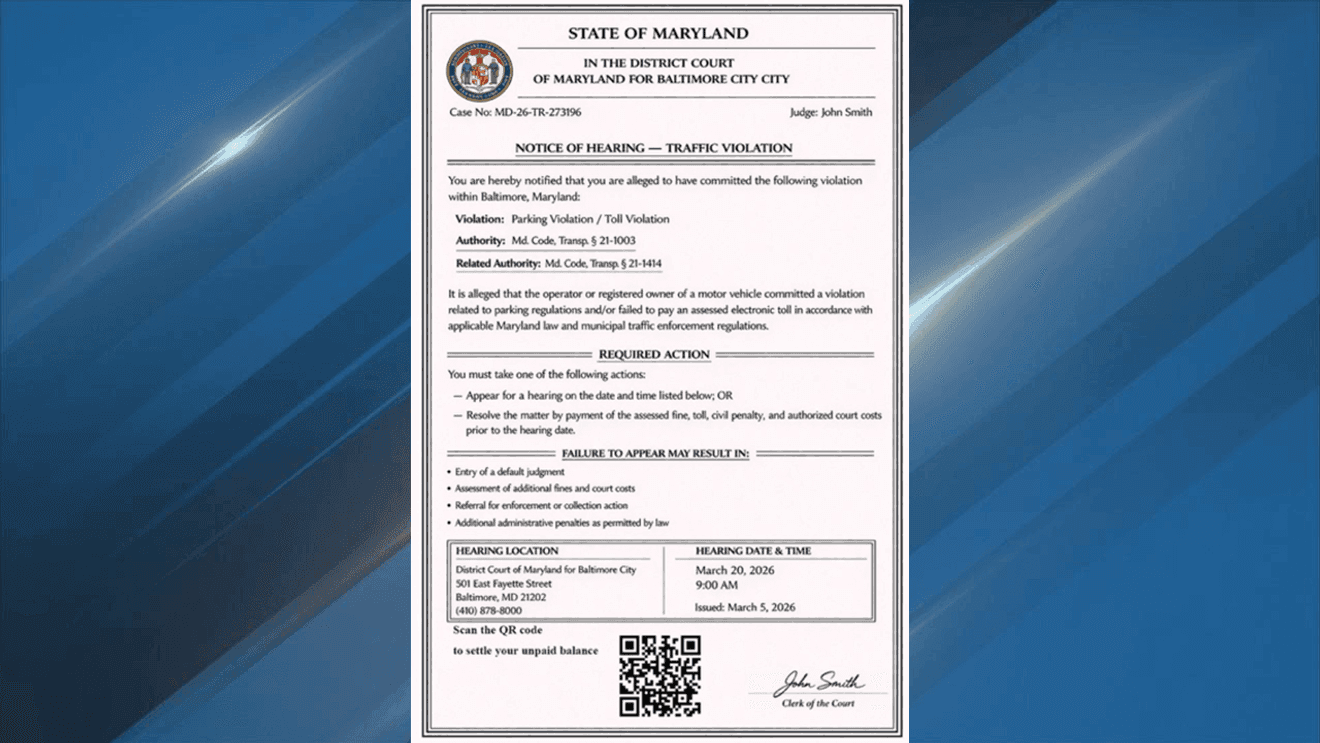
The fraudulent messages identify themselves as either a "Maryland Court Summons" or a "Notice of Hearing – Traffic Violation" and include a fabricated case number, a hearing date and time, and one of several Baltimore City District Court addresses: Wabash, Hargrove, Hubbard, Eastside, or the shuttered Civil Courthouse at 501 East Fayette Street. The text tells recipients that "payment has not been received for a toll violation associated with your vehicle" and instructs them to "resolve the matter by payment of the assessed civil penalty and authorized court costs prior to hearing date," directing them to scan a fictitious QR code to pay. Failure to act, the message threatens, will result in a bench warrant and additional fines.
Fox 45 reported that at least one version of the text invokes the name of a "Judge John Smith" to lend the message an air of legitimacy. Authorities say scammers have circulated variants listing at least two different hearing dates: February 27, 2026 in the official Maryland Judiciary advisory, and March 20, 2026, the date Fox 45 reported from a separate version of the message.
"These texts, or any variations of it, are a scam," the Maryland Judiciary stated in its public advisory, adding a policy clarification that should settle any doubt: Maryland courts do not send texts requesting payment or personal information via text, telephone, or email.
Karen Straughn of the Maryland Attorney General's Office was direct in her assessment. "It is not true. It is not something that people should worry about," she said. But she cautioned that the design of the scam itself is a red flag worth recognizing. "Some of the red flags are that it asks you to do something immediately, gives you very little time to think about it. That's a red flag because what they're trying to do is get you to act quickly without talking to anyone else because they are likely to tell you that this is a scam," Straughn said.
Authorities note the messages can be visually convincing. The scam may use what appears to be an AI-generated court document, complete with a QR code formatted to resemble an official payment portal. Officer Jennifer Peach of the Baltimore County Police Department warned that some fraud schemes in the region have escalated beyond digital payment demands. "The thing that is most unnerving about these cases is that most of the time people want money sent through the mail or sent through the internet. But in these cases, they're actually sending somebody to the victim's house to pick up that cash," Peach said.
Anyone who receives one of these texts should not click any links, scan the QR code, or surrender any personal or financial information. The Office of the Attorney General Consumer Protection Division hotline can be reached at 410-528-8662 or toll-free at 888-743-0023. For questions about a legitimate court matter, the Maryland Judiciary's website lists contact information for every District Court and circuit court in the state under its "Directory of Courts" section.
This article was produced by Prism’s automated news system from verified source data, official records, and press releases, then run through automated quality and moderation checks before publishing. The system is built and supervised by the people who set the standards it runs under. Read our full AI policy.
Did this article answer your question?