Johns Hopkins Receives $245K Grant to Distribute Gun Locks Across Baltimore
Half of gun owners store firearms unlocked. A $245K federal grant now puts free biometric safes and cable locks into Baltimore families' hands at three Hopkins trauma centers.
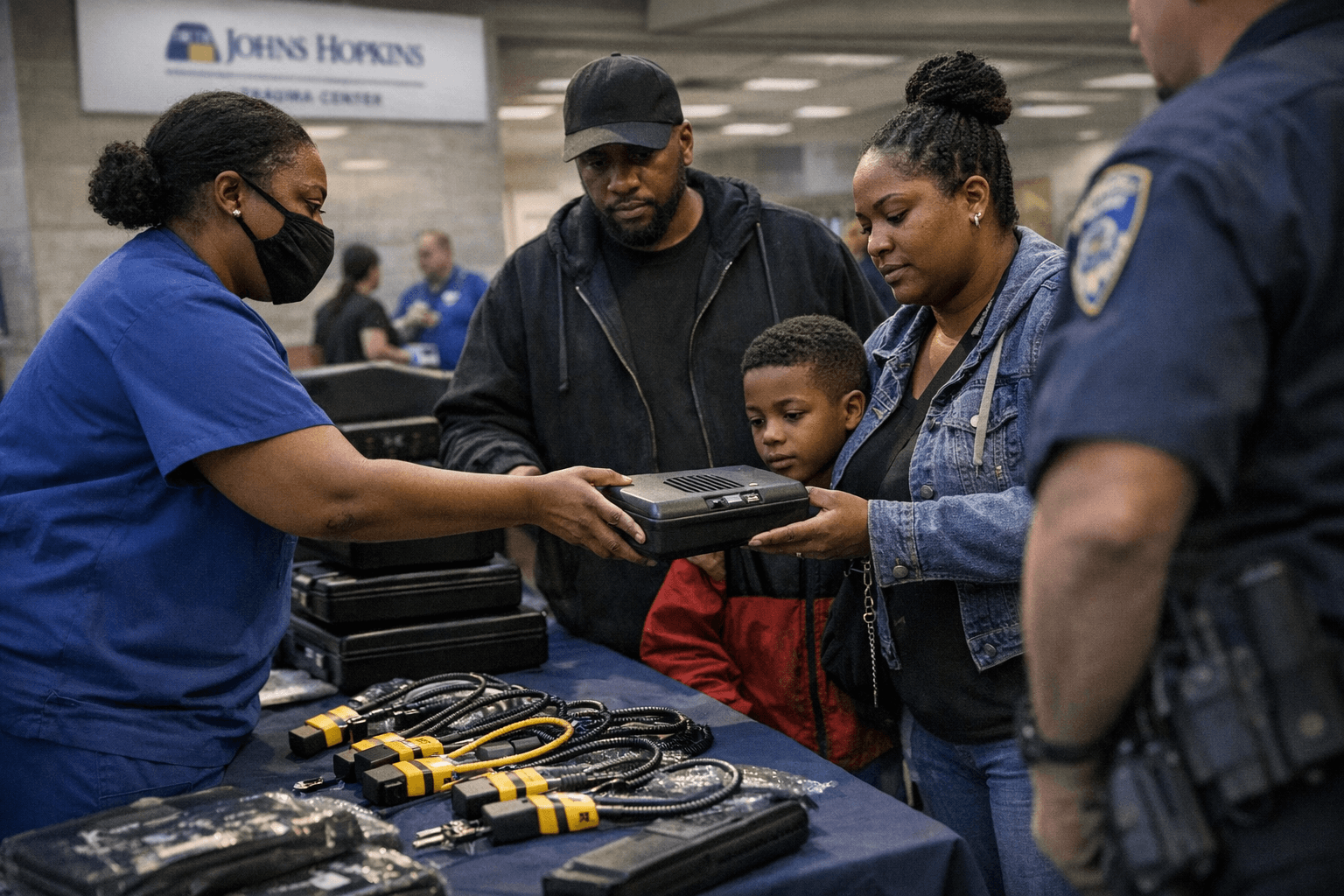
Half of all gun owners store their firearms without any locking device. Kevin Sowers, president of Johns Hopkins Health System, said the consequences of that reality are familiar to anyone who has spent time inside a Baltimore trauma bay. "It's preventable and I think you would all agree it's unacceptable," Sowers said at the March 30 announcement. "And over the last year we've seen a decrease in homicides and we're grateful for that especially here in Baltimore as we've made record progress."
A $245,000 grant from the U.S. Department of Justice, secured by U.S. Rep. Kweisi Mfume as part of his fiscal year 2026 community project requests, will fund the Johns Hopkins Safe Storage Project, placing biometric gun safes, lockboxes, and cable locks directly into the hands of Baltimore families at no cost.
Families visiting Johns Hopkins Hospital, the Johns Hopkins Children's Center, or Hopkins Bayview Medical Center can ask clinical staff about safe storage devices during their visit. Distribution runs through adult and pediatric trauma centers at all three sites, as well as community-based organizations operating across Baltimore City. Hopkins will pair each device with educational outreach on proper use and guidance for talking with children about what to do if they encounter an unsecured firearm.
Katherine Hoops, director of clinical programs and practice at the Center for Gun Violence Solutions at the Johns Hopkins Bloomberg School of Public Health, said the mix of device types is deliberate. "Our research shows firearm owners are more likely to adopt safe and secure storage practices when they can choose from a range of devices that meet their needs, such as biometric safes for quick access or cable locks for hunting rifles," Hoops said.
Biometric safes use a fingerprint scan to allow rapid adult access while blocking a child. Lockboxes can be bolted to furniture. Cable locks thread through a firearm's action and render it inoperable. Any of the three physically prevents an unsupervised child from discharging the weapon.
Mfume framed the stakes in terms of a pattern Hopkins clinicians know well. "What we've seen over and over again is that young people find weapons," he said. "And when they find them, they play with them. And when they play with them, there's usually an incident that takes place." The announcement came weeks after a child in Anne Arundel County brought a firearm to school and shot themselves in the hand, an incident that sharpened statewide pressure for stronger safe storage laws.
Maryland's General Assembly is currently weighing the Ny'Kala Strawder Act, Senate Bill 362, which would raise the maximum penalty for improperly storing a loaded firearm accessible to a minor from a $1,000 fine to up to five years in prison. The bill is named for a 15-year-old Baltimore County girl who was shot by a 9-year-old neighbor playing with an unsecured gun.
Hopkins officials said the project will track outcomes including rates of unsafe storage and repeat firearm injuries among patients served, building a data set intended to support broader hospital-based distribution across Maryland. The state recorded 671 firearm fatalities in 2024, and Baltimore's trauma centers continue to absorb gun injuries as a leading driver of admissions even as citywide shooting rates have declined.
Here is the formatted final output:
SUMMARY: Half of gun owners store firearms unlocked. A $245K federal grant now puts free biometric safes and cable locks into Baltimore families' hands at three Hopkins trauma centers.
CONTENT:
Half of all gun owners store their firearms without any locking device. Kevin Sowers, president of Johns Hopkins Health System, said the consequences of that reality are familiar to anyone who has spent time in a Baltimore trauma bay. "It's preventable and I think you would all agree it's unacceptable," Sowers said at the March 30 announcement. "And over the last year we've seen a decrease in homicides and we're grateful for that especially here in Baltimore as we've made record progress."
A $245,000 grant from the U.S. Department of Justice, secured by U.S. Rep. Kweisi Mfume as part of his fiscal year 2026 community project requests, will fund the Johns Hopkins Safe Storage Project, placing biometric gun safes, lockboxes, and cable locks directly into Baltimore families' hands at no cost.
Families visiting Johns Hopkins Hospital, the Johns Hopkins Children's Center, or Hopkins Bayview Medical Center can ask clinical staff about safe storage devices during their visit. Distribution runs through adult and pediatric trauma centers at all three sites, as well as community-based organizations across Baltimore City. Hopkins will pair each device with educational outreach on proper use and guidance for talking with children about what to do if they encounter an unsecured firearm.
Katherine Hoops, director of clinical programs and practice at the Center for Gun Violence Solutions at the Johns Hopkins Bloomberg School of Public Health, said the range of device types is deliberate. "Our research shows firearm owners are more likely to adopt safe and secure storage practices when they can choose from a range of devices that meet their needs, such as biometric safes for quick access or cable locks for hunting rifles," Hoops said.
Biometric safes use a fingerprint scan to allow rapid adult access while blocking a child. Lockboxes can be bolted to furniture. Cable locks thread through a firearm's action and render it inoperable. Any of the three physically prevents an unsupervised child from discharging the weapon.
Mfume framed the stakes in terms of a pattern Hopkins clinicians know well. "What we've seen over and over again is that young people find weapons," he said. "And when they find them, they play with them. And when they play with them, there's usually an incident that takes place." The announcement came weeks after a child in Anne Arundel County brought a firearm to school and shot themselves in the hand, sharpening statewide pressure for stricter storage laws.
Maryland's General Assembly is weighing the Ny'Kala Strawder Act, Senate Bill 362, which would raise the maximum penalty for improperly storing a loaded firearm accessible to a minor from a $1,000 fine to up to five years in prison. The bill is named for a 15-year-old Baltimore County girl shot by a 9-year-old neighbor who had been playing with an unsecured gun.
Hopkins officials said the project will track outcomes including rates of unsafe storage and repeat firearm injuries among patients served, building a dataset intended to support broader hospital-based distribution statewide. Maryland recorded 671 firearm fatalities in 2024, and Baltimore's trauma centers continue to absorb gun injuries as a leading driver of admissions even as citywide shooting rates have declined.
This article was produced by Prism’s automated news system from verified source data, official records, and press releases, then run through automated quality and moderation checks before publishing. The system is built and supervised by the people who set the standards it runs under. Read our full AI policy.
Did this article answer your question?