Judge Finds BPD Fully Compliant With Consent Decree Technology, Recruitment and Retention
Baltimore Police Department found compliant in technology and recruitment, advancing consent decree progress but staffing shortfall remains the main barrier to exiting oversight.

The Consent Decree Monitoring Team and a federal judge found the Baltimore Police Department in full and effective compliance with the Technology and Recruitment and Retention sections of the federal consent decree, a milestone announced at the Consent Decree Quarterly Public Hearing on January 29, 2026. The original press release said the department achieved "full and effective compliance with all 12 paragraphs of the Technology," while the judge separately concluded the city's body-worn camera program meets the consent decree's standards.
The hearing marked the latest step in a multiyear reform process that began after Freddie Gray's in-custody death in 2015 and the Department of Justice assessment the following year. The city entered into the consent decree with the Justice Department in 2017. City leaders and the department highlighted the finding as confirmation of progress toward modernization that officials say has moved the agency beyond paper-based systems into a more data-driven era.
Baltimore Police Commissioner Richard Worley framed the decision as part of a broader transformation. "We continue to make meaningful progress toward fulfilling the consent decree, and this marks another important step toward full compliance," Worley said. "I want to thank our technology and recruitment teams and everyone who has worked tirelessly to get us here. We remain committed to these reforms as we transform into a world-class police department, serving our city with honor and distinction."
Mayor Brandon Scott underscored the role of modernization and hiring in community safety. "Modernizing the Department and strengthening recruitment and retention have been priorities since well before I took office," Scott said, noting that improved relations with residents have helped recruitment efforts.
The department reported it has grown by 81 sworn officers in the past year but remains short more than 400 officers. The federal judge at the hearing identified that staffing shortfall as the biggest impediment to exiting federal oversight. City officials also reported that 82 percent of consent decree requirements are either in compliance or on track, and multiple sources list seven areas now fully and effectively compliant, including Technology; Recruitment and Retention; Transportation of Persons in Custody; Health and Wellness; Community Oversight Task Force; First Amendment; and Coordination with School Police.
Transparency measures adopted in recent years were cited as part of the reform apparatus; the city launched a consent decree dashboard in 2024 to track implementation metrics. Public reaction included social posts noting the compliance finding and touting careers at BPD, while the department's feed reiterated the two sections' compliance.
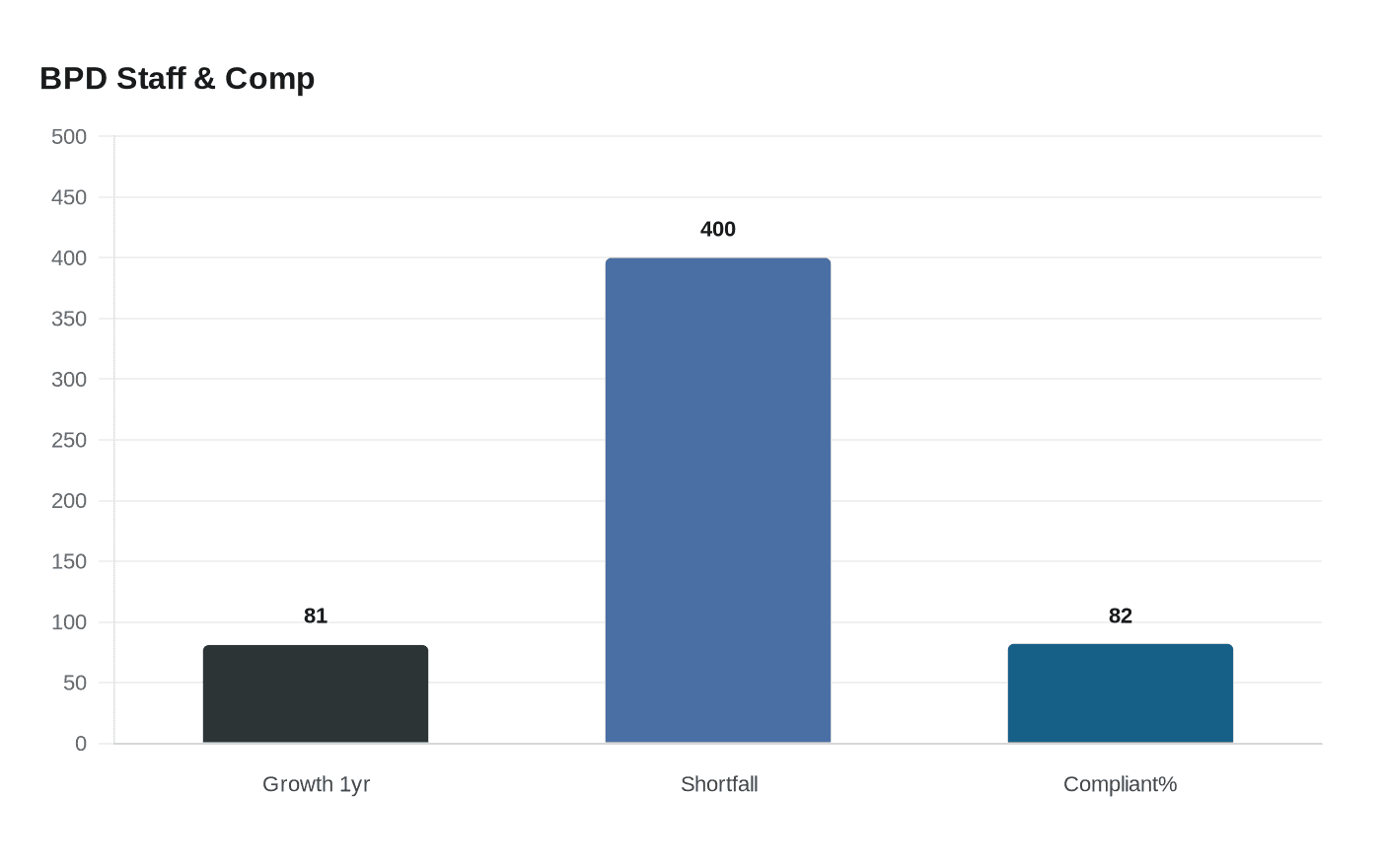
Significant gaps remain. The more-than-400 officer deficit and ongoing monitoring mean federal oversight will continue until staffing and remaining mandates reach the required thresholds. The judge's endorsement of body-worn camera compliance narrows the focus to personnel and sustained implementation.
For Baltimore residents, the ruling signals institutional change in specific compliance areas but not an immediate end to federal oversight. Watch staffing numbers, the consent decree dashboard metrics, and follow-up reports from the Consent Decree Monitoring Team and the judge for how and when the city may petition to exit oversight.
This article was produced by Prism’s automated news system from verified source data, official records, and press releases, then run through automated quality and moderation checks before publishing. The system is built and supervised by the people who set the standards it runs under. Read our full AI policy.
Did this article answer your question?