Maryland Leaders Unveil Utility RELIEF Act to Lower Energy Bills Statewide
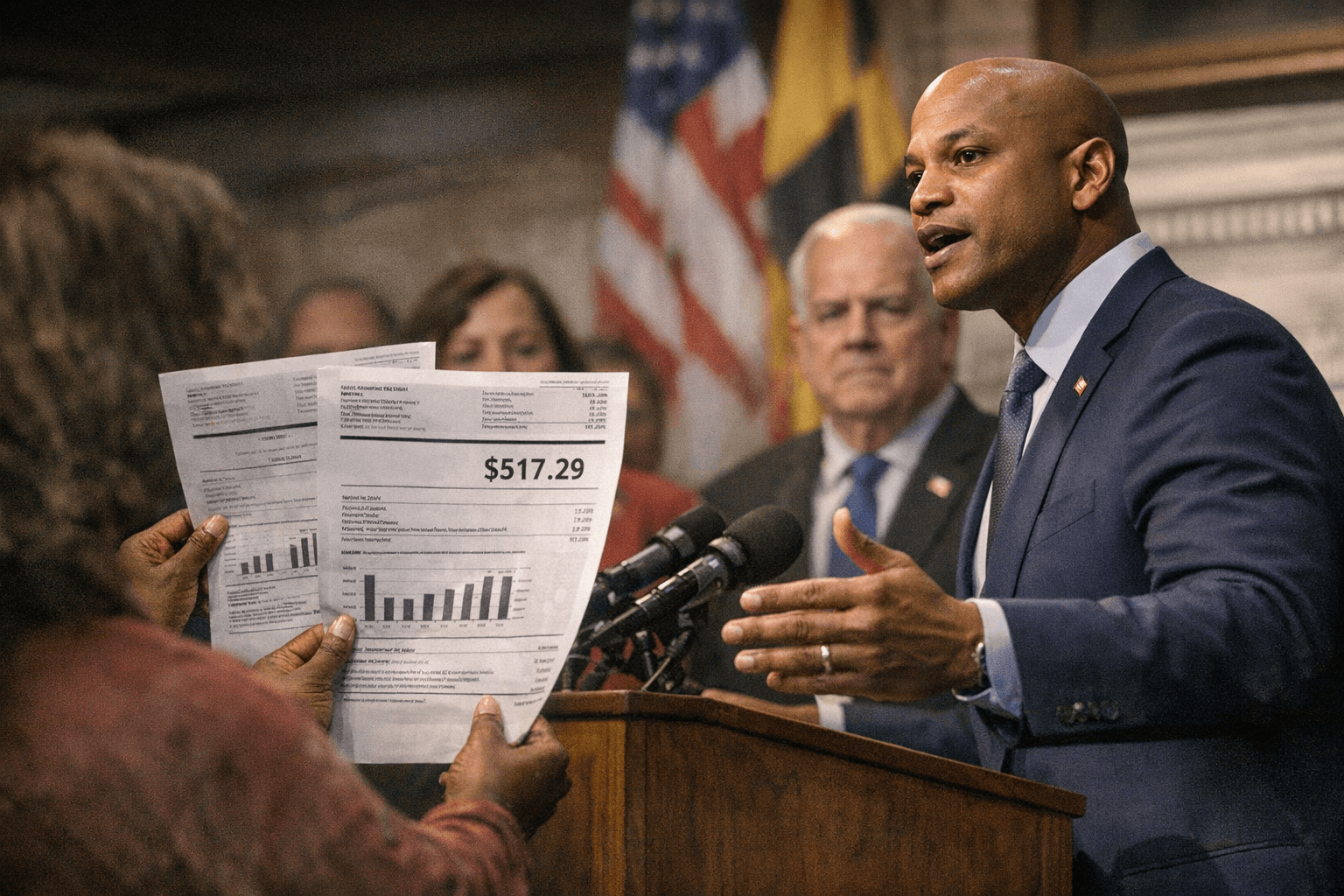
Gov. Wes Moore cited his mother's bill jumping from $142 to $517 as he unveiled a $200M energy relief package promising families $150 in annual savings.

Governor Wes Moore made it personal at the Annapolis announcement of Maryland's sweeping new energy legislation, describing how his own mother watched her monthly utility bill climb from $142.82 last March to $517 in January and $409 in February. "She cannot understand what is going on," Moore said. Neither, the governor argued, should Marylanders be forced to accept it.
Moore, joined by Senate President Bill Ferguson and House Speaker Joseline Peña-Melnyk, unveiled the Utility RELIEF Act on March 13, a legislative package whose acronym spells out the administration's stated mission: Reducing Energy Load Inflation for Everyday Families. Leaders claim the package will save Maryland households at least $150 annually on energy bills while directing more than $200 million from the Strategic Energy Investment Fund toward grid modernization, local clean energy production, and direct ratepayer relief.
The $200 million breaks into two explicit allocations. One hundred million dollars would go toward refunding ratepayers and offsetting utility fees, providing direct reductions on monthly bills. The remaining $100 million would fund a new annual competitive bidding process for renewable energy projects, administered jointly by the Maryland Energy Administration and the Public Service Commission. The legislation also incorporates grid modernization measures aimed at improving the capacity and efficiency of existing power lines, and introduces accountability requirements targeting major energy users, including data centers.
"The Utility RELIEF Act is how we make the system work better for the people, our people, and not the powerful interests that it has worked for for decades," Moore said.
Ferguson, a Democrat representing District 46, framed the package in economic terms. "Maryland families and small-business owners need to have a reduced energy bill. Fundamentally, this legislative package being announced today is about maximizing savings for working families among historic increases in energy consumption and a tightening energy generation market," he said.
Peña-Melnyk, who represents District 21, was direct about the floor on promised savings. "Every one of us has been hit by high energy prices sweeping over our communities. We know well the feeling of panic that sets in before opening that utility bill," she said. "We took action. Our Utility RELIEF Act provides Maryland ratepayers at least $150 in annual savings, and I'm saying 'at least.'" In a written statement, she added that the bill addresses affordability, accountability, and opportunity, and will "make life more affordable for all Marylanders."
The package draws from Moore's earlier proposed Lower Bills and Local Energy Act and incorporates priorities negotiated between the House and Senate, positioning it as a unified product of the Moore-Miller Administration and the General Assembly rather than a purely executive initiative.
Republican reaction was skeptical but partial. Legislative leaders identified as Buckel and Pippy acknowledged that portions of the bill address longstanding GOP concerns about surcharges, artificial taxes, and added fees appearing on monthly energy bills. But they stopped well short of endorsing it. "Fundamentally, this bill is too little, but hopefully it is not too late," the two said, warning that the package does not adequately address short-term affordability or the long-term supply-and-demand pressures they argue threaten Maryland's grid reliability, energy costs, and ability to grow its technology sector.
The Utility RELIEF Act now heads to the Maryland General Assembly for debate. Key details, including the mechanics of how ratepayer refunds will be distributed, eligibility criteria, and the specific rules governing the renewable energy bidding process, have not yet been made public. The $150 annual savings figure is presented as the administration's estimate; no independent methodology has been released. The announcement comes days after BGE declined to appear before a Baltimore City Council hearing on rising utility bills, a no-show that drew sharp criticism from council members who called it political theater.
This article was produced by Prism’s automated news system from verified source data, official records, and press releases, then run through automated quality and moderation checks before publishing. The system is built and supervised by the people who set the standards it runs under. Read our full AI policy.
Did this article answer your question?