Maryland school rankings fall despite years of higher funding
Maryland’s education rank fell from 13th to 20th as K-12 funding climbed 48%, while Baltimore City schools still saw more 3-, 4- and 5-star ratings.
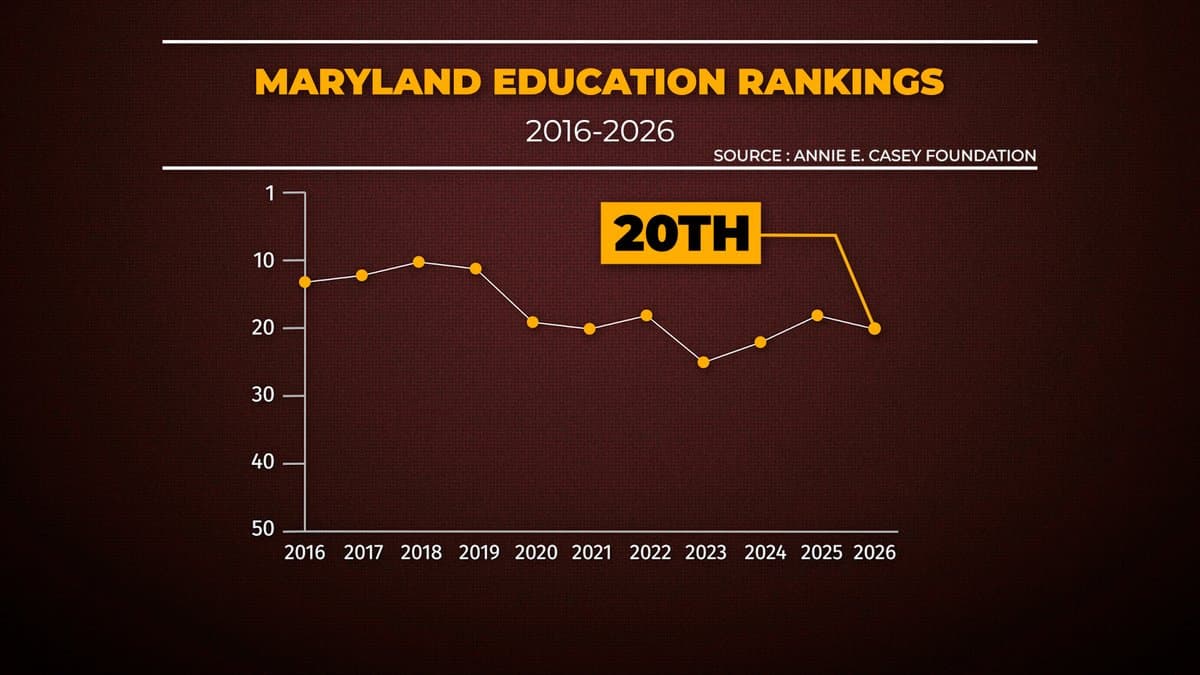
Maryland slipped back to 20th in education in the Annie E. Casey Foundation’s 2026 KIDS COUNT Data Book, even after years of higher school spending and a major reform law meant to push more money into classrooms. The state had ranked 13th in 2016, fell to 20th by 2021, improved to 18th in 2025, then dropped again this year.
The foundation’s ranking is built on preschool attendance, public school reading and math proficiency, and high school graduation rates, which means the slide reflects more than one weak spot. Maryland lawmakers passed the Blueprint for Maryland’s Future in 2021, and the Maryland State Department of Education says the law is designed to transform public education and increase state education funding by $3.8 billion a year for 10 years.

The money has gone up. Project Baltimore reported that Maryland education funding rose 48% from $7.7 billion in 2017 to $11.4 billion in 2024. But the ranking has not followed the spending. The latest statewide numbers show a disconnect that has become especially visible in Baltimore City, where families have been waiting for better results to match the larger checks flowing from Annapolis.

Baltimore City Public Schools has posted some gains on the state report card. The district said in December 2024 that a larger share of its schools earned 3-, 4- or 5-star ratings and that it had its fewest schools in the lowest category. By November 2025, the district said the share of schools earning 3, 4 or 5 stars had reached its highest level since the Maryland report card began in 2018, after the state’s ESSA plan was approved earlier that year.
Even so, the money flowing into Baltimore has not matched the statewide surge. A 2024 analysis found state per-pupil funding for Baltimore City Public Schools rose 34.6% between fiscal 2019 and fiscal 2024, a smaller increase than in many other Maryland districts. That gap matters in a city where state support is supposed to help offset deep poverty, concentrated need and persistent academic shortfalls, yet the measures used to judge school performance still leave Maryland ranked near the bottom of its recent history.
This article was produced by Prism’s automated news system from verified source data, official records, and press releases, then run through automated quality and moderation checks before publishing. The system is built and supervised by the people who set the standards it runs under. Read our full AI policy.
Did this article answer your question?