Removed Confederate statues return to Baltimore, reigniting debate
Four monuments removed in 2017 are coming back from Los Angeles, and Baltimore once again has to decide where, if anywhere, they belong.

Four monuments Baltimore removed in 2017 are coming back to the city after months on display in Los Angeles, reopening a fight over who controls the story those statues tell and where they should end up.
The monuments were taken down overnight on Aug. 16, 2017, after the violent Unite the Right rally in Charlottesville, Virginia. City officials said at the time that the removals were needed to protect public safety. The set included the Confederate Soldiers and Sailors Monument, the Confederate Women’s Monument, the Lee and Jackson Monument and the Roger B. Taney Monument.
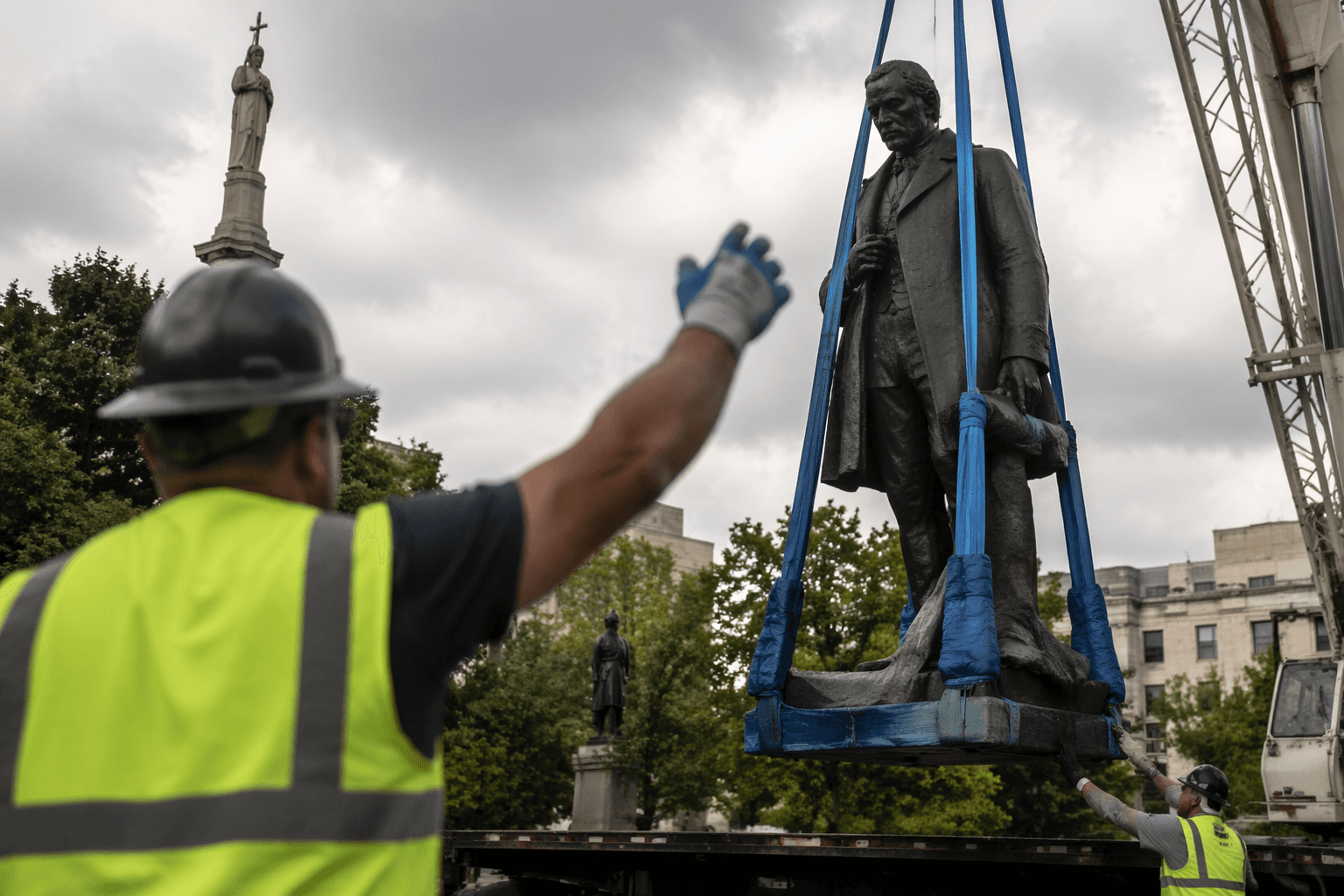
The statues had spent years in a city-owned impound lot off Pulaski Highway, hidden behind fencing and barriers, before Baltimore loaned them for exhibition. They went on view at The Geffen Contemporary at MOCA in Los Angeles, where the show opened Oct. 23, 2025. The museum described the decommissioned monuments as showing the evolution of Confederate memorialization and its link to white supremacist ideology.
Baltimore’s current dilemma is less about whether the monuments belong in storage than about what happens when they re-enter civic circulation. City leaders told WBAL they are staying informed while agencies identify next steps for the statues’ return, a sign that the question is now as administrative as it is political. Any decision will have to settle custody, display and the public meaning of the works before they are placed anywhere in the city again.
The monuments were first pushed into the public agenda on June 30, 2015, when then-Mayor Stephanie Rawlings-Blake announced a special commission to review Baltimore’s Confederate statues and historical assets. Baltimore Heritage has described the monuments as part of a broader local memory campaign, and the city’s removal of them followed years of pressure over their presence in prominent public spaces.
Those locations included Wyman Park, Charles Street and University Parkway, Mount Vernon Place and Bolton Hill, where the monuments had long stood as some of the city’s most visible symbols of a past tied to slavery and segregation. Residents reacting to the return told WBAL the statues evoke slavery and ongoing oppression, underscoring how sharply the issue still divides Baltimore.
For Baltimore, the return is not simply a matter of storing four heavy objects again. It forces a new decision about interpretation, public space and the authority to decide what the city is willing to display in its own neighborhoods.
This article was produced by Prism’s automated news system from verified source data, official records, and press releases, then run through automated quality and moderation checks before publishing. The system is built and supervised by the people who set the standards it runs under. Read our full AI policy.
Did this article answer your question?