Residents Press Baltimore Leaders on Budget Priorities, Safety and Vacant Homes
Cherry Hill residents pushed Baltimore to spend on safer streets, vacant-home cleanup and fresh food access as Mayor Brandon Scott defended a budget built around a $12 million gap.
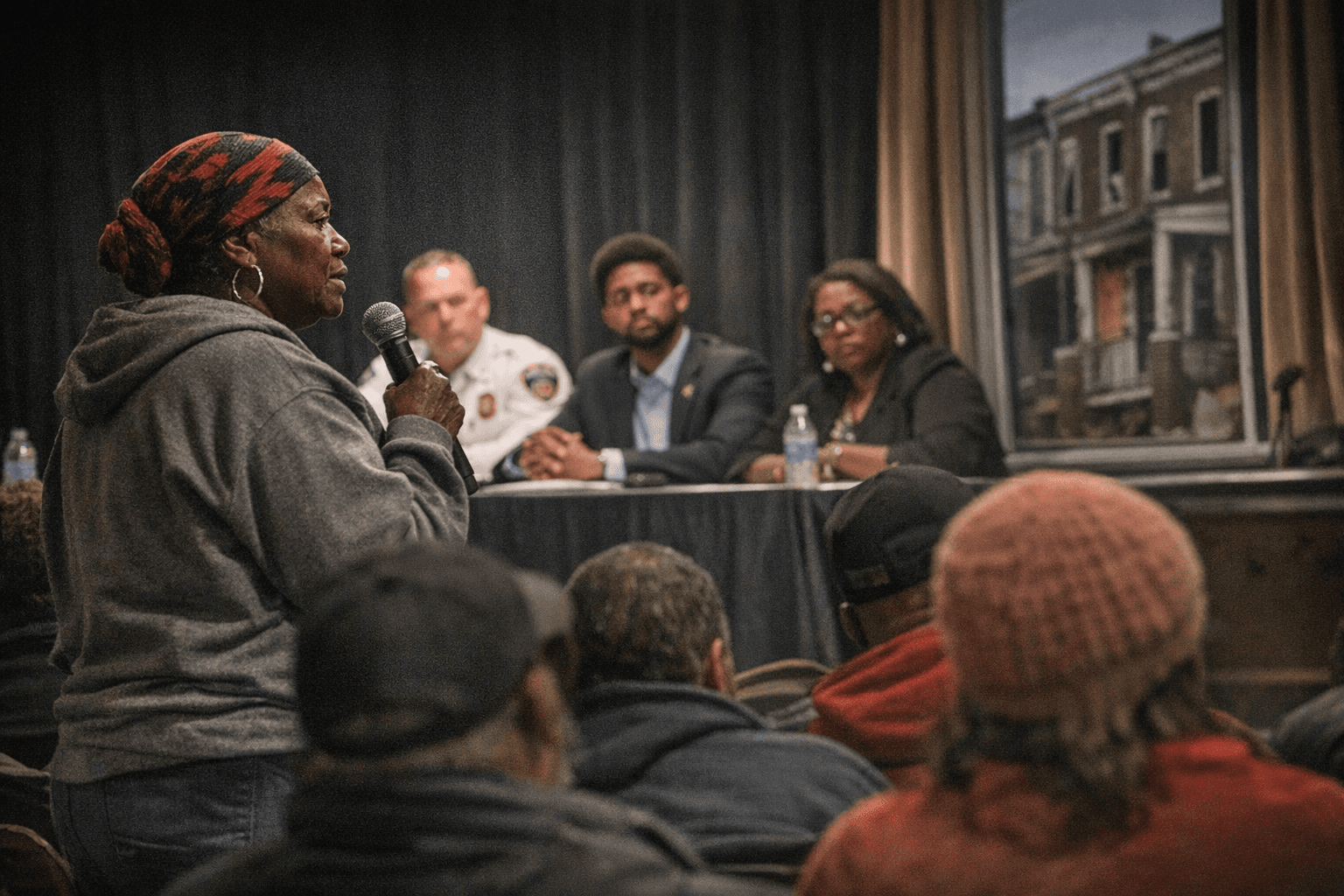
At Cherry Hill’s Middle Branch Fitness and Wellness Center, Baltimore residents pressed city leaders to treat safety, vacant houses and grocery access as the budget issues that shape daily life. The forum, held Wednesday evening at 2001 Reedbird Avenue, turned the city’s FY27 spending debate into a neighborhood conversation about what a family can actually feel on its block.
One resident described the fear of living near a police station and still not feeling safe. Another spoke about a cousin who had recently been found in a vacant home, a reminder that Baltimore’s housing crisis and public safety problems are often the same problem on different corners. A Cherry Hill resident said a fitness center alone does not solve a neighborhood’s needs if families cannot reliably get fresh food, especially when many people do not drive.
Those demands line up with the city’s biggest spending pressures. Mayor Brandon Scott said the preliminary FY27 budget, released April 1, closed a $12 million funding gap and was built around six priorities: youth, older adults and vulnerable communities; public safety; clean, healthy and sustainable communities; equitable economic development; responsible stewardship of city resources; and modernizing public infrastructure. He told residents he wanted as much public input as possible before final decisions are made.
The stakes are familiar in Baltimore, where last year’s $4.6 billion budget closed an $85 million gap and moved through City Council on a 13-2 vote before Scott signed it June 23, 2025. That budget put $1.2 billion into public safety, $634.4 million into youth programs, $1.1 billion into clean and healthy neighborhoods and $349.6 million into equitable neighborhood development. It also avoided layoffs, broad-based tax increases and major service disruptions, a reminder that every new request must compete with limited room.
The budget calendar now puts residents in one of the few stages where they can still shape the outcome. After the Board of Estimates presents the Ordinance of Estimates to City Council, lawmakers have at least 40 days to act and must adopt the budget at least five days before July 1, when the new fiscal year begins. The city also plans another public meeting, a Cabinet in Community walking budget discussion at Druid Hill Park on April 20.
For Cherry Hill and other neighborhoods wrestling with vacant rowhouses, uneven services and weak food access, the debate is not abstract. The Middle Branch center itself is a roughly $23 million, 35,000-square-foot investment, but residents made clear that a building does not feed a block, secure a street or fix a vacant house. What Scott and the council choose next will show whether Baltimore’s budget follows the needs people named in the room or the limits on City Hall’s ledger.
This article was produced by Prism’s automated news system from verified source data, official records, and press releases, then run through automated quality and moderation checks before publishing. The system is built and supervised by the people who set the standards it runs under. Read our full AI policy.
Did this article answer your question?