Salisbury Works to Clear Trash, Medical Waste From Polluted Wicomico River
Syringes, dead birds, and medical waste choke Salisbury's Wicomico River during a downtown redevelopment push — a pattern Baltimore's Jones Falls can't ignore.
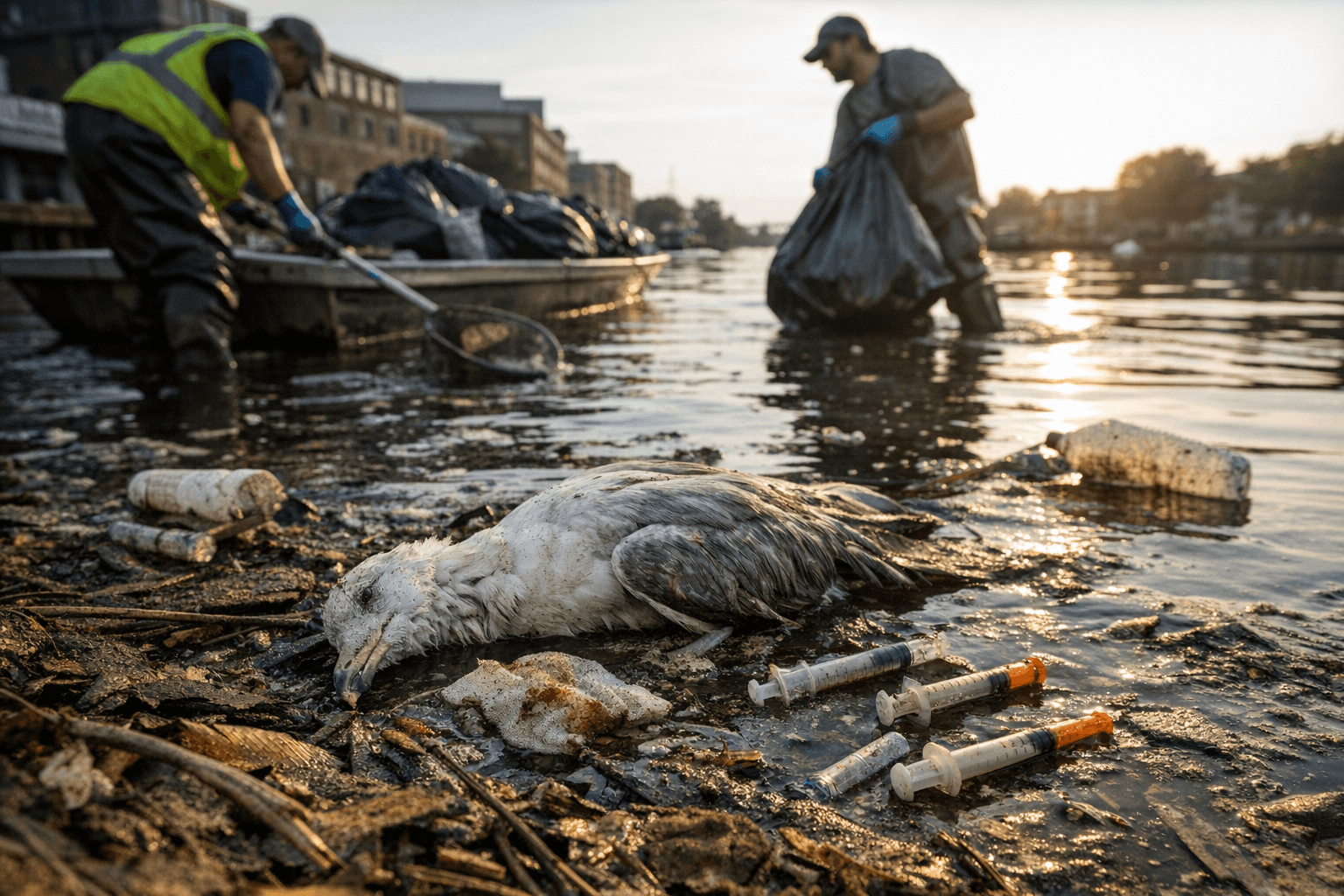
Bruce Wootten has guided bass fishing tours on the Wicomico River for more than three decades. What he finds beneath downtown Salisbury's bridges reads like a hazmat manifest.
"It's got medical waste, tampons, dead birds, syringes — everything floating in the water," Wootten said. "The river has been abused to death."
The roughly 25-mile Wicomico River on Maryland's Eastern Shore flows through Salisbury's downtown, which has become a magnet for pollution even as the city pursues new development along its banks. Wootten pointed to discharge from the Salisbury Wastewater Treatment Plant that opened in 2018, along with possible waste from local health centers and trash from a downtown homeless population as the primary drivers. City and county officials have described what it will take to fix it as a "Herculean" challenge.
Salisbury has responded with a layered approach. City officials say they are aware of the issue and are working to address it, not just by removing trash, but by targeting its source; most of the debris, they say, begins as litter far from the riverbank before stormwater drains carry it in. The city deployed a trash skimmer boat to pull debris off the surface and, installed mesh trash nets on municipal stormwater outfall pipes. Made from durable mesh designed to withstand variable flow and seasonal conditions, the nets trap floatable litter such as plastic bottles, food wrappers, Styrofoam, and organic debris while allowing water to pass through. A debris-catching net went in at the Riverwalk footbridge in June 2025. "This will not be the last step in taking control of trash in the storm drains running into the river," Mayor Randy Taylor said at the time.
Beneath the surface, the data is more encouraging. Jennifer Nyland, a board member of the Wicomico Environmental Trust and an associate professor of biological sciences at Salisbury University, said the Trust tests 26 sites on the river to measure salinity, water temperature, chlorophyll levels and blue-green algae, along with nutrient and bacteria levels. "The health of the water is actually good, and it's moving in the right direction," Nyland said. She added a critical caveat: "There have been reports of releases or of documented measurable amounts of things like Trichloroethylene and PFAS in our water — and we're not testing for those things."
The Salisbury pattern, a redeveloping urban river swamped by stormwater-borne trash and medical waste while subsurface data lags behind, runs parallel to what Baltimore's Jones Falls, Gwynns Falls, and Inner Harbor face right now. A broken manhole sent an estimated 1.7 million gallons of sewage into the Jones Falls in December 2025, requiring emergency cleanup by the Baltimore City Department of Public Works. City plans to relocate a trash and recycling facility next to the Jones Falls, reported in November 2025, drew warnings from advocates who have spent decades restoring what they call Baltimore's founding river. Baltimore's trash interceptor vessels — Mr. Trash Wheel at the Inner Harbor, Professor Trash Wheel in Canton, and Captain Trash Wheel at Masonville Cove — remove debris from city waterways before it reaches the Patapsco, with a fourth interceptor planned at the mouth of the Gwynns Falls. Blue Water Baltimore tracks water quality across all four major city watersheds, issuing annual report cards that can identify contamination trends before they calcify into crisis.
Salisbury's experience makes the core lesson plain: surface removal without stormwater source control is a cycle with no exit.
Baltimore residents can intervene at each pressure point. Illegal dumping near any waterway can be reported through the city's 311 system, available by phone or at balt311.baltimorecity.gov. The Baltimore City Health Department's harm reduction services include syringe disposal at no cost; current locations are listed through BCHD's website at health.baltimorecity.gov. The Jones Falls trash facility proposal is the most consequential pending decision: district City Council offices can connect residents to the comment process before a final site determination is made. Every redevelopment proposal in the Jones Falls corridor, the Middle Branch, and along the Inner Harbor should face an explicit stormwater debris and medical waste assessment from the outset. The Wicomico River shows what the bill looks like when that review comes after the fact.
This article was produced by Prism’s automated news system from verified source data, official records, and press releases, then run through automated quality and moderation checks before publishing. The system is built and supervised by the people who set the standards it runs under. Read our full AI policy.
Did this article answer your question?