State Cites Baltimore City After Lead, PCB Paint Chips Contaminate Jones Falls
MDE ordered Baltimore City to remove tens of thousands of orange and white paint chips from Falls Road, Jones Falls and the Jones Falls Trail after tests found high lead and PCBs.
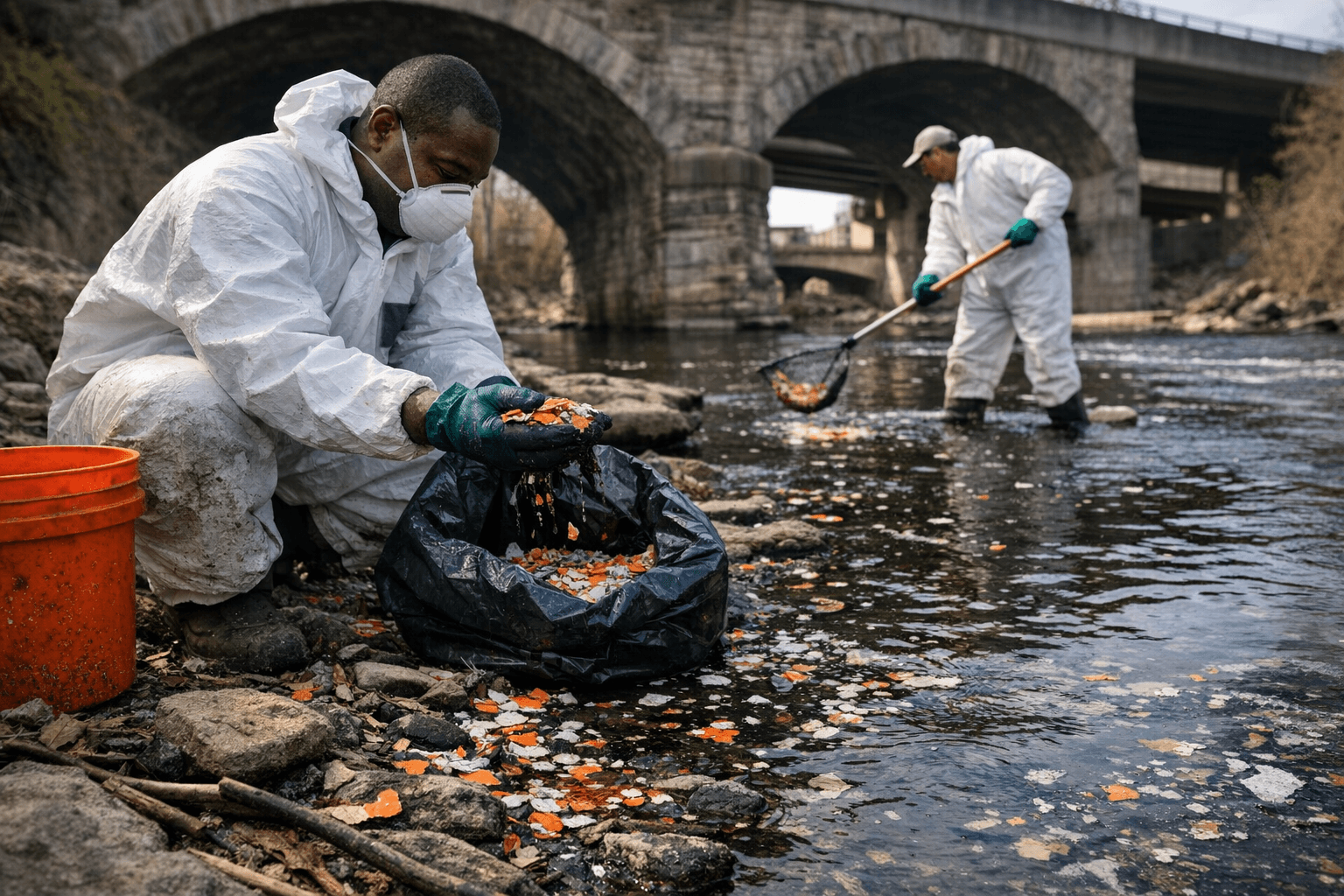
Maryland Department of the Environment investigators documented tens of thousands of orange and white paint chips littering Falls Road, the Jones Falls stream and the Jones Falls Trail beneath the West 28th Street (JFX) overpass and have ordered Baltimore City to remove the debris as hazardous waste. MDE’s laboratory analysis found lead concentrations “far above the safety standard” and detected polychlorinated biphenyls in some samples, prompting a formal violation under Maryland Environment Article Title 9 and a warning of potential penalties of “thousands of dollars” for each day the violation continues.
MDE field teams spent nearly an hour under the West 28th Street overpass on Feb. 6 documenting the flakes and collecting multiple samples, the agency reports. Photographs show bright orange paint chips on the ground by the edge of the snow, along a property fence on Falls Road, peeling from the underside of the overpass facing southwest and settling in the Jones Falls stream below; the West 28th Street bridge originally opened in 1961.
Independent testing commissioned by Blue Water Baltimore produced numeric results that underscore the state’s findings. Blue Water Baltimore’s samples, reported by Baltimore Brew, registered 26,500 mg/kg lead and 1,650 µg/kg PCBs. MDE’s own public description characterized its laboratory results as lead levels far above safety thresholds and confirmed the presence of PCBs, though MDE’s public summaries did not include numeric values in the documents released so far.
The state’s violation directs Baltimore City to remove paint chips from the ground and the Jones Falls, manage the removed material as hazardous waste, and address loose paint on the bridge while using environmental protection measures to prevent further contamination. MDE spokesperson Jay Apperson wrote by email, “We will follow up to ensure that the environment and public health are protected.” The notice cites Maryland Environment Article Title 9 as the legal basis for enforcement.
Baltimore officials have signaled they will engage with state regulators as the enforcement process moves forward. Reporting indicates city officials “say they plan to follow up,” while advocates and local monitors had earlier flagged the problem to state investigators. One practitioner quoted in coverage, identified only as Volpitta, said, “Volpitta said she is still looking forward to insights from experts on the precise environmental and human health risks of the paint flakes.”
Health-risk context cited by regulators and environmental groups points to established hazards: EPA guidance notes that lead is toxic at low levels and can impair learning and development in children, and EPA further warns that PCBs are long-lasting chemicals associated with endocrine, immune, neurological and reproductive harms. Because both lead and PCBs were found in the same paint chips, state and nonprofit accounts say cleanup and disposal will be more complicated than sweeping the trail and likely require hazardous-waste protocols.
The West 28th Street findings come amid a national context in which lead paint on older steel structures remains an unresolved legacy: MassDOT notes that lead-based paint for most steel structures in the U.S. ended in 1992, and the CDC has estimated roughly 90,000 U.S. bridges are coated with lead-based paints. Blue Water Baltimore is also testing flakes from the Orleans Street bridge over Guilford Avenue as Baltimore and state agencies sort out enforcement, technical cleanup plans and timelines. MDE’s violation starts a formal enforcement clock; unless Baltimore City quickly removes and properly disposes of the contaminated paint chips, the agency has warned of daily penalties.
This article was produced by Prism’s automated news system from verified source data, official records, and press releases, then run through automated quality and moderation checks before publishing. The system is built and supervised by the people who set the standards it runs under. Read our full AI policy.
Did this article answer your question?