Study says grade inflation could cost Maryland students tens of thousands
A Maryland-linked study says grade inflation can trim student lifetime earnings by $213,872, a warning that hits Baltimore families already wary of grade changes.
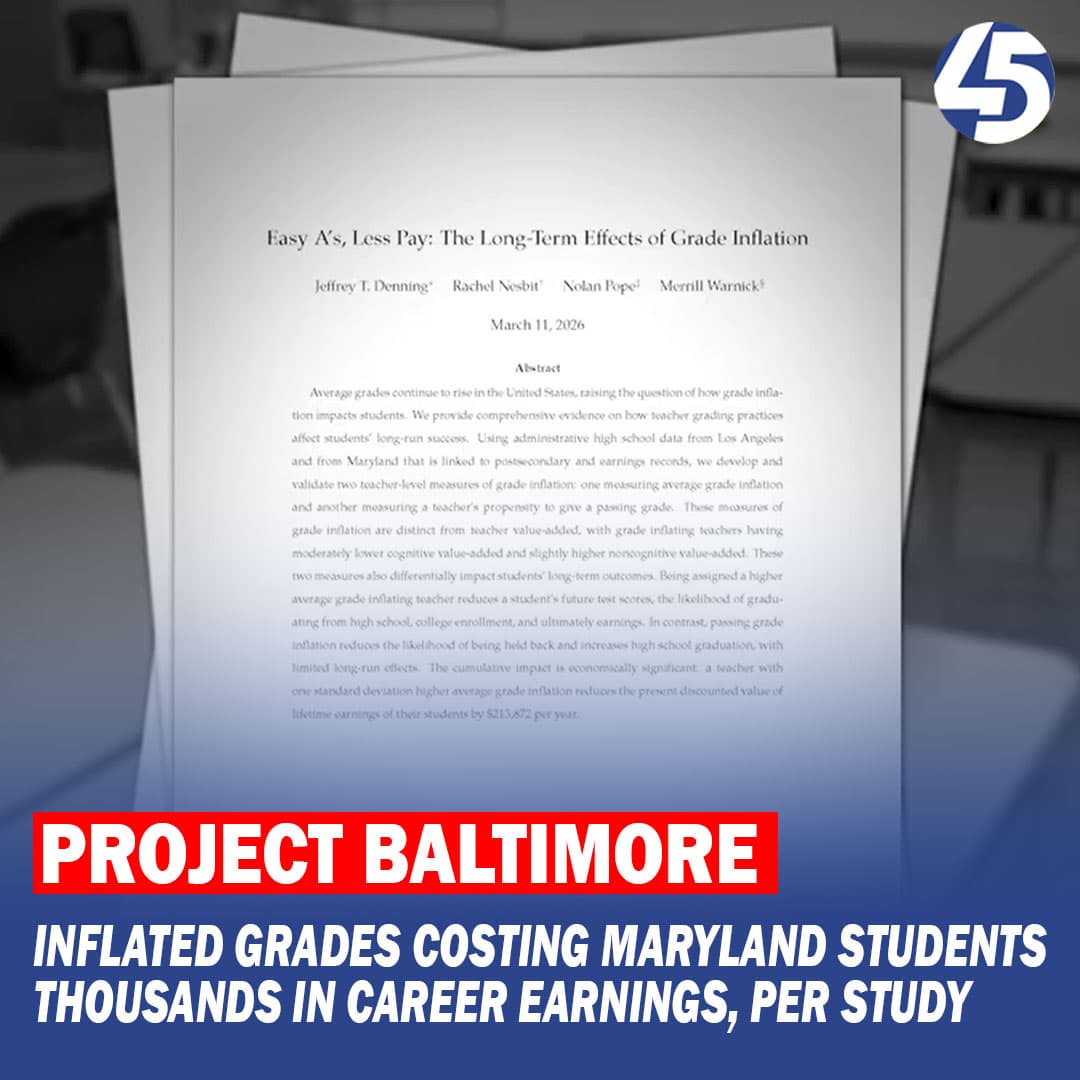
A University of Maryland co-authored study says inflated grading can follow students long after prom and graduation, lowering lifetime earnings and distorting what a transcript really means. For Baltimore families, the warning lands in a city where school grades have already been under intense scrutiny and where a higher GPA can shape college admission, scholarships and the first paycheck.
The paper, Easy A’s, Less Pay: The Long-Term Effects of Grade Inflation, was issued as NBER Working Paper 34952 in March 2026 after being presented at the Harvard Graduate School of Education in February. Co-authored by Jeffrey T. Denning, Rachel L. Nesbit, Nolan G. Pope of the University of Maryland and Merrill Warnick, the study used administrative high school data from Los Angeles and Maryland linked to postsecondary and earnings records. The researchers built two teacher-level measures of grade inflation, one for average grade inflation and one for a teacher’s tendency to give a passing grade.

Their central finding was stark: a teacher one standard deviation higher in average grade inflation reduces students’ present discounted lifetime earnings by $213,872. The paper also says high school grades in the United States have risen by nearly half a letter grade over the last 40 years, even as standardized test scores have not kept pace. At a February 4 event at the Harvard Center for Education Policy Research, Denning said grade inflation is not just a college issue, but also happens in K-12 schools, calling it a "bulk phenomenon."
Maryland played a major role in the research. The state data came from the Maryland Longitudinal Data System and covered all public high schools in Maryland, linking student records to postsecondary and labor-market outcomes. A 2026 commentary on the findings said the Maryland portion alone covered more than 1.6 million high school students from 2013 to 2023, giving the study unusual reach for a policy debate that often centers on a single classroom or school.
In Baltimore, that debate is not theoretical. The Maryland Office of the Inspector General for Education found 12,542 failing grades were changed to passing in Baltimore City Schools between 2016 and 2020 across 136 schools serving grades 6 through 12. Investigators said the problem may have affected as many as 10% of graduates in some schools, and records described pressure flowing from administrators and central office staff, including an email saying "all 58s and 59s must be changed to a 60."
Baltimore City Public Schools now says its grading guidance relies on a wide range of assessments, including presentations, projects and debates. For parents and students, the question is whether those grades reflect real mastery, or whether they are masking weak preparation that can show up later in college placement, scholarship competition and earnings. In a city still wrestling with grade manipulation, the new study argues that what looks like kindness in the classroom can carry a financial cost for years.
This article was produced by Prism’s automated news system from verified source data, official records, and press releases, then run through automated quality and moderation checks before publishing. The system is built and supervised by the people who set the standards it runs under. Read our full AI policy.
Did this article answer your question?