Tests Confirm Fourth Maryland Bridge Shedding Toxic Lead Paint, PCBs
Paint chips from a JFX off-ramp above Clipper Mill Road tested at 63,500 mg/kg of lead, more than 12 times the standard limit, and also contained PCBs.

Orange-and-white paint chips falling from the Jones Falls Expressway off-ramp at Exit 8, above Clipper Mill Road near Hampden, have tested positive for lead at 63,500 mg/kg and contain polychlorinated biphenyls, making it the fourth Maryland bridge confirmed to be shedding toxic paint and the third identified within Baltimore City.
Blue Water Baltimore collected the chips from below the structure, which spans Clipper Mill Road and the Jones Falls, and released independent laboratory results on March 13. Barbara Johnson, the organization's Senior Manager of Water Protection and Community Advocacy, reported that the lead level in the samples was more than 12 times the standard limit of 5,000 mg/kg for paint chips. The chips were observed both on the ground and in the Jones Falls waterway itself.
PCBs, toxic industrial chemicals banned from production in 1979, were present in the Exit 8 chips as they were at each of the three previously confirmed locations. Lab testing reported by Fox45 on the I-95 bridge in Halethorpe, Baltimore County, found lead levels of 330,000 and 420,000 mg/kg, far above a reporting threshold of 63 mg/kg, with PCBs also present. PCBs persist in the environment because they do not break down readily and have been linked to cancer and neurodevelopmental disorders.
The broader pattern stretches back to February, when a steady rain of paint chips under the West 28th Street overpass tested positive for lead and contaminated the Jones Falls and the Jones Falls Trail. Similarly colored chips were subsequently found falling onto Bath Street between Calvert and Guilford avenues from the Orleans Street overpass. A lab test had not confirmed lead in the Orleans Street flakes as of the most recent reporting, but the Maryland Department of the Environment instructed Baltimore City to treat those chips as hazardous waste, the same standard applied at West 28th Street. The Baltimore City Department of Transportation said it is moving to clean up paint chips at both city-owned overpasses.
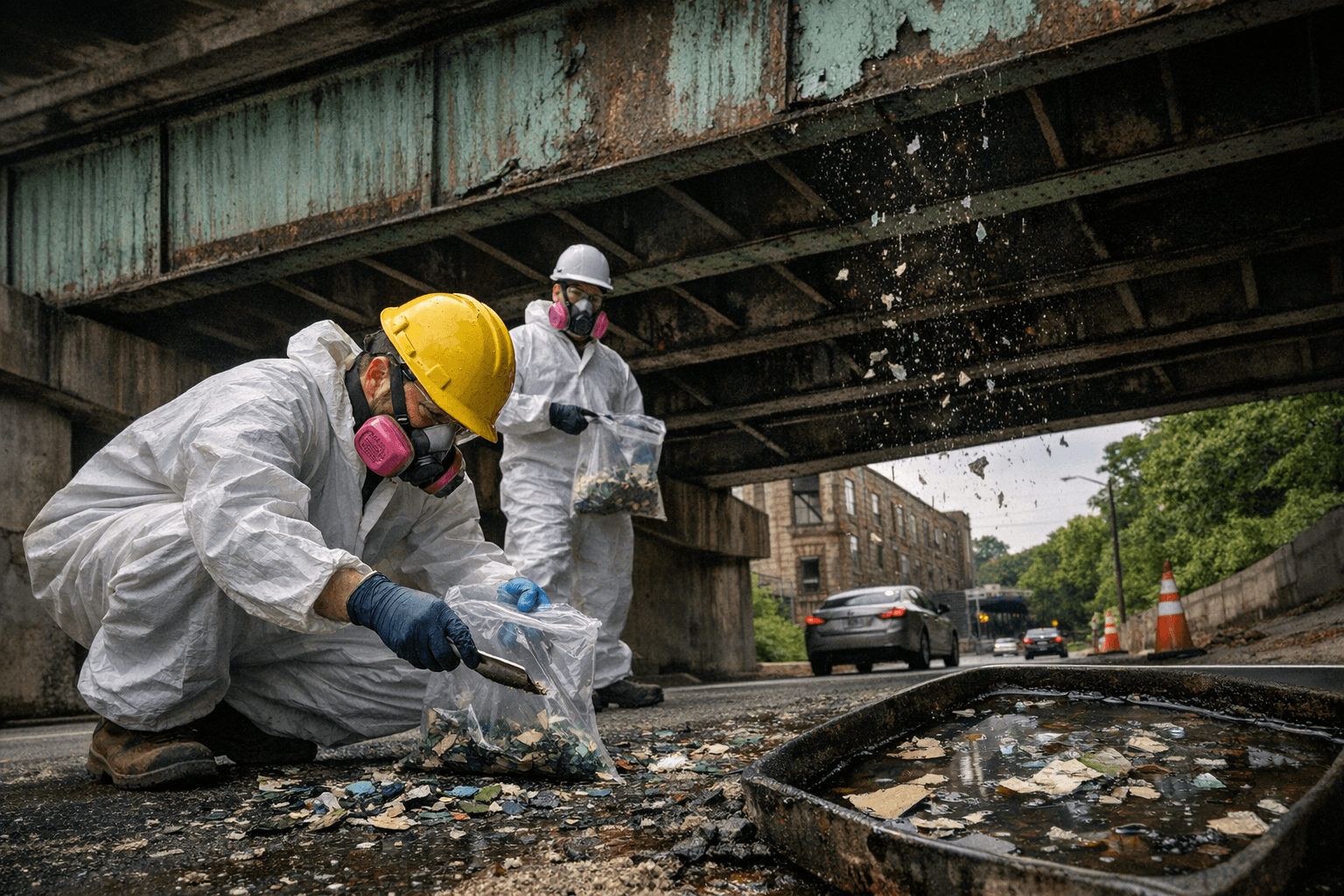
The I-95 bridge in Halethorpe, at the intersection of Arbutus and Potomac avenues, is owned by the State Highway Administration. MDE inspectors found paint chips scattered across sidewalks, roadways, railroad tracks, grassy areas, and inside storm drains at that site, and the agency has opened a formal investigation. SHA spokeswoman Shanteé Felix said in an emailed statement: "In addition to the bridge deck repairs and upgraded parapet walls, we are adding repairs and cleaning and painting the structure. SHA is working with Amtrak on an agreement as their tracks are within work limits. Once the agreement is finalized, the project will advance."
The Exit 8 chips are not newly observed. The Baltimore Brew had reported similar health-harming orange chips near Falls Road to the city approximately one month before the March 13 lab results were released, and those chips were still littering Falls Road at the time of the latest confirmation.
Sources differ on the precise count of affected bridges. The Baltimore Brew reported the JFX Exit 8 finding as the fourth Maryland bridge and third in Baltimore confirmed to be shedding hazardous lead paint. The Baltimore Sun and Fox45 described MDE as investigating three bridges in the region, a count that does not appear to include the JFX site in their tallies. Neither source reconciled the difference.
This article was produced by Prism’s automated news system from verified source data, official records, and press releases, then run through automated quality and moderation checks before publishing. The system is built and supervised by the people who set the standards it runs under. Read our full AI policy.
Did this article answer your question?