Mizpah Methodist Church stands as last survivor of Buford’s Bridge
Mizpah Methodist Church is the last standing piece of Buford’s Bridge, with worship roots back to 1819 and a sanctuary that survived the 1865 burnings.
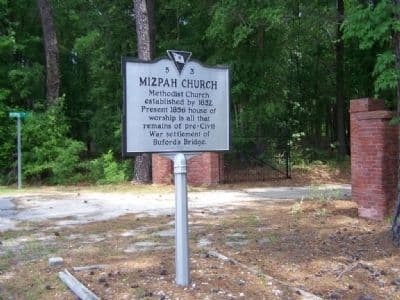
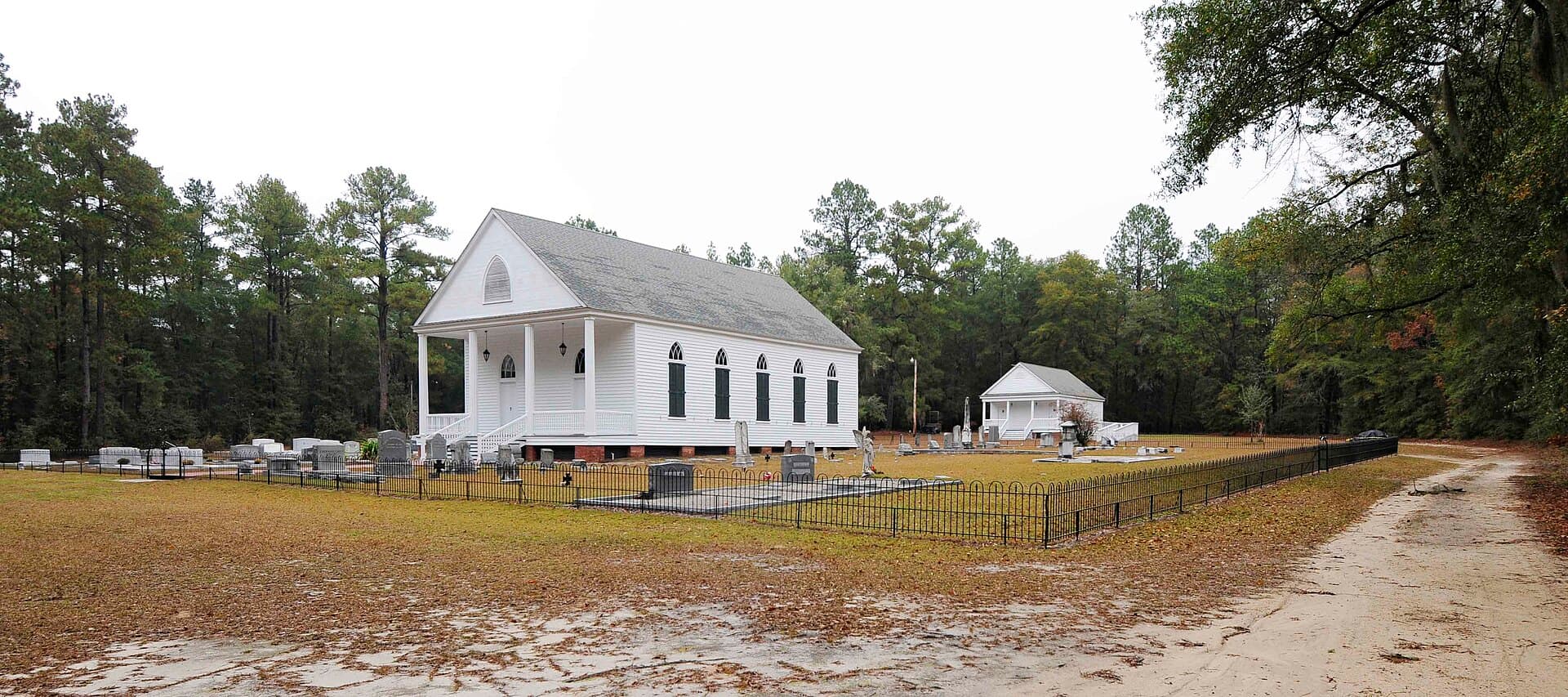
Mizpah Methodist Church is more than an old sanctuary in Olar. It is the only surviving building from Buford’s Bridge, the vanished Salkehatchie River settlement that once held stores, taverns, a boarding house and a Masonic lodge before war and time erased almost everything else. Listed in the National Register of Historic Places in 2000, the church remains one of Bamberg County’s clearest links to the world that existed there before the Civil War.
What still stands at Mizpah
The church dates to 1856 and occupies the site where Buford’s Bridge once had a small but real commercial life. National Register materials describe Mizpah Methodist Church as a braced-frame, weatherboard vernacular meeting house with Greek Revival and Gothic Revival elements, a combination that sets it apart from many rural churches built in the same era. It stands about 15 miles south of Bamberg near the Allendale County line, where the landscape still feels tied to the old road-and-river patterns that shaped settlement in this corner of South Carolina.
The building matters because it is not a replica, a relocated structure or a commemorative marker. It is the last extant building from the old Barnwell District town, and that makes every surviving board, window and roofline part of the county’s original physical record. When the rest of Buford’s Bridge disappeared, Mizpah Methodist Church did not.
How Buford’s Bridge took shape
Buford’s Bridge began as a crossing point tied to Major William Buford, who maintained a bridge and ferry over the Salkehatchie River as early as 1792. That transportation link gave the place its first identity, long before it had the more settled look of a village. By the 1850s, the area had developed into a small merchant stop with several residences, four stores, two taverns, a boarding house, a Masonic lodge and the church.
That mix tells the story of a working community rather than a single-site landmark. People lived there, traded there, worshiped there and passed through there along the river corridor. In other words, Buford’s Bridge was not just a name on a map. It was a place with the ordinary institutions that make a settlement endure.
The congregation reaches back before the building
The church building from 1856 came after decades of Methodist worship in the area. Records place Methodist services there as early as 1819, first in a log cabin, then in a schoolhouse, then in the Philadelphia Meeting House. That sequence shows how the congregation grew alongside the settlement, moving from improvised spaces to a shared meeting house before the Methodists and Baptists split and built separate houses of worship.
That longer history is important because it shows the church as the product of community change, not a stand-alone relic. The building that survives today was the last step in a much older religious timeline, one that began well before Bamberg County existed in its modern form. Mizpah Methodist Church carries that earlier story in its walls.
Why the church outlasted the town
The decisive break came during the Civil War. Federal troops destroyed most of the buildings in Buford’s Bridge during the February 3-5, 1865 advance toward Columbia, but Mizpah Methodist Church remained intact. That single fact explains why the church carries so much historical weight today: it is the lone physical survivor from a place that otherwise vanished.
What remains of the broader settlement now survives mostly through written record and memory. The church’s preservation value is therefore unusually high, because it preserves evidence of how Buford’s Bridge looked and functioned before the destruction. If the building were lost, Bamberg County would lose its most tangible link to the original village and to the social world that surrounded it.
How Olar replaced the old name
Buford’s Bridge did not disappear overnight in name as well as structure. Another SC Picture Project page notes that the settlement later had a depot called Hammond Station, then a post office named Olar, and finally adopted the Olar name in 1894. A historical marker gives the sharper sequence: the post office called Olar was established on October 1, 1892, and the South Carolina Legislature approved the town’s name change from Hammond to Olar on December 24, 1894.
The new name honored Richard Morris’s daughter, Olar Morris. That detail matters because it captures the way local identity shifted from a river crossing and transportation hub to a named town with its own civic label. Buford’s Bridge became Olar, but Mizpah Methodist Church preserved the older landscape underneath that newer name.
The cemetery adds another layer of record
The grounds around the church are as important as the building itself. The cemetery contains early family markers, some of them signed by their cutters, along with iron Maltese cross markers for Confederate veterans. Those details turn the site into a layered historical ledger, where names, craftsmanship and military memory sit beside one another.
The cemetery also reinforces how local history survives in fragments. Signed gravestones show the work of individual carvers. Confederate veteran markers anchor the site in the region’s postwar memory. Together, they extend the church’s story beyond architecture and into the people who lived, died and were buried there.
Why Mizpah Methodist Church still matters
Mizpah Methodist Church remains active, which gives the site a living presence that many historic places have lost. It is still a worship space, still a landmark in Olar and still one of the few places in Bamberg County where the prewar settlement pattern can be seen in its original setting. The church’s National Register listing in 2000 formalized what locals have long known: this is a rare surviving piece of the county’s early built environment.
For Bamberg County, the stakes are concrete. If Mizpah Methodist Church were damaged or lost, the county would not just lose a historic building. It would lose the last visible structure from Buford’s Bridge, the oldest surviving witness to the area’s transportation history, religious life and 19th-century settlement pattern. That is why the church is not merely remembered. It is the line between the county’s present landscape and the town that once stood there.
This article was produced by Prism’s automated news system from verified source data, official records, and press releases, then run through automated quality and moderation checks before publishing. The system is built and supervised by the people who set the standards it runs under. Read our full AI policy.
Did this article answer your question?
