Paul Bunyan Statue and Lake Bemidji Anchor Community Life Year-Round
Built in 1937 to anchor a winter carnival, Bemidji's 18-foot Paul Bunyan statue is now the second most photographed roadside attraction in the U.S. and a year-round civic heart.
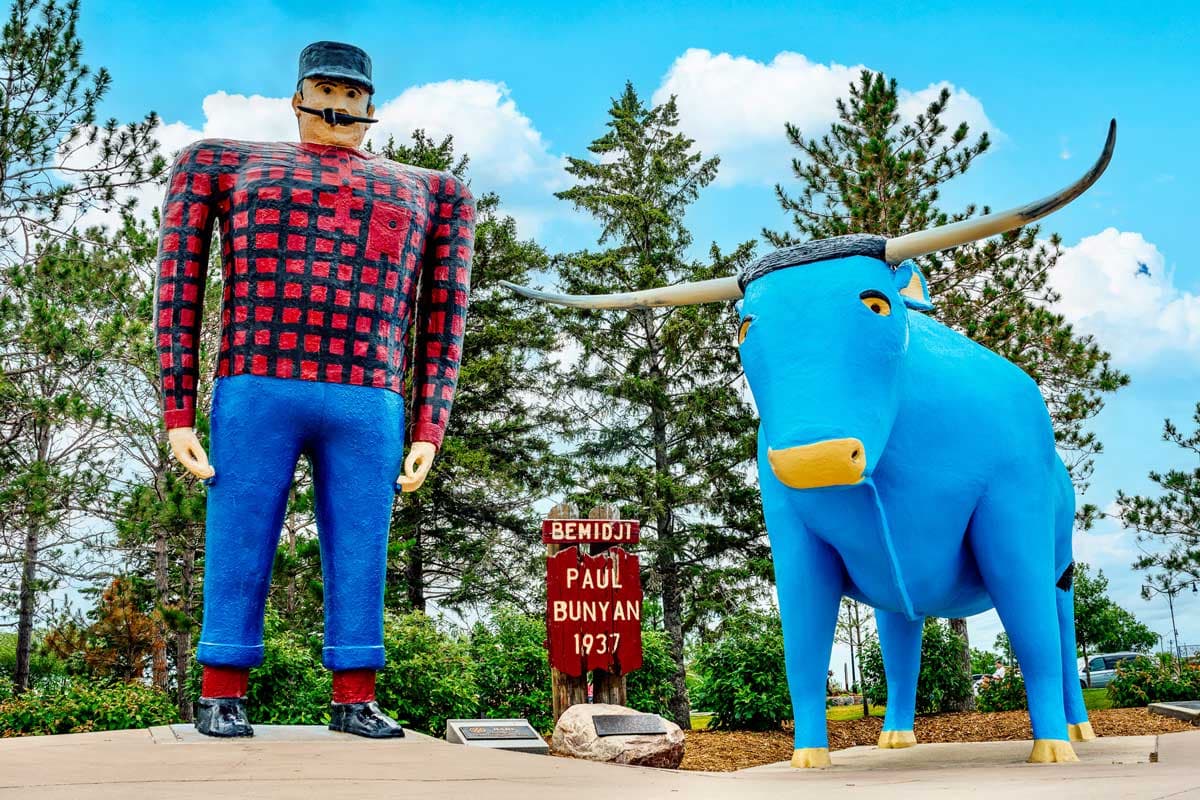
Somewhere in the January cold of 1937, workers at Cyril Dickinson's lumber yard in Bemidji shaped steel, concrete, and plaster around a wooden frame, spending 737 documented man-hours building what would become one of the most recognized roadside figures in the country. The result: an 18-foot, 7.5-ton Paul Bunyan, broad-shouldered and mustachioed, wearing a red plaid shirt and gray cap, modeled in part on then-Mayor Earl Bucklen. His companion, Babe the Blue Ox, was built simultaneously under the supervision of Jim Payton, manager of Bemidji Electric Company, with both figures constructed on a three-to-one scale. What started as a promotional stunt for a Bemidji Rotary-sponsored winter carnival quickly became a national sensation, earning a full-page spread in Life Magazine and a permanent home on the southwestern shore of Lake Bemidji.
Nearly 90 years later, Paul and Babe haven't moved. They still stand in Paul Bunyan Park, listed on the National Register of Historic Places since 1988, and recognized as the second most photographed roadside attraction in the United States.
A Landmark Rooted in Logging and Civic Pride
Bemidji's decision to build a lumberjack as its mascot was no accident. When rail connections reached the city in 1898, the region was already a center for logging and lumber production, and promoters had been developing lakeshore sites for resorts catering to hunters and anglers ever since. The rise of automobile travel in the 1920s supercharged that tourism economy, and though the Great Depression stalled it, the winter carnival of 1937 was designed specifically to revive it. Paul Bunyan and Babe the Blue Ox were tools of economic recovery before they were icons.
Babe's own story has a twist: while Paul went directly to his park-side post after the carnival closed, Babe was mounted on a Model T Ford and spent years as a parade float before permanently joining Paul on the lakefront. The adjacent Tourist Information Center, a state of Minnesota Travel Affiliate open year-round, carries on the interpretive mission with historic photographs, Bunyan memorabilia, and visitor services that have greeted travelers across generations.
Lake Bemidji: Where the Mississippi Begins
The lake itself carries a name that tells its own story. "Bemidji" derives from the Ojibwe word "Bemidgegumaug," meaning "river flowing crosswise," a description of how the Mississippi River crosses through the lake from west to east. Bemidji is, by that geography, the first city on the Mississippi River, situated near where the great river begins its 2,300-mile journey south. The Ojibwe presence in this landscape predates the logging era by centuries, and interpretive signage throughout the park connects visitors to that longer history, including the story of Chief Shaynowishkung, known as Chief Bemidji, who fed the white settlers who arrived on the lake's shores in 1888.
The lake supports boating, fishing, swimming, and wildlife habitat that draw anglers and outdoor recreationists throughout the warm months. Birdwatchers find the shoreline and adjacent wetlands productive year-round. In winter, the frozen lake and surrounding trails offer a quieter form of access, with scenic walks and, when conditions allow, ice-related recreation that keeps the park active even in the depths of a northern Minnesota winter.
Paul Bunyan Park: More Than a Photo Backdrop
The park functions as Bemidji's downtown living room. Its playground, plaza, shaded picnic areas, and waterfront walking paths make it a daily gathering place for residents, not just a seasonal attraction. It serves as the backdrop for community milestones: parades, high school graduation photos, homecoming events, and seasonal festivals occupy the park's calendar from spring through fall. The Beltrami County Historical Society, Lake Bemidji State Park rangers, and local chambers and civic groups frequently use the site for interpretive events and guided walks.
Lake Bemidji State Park, a short distance from downtown, expands the outdoor offering considerably. The park's trails, including Homestead, Balsam, Bass Creek, and Rocky Point routes, connect visitors to old-growth forest and lakeside habitat that the Works Progress Administration and the National Youth Administration helped develop in the late 1930s and 1940s. The Minnesota DNR formally placed the park under state jurisdiction in the mid-20th century, and it has been a conservation anchor for the region ever since.
Planning Your Visit
Paul Bunyan Park sits in the heart of downtown Bemidji, walkable from local shops and restaurants, with public parking and year-round access to lake trails. A few practical notes for getting the most out of the site:
- Bring binoculars: the shoreline and adjacent wetland habitat reward birdwatchers, especially during spring and fall migration.
- Layers matter: northern Minnesota shoulder-season weather shifts quickly, and mornings on the lake can be significantly cooler than afternoons.
- Check local event calendars before visiting: the Beltrami County Historical Society and Lake Bemidji State Park rangers regularly host interpretive programming and guided walks that add depth to any visit.
- Respect cultural signage: interpretive markers throughout the park address Ojibwe history and the region's logging heritage. They are part of what makes this site more than a roadside stop.
- Follow lakeside safety postings and Leave No Trace principles on trails, particularly during high-traffic summer weekends.
Spring through fall remains the peak window for boating and festival programming, but winter visits carry their own appeal: the park's open landscape and quiet waterfront offer a perspective on Bemidji that the busier months don't allow.
A Civic Asset That Earns Its Place
The tourism economics are real: visitors drawn to Paul and Babe support downtown lodging, restaurants, and retail, and Visit Bemidji and the broader Beltrami County tourism ecosystem promote the site as a year-round destination to audiences well beyond the region. But the park's value to the people who live here runs deeper than visitor spending. For a city that built an 18-foot statue out of concrete in January to survive the Depression, Paul Bunyan and Lake Bemidji represent a particular kind of local character: resourceful, community-driven, and stubbornly proud of where it stands on the map and on the river.
This article was produced by Prism’s automated news system from verified source data, official records, and press releases, then run through automated quality and moderation checks before publishing. The system is built and supervised by the people who set the standards it runs under. Read our full AI policy.
Did this article answer your question?