Albuquerque adds four more speed cameras on high-crash roads
Four new speed cameras went live on Griegos, Central and Unser, pushing Albuquerque’s automated enforcement network to 34 sites on crash-heavy roads.

Albuquerque turned on four more automated speed cameras this week, pushing the citywide network to 34 sites on some of the city’s busiest crash corridors. One camera went up on 4th Street near Griegos Road, two were added at Central Avenue and 61st Street in both directions, and one was installed at Unser Boulevard and Gwin Road.
City officials said the new placements were picked with crash data, local input and maps that flag streets with injury and fatality crashes. That approach fits the program’s role inside Vision Zero, the city’s traffic-safety strategy that uses cameras to slow drivers where the danger is highest, not just to write tickets after the fact.
The automated speed enforcement program began in May 2022. Since then, the city has said the network has spread across 15 critical arteries and that the program has already produced major behavior changes, with average speeds and the number of speeding drivers declining. In 2025, Mayor Tim Keller said fatal traffic crashes were down 20 percent that year.
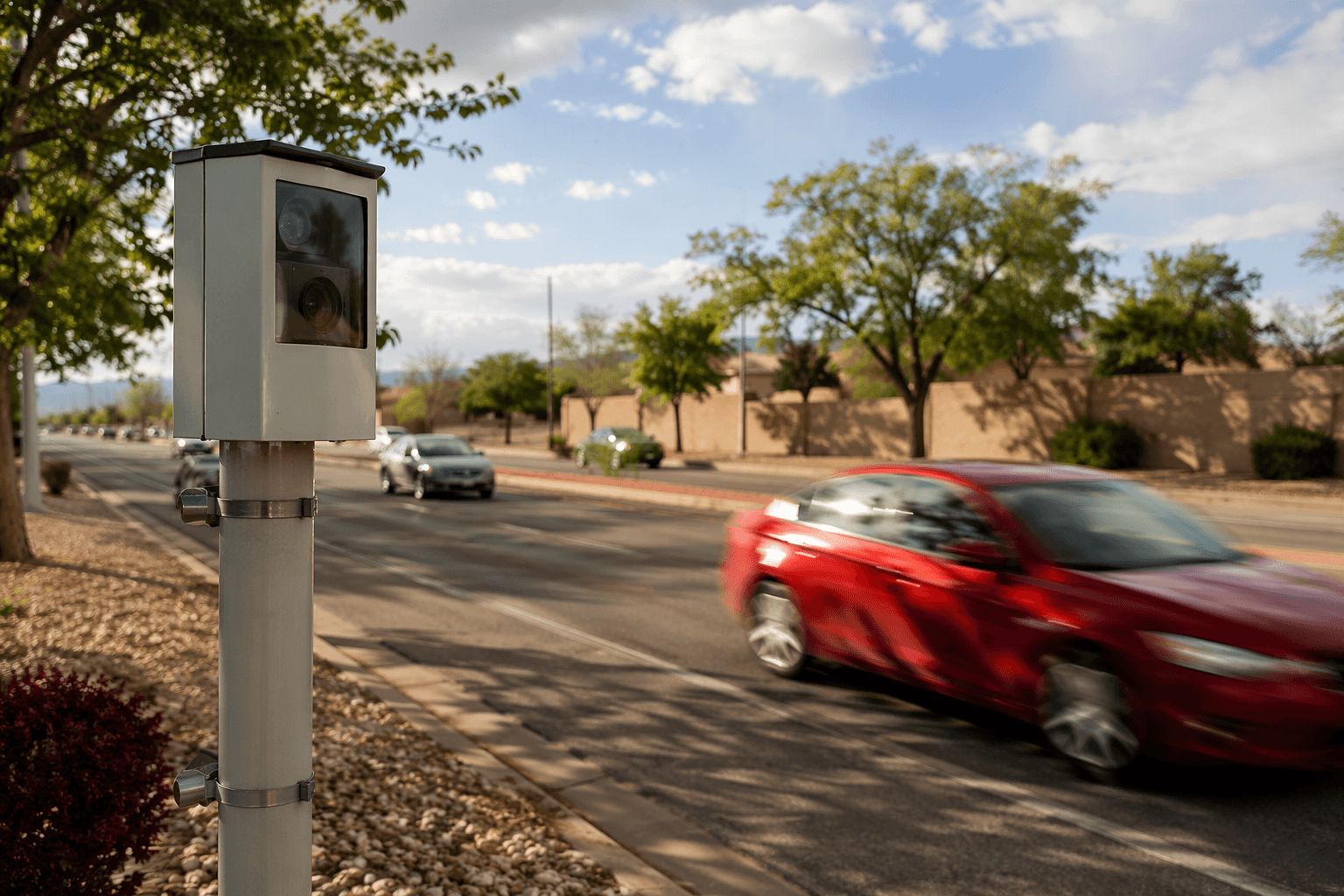
Each camera captures continuous passing data, giving the city a running picture of how drivers use the corridor over time and whether enforcement is changing behavior. City leaders have repeatedly described the system as a force multiplier for the Albuquerque Police Department, allowing officers to spend more time on other traffic enforcement and criminal priorities while the cameras cover roads where police cannot always be present.
For drivers who get caught, the penalty is a $100 citation. City materials say eligible cases can be resolved with four hours of community service, and the city says revenue is split under state law, with half remitted to the state and half kept by the municipality to cover reasonable costs.

The latest expansion is another sign that automated enforcement is now part of daily driving in Bernalillo County, especially on arterial roads that carry heavy traffic, transit, pedestrians and neighborhood cut-through drivers. With 34 cameras now active, commuters moving across Albuquerque face a wider net of enforcement on the corridors the city has identified as most dangerous, including the city’s long-running focus on high-speed roads near the Lead/Coal corridor, Coors Boulevard and Paseo del Norte.
This article was produced by Prism’s automated news system from verified source data, official records, and press releases, then run through automated quality and moderation checks before publishing. The system is built and supervised by the people who set the standards it runs under. Read our full AI policy.
Did this article answer your question?