Bachechi Open Space blends river access and North Valley history
Bachechi Open Space gives North Valley families an easy Bosque outing, while its solar education building and restored land show how Bernalillo County stewards public access.

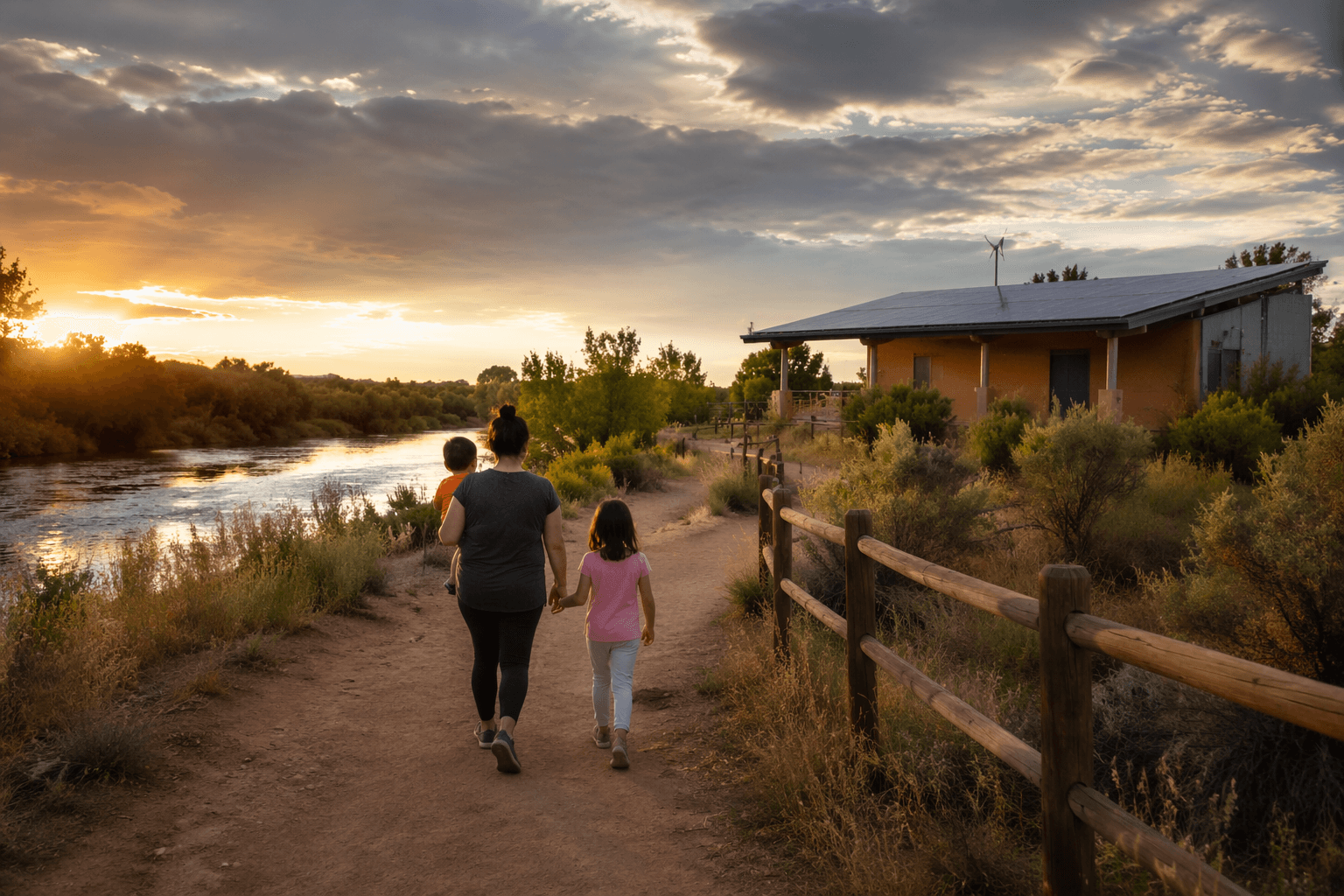
Bachechi Open Space is one of Bernalillo County’s most useful low-key outdoor assets: a 28-acre North Valley site at 9521 Rio Grande Blvd. NW that gives families, walkers, and nearby residents a simple way into the river corridor. Parking is reached from the Alameda Blvd. entrance, the trail is open from dawn to dusk year-round, and the setting sits beside the Rio Grande Bosque and Rio Grande Valley State Park, which makes the property feel connected to much larger public open space without requiring a long drive or a complicated outing.
An easy trail stop with a river-corridor setting
The trail layout is modest, and that is part of the appeal. The county map shows a 0.37-mile City open-space trail and a 1.45-mile County open-space trail, giving visitors options that fit a short walk, a stroller loop, or a slower visit centered on nature watching. The site map also marks accessible parking, bathrooms, the Bachechi Environmental Education Building, and the open-space boundary, which helps turn the property into an easy place to navigate rather than a destination that requires guesswork.
That practicality matters in the Bosque. Bachechi is not a remote preserve or a formal park with an oversized footprint; it is a small public opening onto the Rio Grande landscape. For residents looking for a nearby place to stretch, watch birds, or let children get outside without committing to a full-day hike, the site’s scale is the point.
What the land used to be
Bachechi’s present-day calm sits on top of a more utilitarian past. The property was formerly known as Sullivan’s Stables, a commercial equestrian operation dating to the mid-1970s, and before that it was a private farm where alfalfa and chickens were raised. Bernalillo County’s materials say a master plan for Bachechi and adjacent Alameda Open Space was developed between 2007 and 2010 through extensive community collaboration, turning a working landscape into a public one while preserving a sense of the site’s original character.
That planning shows up on the ground in the mix of uses. Bernalillo County describes wildlife-viewing areas, multi-use trails, improved equestrian parking, xeric and native landscaping, expanded pecan orchard and wetland habitat, a memorial rose garden, and migratory waterfowl habitat planted with native grasses. The result is a property that still feels rooted in the North Valley’s agricultural and river-edge history, even as it serves modern recreation and habitat goals.
A family story tied to downtown Albuquerque
The history of the site reaches beyond land use. Bernalillo County identifies the Bachechi family as part of Albuquerque’s Italian-immigration history, and says Oreste Bachechi helped build the KiMo Theatre in downtown Albuquerque in the mid-1920s. City history materials add that Oreste Bachechi came to the United States from Italy in 1885 and later became a liquor dealer and grocery proprietor in Albuquerque before moving into theater development.
That connection gives Bachechi Open Space a second kind of value. It is not only a place to walk beside the Bosque, but also a place that reflects the city’s older immigrant and business history. The link to the KiMo Theatre places the North Valley site within the larger story of Albuquerque’s downtown development and the Italian-American entrepreneurs who helped shape it.
Restoration work and environmental cleanup
Bernalillo County has also treated the site as a restoration project, not just a recreation site. The county says contaminated soil from underground storage tanks was removed, and quarterly groundwater monitoring continues until naphthalene falls below the federal standard. That makes the open space a clear example of how public land can carry an environmental-recovery function alongside trails and habitat.
The restoration work is visible in the arboretum area as well. The county says the northern 8 acres were turned into an arboretum after Siberian elm was removed, with original fruit trees, sycamores, junipers, and cottonwoods restored or reintroduced. That kind of planting gives the site its layered character: part ecological repair, part shade landscape, part living reminder of the farm that came before.
The education building at the center of the site
At the heart of the property is Bernalillo County’s first solar-powered building, the Bachechi Environmental Education Building, or BEEB. A county presentation describes it as 2,200 square feet and part of a 29-acre master plan on the original Bachechi Family Farm. The building hosts Open Space events and can be reserved for workshops, meetings, presentations, and classes for all age levels, which makes it a working public facility rather than a decorative add-on.
County rules add a few practical details that matter for anyone planning a visit or reservation. The education building doors lock automatically when closed, and parking must be in designated spaces only at Bachechi Open Space. Those rules reflect a site that is open to the public but still carefully managed, with county stewardship showing up in daily operations as much as in landscape design.
How Bernalillo County balances access and protection
Bachechi shows how Bernalillo County uses open space to do several jobs at once. It gives residents a short trail option near the river, it protects and restores habitat, it preserves a property with local historical meaning, and it creates a place where education can happen outdoors and indoors. That mix is especially important in the North Valley, where public access to the Bosque and river corridor depends on well-managed sites that can handle both foot traffic and conservation goals.
The larger city context helps explain why these places matter. City of Albuquerque open-space history materials say the movement began in the 1960s and led to the acquisition of more than 8,500 acres by 1968. The City of Albuquerque Open Space Division marked its 40th anniversary in 2024, underscoring how long local governments have been building and maintaining access to land like Bachechi. In that sense, Bachechi is not an isolated property but one piece of a broader public landscape that has taken decades to assemble.
A site that stays active, not static
Bachechi is also used, not just preserved. Bernalillo County programming materials show recurring public events there, including Master Naturalist activities, Nature Packs, and nature immersion walks. Those programs reinforce what the site already suggests on a normal afternoon: this is a public classroom as much as a trailhead.
That combination of short trails, restored habitat, solar-powered education space, and local history is what makes Bachechi stand out in the county’s open-space system. It is easy to reach, easy to understand, and carefully managed, which is exactly why it works so well for an uncomplicated Bosque-adjacent outing.
This article was produced by Prism’s automated news system from verified source data, official records, and press releases, then run through automated quality and moderation checks before publishing. The system is built and supervised by the people who set the standards it runs under. Read our full AI policy.
Did this article answer your question?