Gutiérrez-Hubbell House links Bernalillo County history to El Camino Real
The South Valley site is a working museum, farm and trail stop. It turns El Camino Real history into open space, classes and public access.

On nearly 16 acres in Bernalillo County’s South Valley, the Gutiérrez-Hubbell House is more than an adobe landmark. Visitors can still move through a restored historic house, courtyard, kitchen garden, heritage orchard, acequia, farm fields, trail and picnic area, all within a site that ties local land use to El Camino Real de Tierra Adentro.
A South Valley property with a trail-wide story
The house sits at the center of a landscape that helps explain how Albuquerque’s South Valley developed. Built in the mid-1850s, the 5,700-square-foot, 13-room Territorial-style adobe reflects a family history rooted in two worlds: Juliana Gutiérrez came from a prominent Hispanic family with deep ties to Pajarito and Los Padillas, while James “Santiago” Hubbell represented the New England trader-and-public-official arrival in the New Mexico Territory.
Their household was bilingual and bicultural, and that mattered beyond one family line. John Lorenzo Hubbell was born in Pajarito in 1853 and grew up in that environment before becoming J. L. Hubbell, the figure associated with the Hubbell Trading Post in Ganado, Arizona. The National Park Service also identifies Juliana Gutiérrez as the granddaughter of a Mexican governor of New Mexico, a reminder that the site’s history reaches into the political and social elite of territorial New Mexico as well as into everyday village life.
The property is also part of a much larger corridor. The National Park Service recognizes the Gutiérrez-Hubbell House as a Certified Site on El Camino Real de Tierra Adentro, the royal road formally established by the Spanish in 1598. The trail stretched about 1,500 miles from Mexico City to Ohkay Owingeh and later became a National Historic Trail in 2000. That connection makes the site useful for understanding Bernalillo County not as a sealed-off place, but as one node in a long-running trade, travel and settlement network.
From residence to road stop
The National Register of Historic Places lists the property under NRIS ID 15000491 and marks its areas of significance as architecture, commerce and transportation. The record also notes significant years of 1855, 1867 and 1868, which matches the site’s evolution from family home to working stop along a busy route through the South Valley.
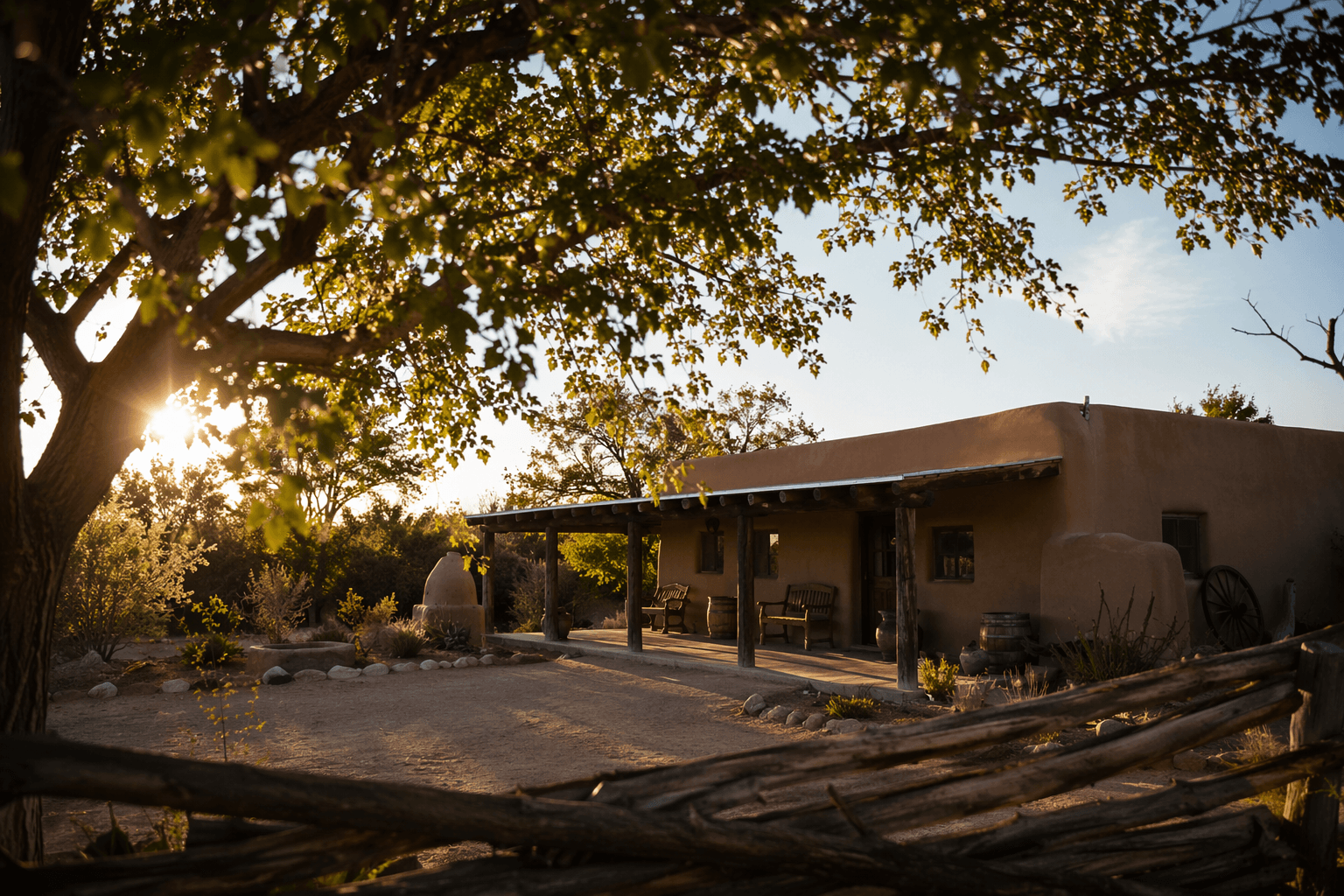
That use history matters because it shows what the building did, not just what it looked like. The house served as a residence, trading post, post office and stagecoach stop from the late 1860s through 1929. In practical terms, that means the property once helped move goods, people and information across a region where roads were slow, distances were long and local exchanges depended on places that could serve multiple purposes at once.
Bernalillo County’s materials describe the original ranch location as a paraje, one of the important camp locations along El Camino Real. That detail helps explain why the site still resonates in debates over land stewardship and identity: it was always more than a house on a lot. It was part of an infrastructure of movement, agriculture and settlement that shaped the South Valley’s built and social geography.
Why Bernalillo County bought it
In November 2000, after grassroots advocacy by area residents, Bernalillo County purchased the property and made it the county’s first Open Space property. The county says that purchase prevented development, which is a key fact for anyone trying to understand why the site still matters in a county where land pressure, growth and preservation often collide.
That decision turned the property into a public asset rather than a private one. Today, the county describes it as a rehabilitated historic house with a museum and community space, but also as a working landscape with a kitchen garden, heritage orchard, historic acequia and actively farmed fields. The site’s identity now depends on both preservation and use, which is exactly what makes it relevant to current conversations about who gets access to land, what gets protected and how history is maintained in a living community.
A 2025 county document places the site within the traditional Pajarito Village Center, underscoring that it belongs to a broader village landscape rather than standing apart from it. That framing matters because it shifts the question from whether the house is historically important to how a historic property can still function as neighborhood infrastructure.
What residents can do there now
The Gutiérrez-Hubbell House is open as a place to visit, learn and spend time outdoors. Bernalillo County’s open-space programming uses the site for guided tours, backyard refuge activities and adobe preservation workshops, while the National Park Service describes it as a community gathering and education place.
For people in Bernalillo County, that means the site offers more than a look at old walls and furniture. It provides a place to walk a perimeter trail, sit at a picnic area, visit a heritage orchard, see an acequia in operation and connect the region’s agricultural past to present-day conservation and cultural education. The mix of uses is the point: it allows the site to operate as a historic house, a public open space and a teaching landscape at the same time.
That combination gives the house continuing civic value. A preserved building alone can become static, but the Gutiérrez-Hubbell House remains legible because county programming, museum activity and working land keep the place active. The result is a site that helps explain how El Camino Real shaped Bernalillo County, while also showing what can still happen on the ground when preservation is treated as public infrastructure rather than a display case for the past.
Why it still matters
The strongest case for the Gutiérrez-Hubbell House is that it links memory to daily use. Its National Register status, its role on El Camino Real de Tierra Adentro and its family history all matter, but so do the orchard, the fields, the acequia and the public programs that keep people coming through the gate.
If places like this were treated only as static history, Bernalillo County would lose a working example of how land stewardship, cultural identity and public access can coexist. The site shows that preservation can still produce open space, education and community space in one place, which is why it remains one of the county’s most useful historic properties.
This article was produced by Prism’s automated news system from verified source data, official records, and press releases, then run through automated quality and moderation checks before publishing. The system is built and supervised by the people who set the standards it runs under. Read our full AI policy.
Did this article answer your question?