Hawaii County Targets Short-Term Rentals With Stricter Registration, Enforcement Rules
Hawaii County's STR crackdown hits July 1, with fines up to $10,000 for unregistered hosts — and a new bill could tighten the rules even further.
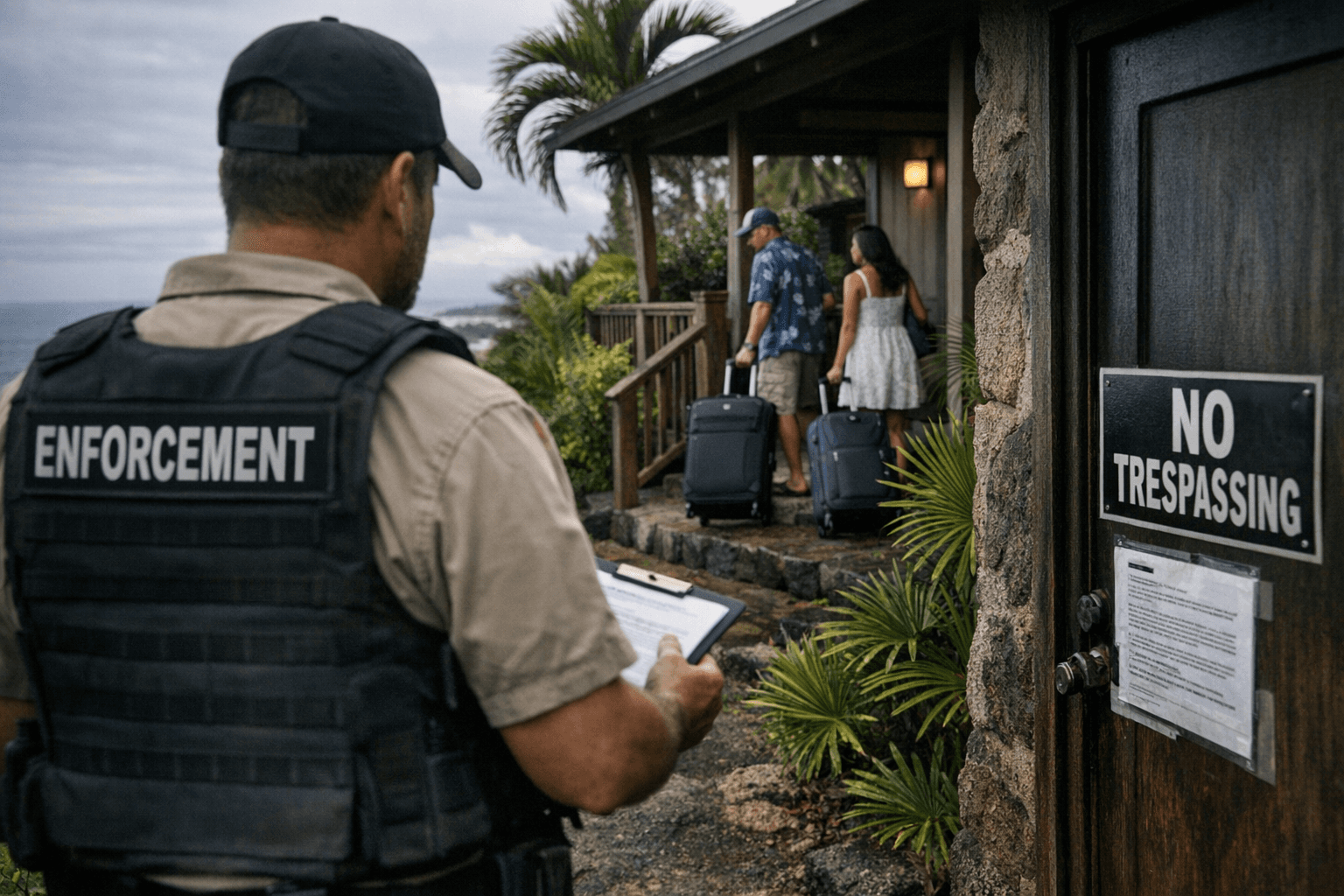
Short-term vacation rental owners on the Big Island are facing a hard July 1 deadline to register with Hawaii County under Ordinance 25-50, while a second bill that would strengthen enforcement further is moving through the County Council.
Bill 47, signed into law on June 23, 2025, governs rentals of less than 180 consecutive days and is notable for covering both hosted and unhosted properties for the first time. For years, county rules largely required only unhosted operators to register. The original deadline of December 20, 2025 was extended to July 1, 2026, with Council member Heather Kimball citing the need to give the county more time to get a registration management and enforcement system in place.
Registration fees are set at $250 for hosted rentals and $500 for unhosted. Platforms such as Airbnb and VRBO are also required to register, at a cost of $1,000, and must submit monthly activity reports. Fines for non-compliance range from $1,000 to $10,000 per violation per day.
Even as the county prepares to enforce Ordinance 25-50, Kimball is pushing forward with a companion measure. Bill 147, which aims to strengthen enforcement and better align existing rules, was scheduled to be heard by a council committee this week. The move signals that the county sees its first registration law as a foundation, not a finish line.
Council members Ashley Kierkiewicz and Kimball, who introduced the original measure, said it will help gather data about rental properties on Hawaii Island. In a webinar on the bill, Kimball said 4,800 short-term rentals are currently registered with the county's Planning Department, though only unhosted rentals had been required to register. She estimated that two to three times more short-term rentals are actually in operation.
Kimball framed the push in blunt terms: "Not only do transient vacation rentals take away individual units from the housing market, but they have an overall inflationary pressure on the market itself in terms of rent."
Not all council members were on board. Council member Holeka Inaba was the only member to vote against the 2025 bill, saying he would have supported it if it had included regulations on hosted rentals. Even so, Inaba acknowledged a community frustration: "We've gotten a lot of complaints from residents who are dealing with noisy vacation rental tenants, irresponsible vacation rental owners."
Resident John Pelletier pressed a legal concern before the council, arguing that fundamental land use questions remain unresolved. "Because transient vacation rentals are not defined in Chapter 25, fundamental land use regulations remain unaddressed — including which districts they are permitted in, use permit requirements, parking and limits on rental rooms," Pelletier said, adding that "many of us in the community felt that Bill 47 was premature."
The county's action follows a 2024 state law that gave Hawaii counties broader authority to regulate and even phase out short-term rentals. Maui has already moved to phase out approximately 7,000 apartment-district vacation rentals on a timeline stretching to 2031. Kauai restricted vacation rentals to resort zones more than a decade ago. For Kimball, the goal is to act before the Big Island's housing market reaches a similar breaking point.
With the registration portal still under development, the county has until July 1 to stand up the system that will determine whether the law's steep penalties ever reach operators.
This article was produced by Prism’s automated news system from verified source data, official records, and press releases, then run through automated quality and moderation checks before publishing. The system is built and supervised by the people who set the standards it runs under. Read our full AI policy.
Did this article answer your question?