Hilo's Banyan Drive Redevelopment Moves Forward in State Legislature
HB 2616, the main Banyan Drive redevelopment bill, crossed to the Senate without a hearing as SB 2692 to seize the Grand Naniloa golf course's 62.5 acres died before crossing over.
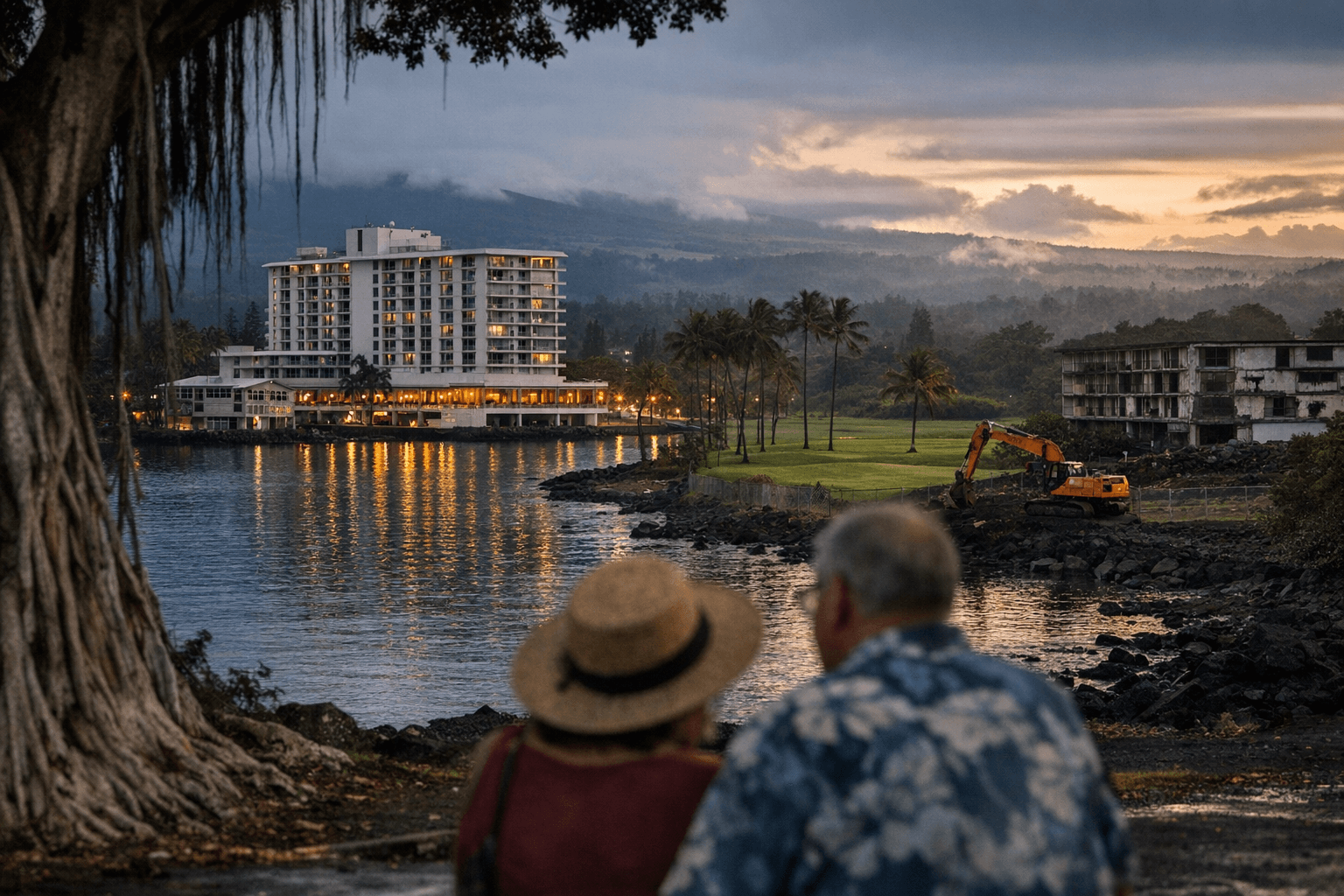
For over a decade, Banyan Drive has been in disrepair, its trees rotting and its buildings derelict, even as state lawmakers have pressed for funds to revitalize it. Now, with Hilo's wider tourist economy hanging in the balance, the effort has moved to the most concrete legislative stage yet — and a fight over who gets a seat at the decision-making table has emerged as the session's sharpest fault line.
House Bill 2616, introduced by Rep. Chris Todd, with the endorsement of fellow Big Island Democratic Reps. Sue Keohokapu-Lee Loy and Matthias Kusch, passed 7-1 by the Water and Land Committee, with amendments. The measure crossed over to the Senate, but hasn't received a committee hearing. The bill would create a Banyan Drive-Makaokū Community Development district and special fund under the authority of the Hawaii Community Development Authority, with the development district including two representatives from Hilo, a lineal descendant of the area, a cultural specialist, and a director of planning from the county. It also requests $2 million to perform an environmental assessment of the peninsula and additional funding to hire a full-time employee.
The sole no vote was cast by Rep. Kim Coco Iwamoto, who objected to an amendment that removed a lineal descendant of the area as a voting member of the district authority and instead, at the behest of the Hawaii Community Development Authority, would authorize a nonvoting advisory committee with at least one lineal or cultural descendant with ties to the Waiakea area, selected by the Office of Hawaiian Affairs. That tension surfaced beyond the committee room as well. Kanoeuluwehianuhea Case, co-founder of Na Wai Ho'ola Nui La'au Lapa'au, voiced her opposition to the bill because lineal descendants are excluded from the voting body, telling lawmakers: "I hope that you folks would appreciate that we would like to be a voting member, not part of an advisory group."
Rep. Keohokapu-Lee Loy framed the structural overhaul as an overdue course correction. "The way (redevelopment) was being done in the past, it's not working, so we just got to try a different way," she said. She added that HB 2616 "really starts to lend itself to community visioning, starting with ʻāina. I think when we start there, we cannot go wrong."
Hawai'i island lawmakers, including the mayor, agree that DLNR should not be in charge of redevelopment. Sen. Lorraine Inouye, who introduced the companion Senate Bill 2001, put it plainly: "DLNR is not a developer, and that's why we decided to have HCDA instead of DLNR provide the project and do all of the things that needs to be done — like the environmental assessment and hiring contracts and doing the (request for proposal) for a developer."
The fight over the Grand Naniloa Golf Course's 62.5 inland acres is equally central to the plan. Rep. Mark Hashem, an Oahu Democrat and the Water and Land Committee chair, changed the effective date of the eminent domain legislation from July 1, 2026, to July 1, 3000, to encourage further discussion — a procedural signal that the question of acquiring those acres is far from settled. SB 2692, the bill introduced by Inouye that would authorize DLNR to acquire the leasehold interest in the parcel through eminent domain or otherwise, died before crossing over. Inouye was direct about the stakes: "We need the golf course. So, DLNR is going to do eminent domain in getting the lease from the Grand Naniloa. DLNR already has the power to do that, because we own the land."
The urgency behind that position is tied to geography and climate. Planners want to place at least one hotel and a venue capable of hosting the Merrie Monarch Festival on those inland acres specifically because of sea-level rise threatening the peninsula's waterfront footprint. Concerns are growing that without a tourist district in Hilo, the island could lose the annual Merrie Monarch Festival, and for some small businesses, the event is the only thing keeping them afloat.
The physical condition of what remains along the Drive underscores why the pressure is building. James McCully, chairman of the county's appointed Banyan Drive Hawaii Redevelopment Agency, said the demolition of the former Uncle Billy's Hilo Bay Hotel and the shuttering of the derelict County Club Apartment Hotel occurred because they "fell into economic obsolescence" because the state's leasehold laws for commercial properties "did not allow for a rational land tenure." A separate bill, SB 3288, introduced by Inouye with Sens. Kanuha and Tim Richards as co-sponsors, passed the Water and Land Committee on Feb. 13 with amendments that removed a $15 million appropriation to demolish the County Club Apartment Hotel; the Ways and Means Committee would have to authorize an appropriation to raze the dilapidated six-story building.
HCDA executive director Craig Nakamoto told lawmakers the "master planning effort for Banyan Drive" is ongoing, funded by appropriations secured by the late Hamakua Rep. Mark Nakashima, whose district is now represented by Kusch. With HB 2616 awaiting a Senate committee assignment, the governance dispute over lineal descendant voting rights unresolved, and the eminent domain path to the golf course parcel still uncertain, the shape of Banyan Drive's future will likely come down to what emerges from a House-Senate conference table.
This article was produced by Prism’s automated news system from verified source data, official records, and press releases, then run through automated quality and moderation checks before publishing. The system is built and supervised by the people who set the standards it runs under. Read our full AI policy.
Did this article answer your question?