Portable field tests let responders detect deadly whale and dolphin diseases in about an hour
A portable disease test delivering results in an hour could have shortened February's Kona sperm whale advisory; UH Mānoa researchers say the technology is ready now.
When a sperm whale carcass washed ashore near Makalawena Beach last February, state and federal responders spent weeks monitoring a stretch of Kona coast from Makalawena to Honokohau without knowing whether the animal carried a transmissible disease. A new portable diagnostic platform developed by University of Hawai'i at Mānoa researchers can return that answer in about an hour, a capability that could fundamentally compress how long managers must keep the public, and the tourism economy, guessing.
Researchers at UH Mānoa's Health and Stranding Lab, part of the College of Tropical Agriculture and Human Resilience, validated a field-deployable molecular tool capable of detecting Cetacean Morbillivirus, the pathogen behind some of the most catastrophic mass die-offs in marine mammal history. The study was published in the journal Transboundary and Emerging Diseases.
"This is the first application of a field-deployable system for rapid testing for whales and dolphins," said Kristi West, director of the UH Health and Stranding Lab, adding that the portable unit "breaks down barriers to detection because it can be used remotely, even without a traditional lab nearby."
Traditional disease surveillance required shipping tissue samples to specialized mainland or international laboratories, a process that could stretch from weeks to months, enough time for an outbreak to spread, for beaches to stay closed indefinitely, and for stranding teams to make critical triage calls without essential clinical data. The Kona sperm whale, first detected February 6 by the state Division of Aquatic Resources in partnership with Kiaʻi Kanaloa and NOAA, illustrates that gap directly. When DLNR issued its public health advisory on February 26, it warned the public out of waters from Makalawena to Honokohau as tiger sharks, oceanic whitetip sharks and visiting dolphins fed on the remains, but the animal's disease status went unaddressed in public communications throughout.
The portable device is designed for hot, humid field conditions and uses high-speed molecular techniques to produce on-site results. In validation testing, it detected divergent viral strains from Hawai'i, Europe and Brazil and worked on archived tissue samples up to 28 years old, a sign of its sensitivity even with degraded material.
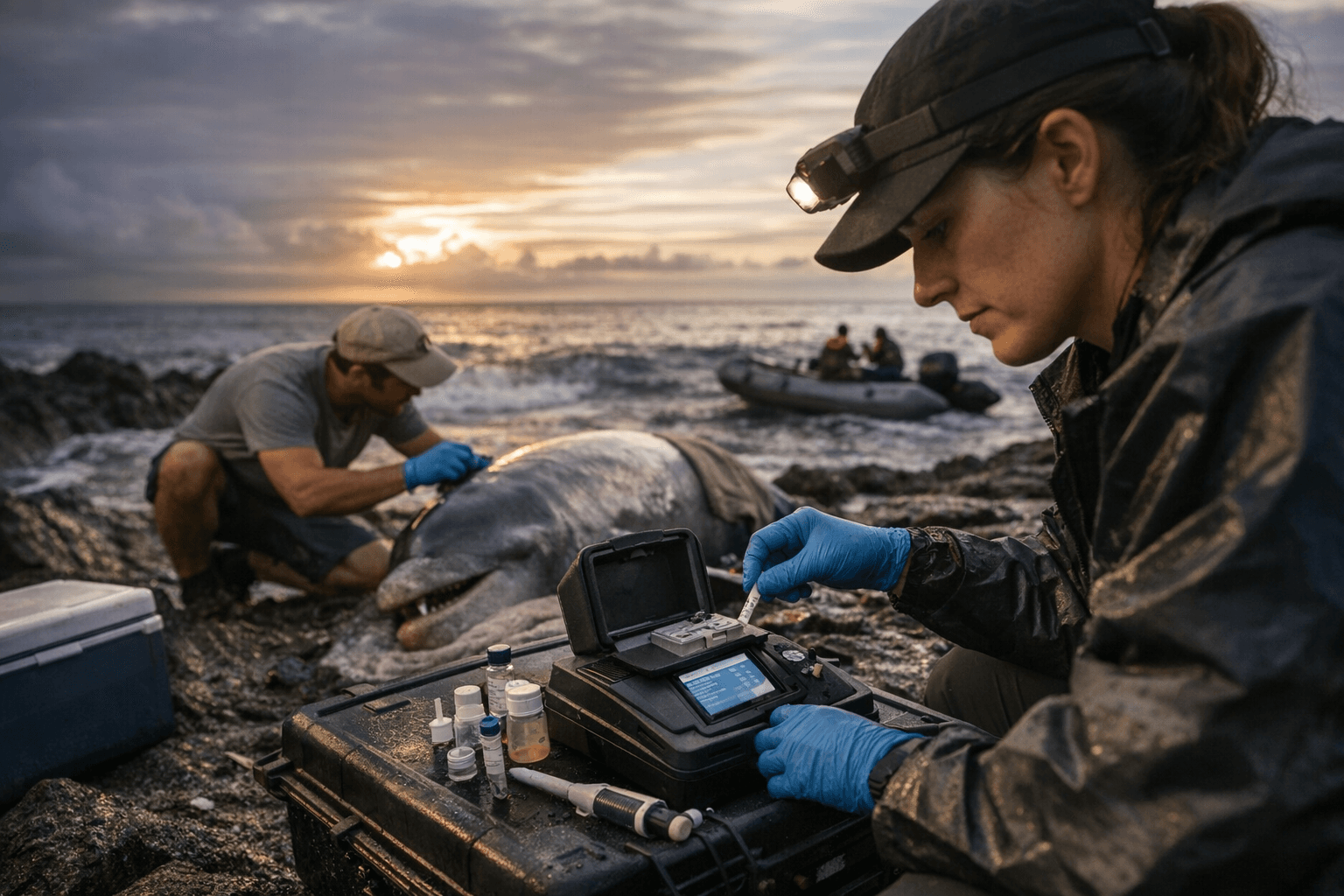
For responders in Hilo, Kona and Puna, where rough seas and long distances have always complicated logistics, the implications are direct. Rather than packaging samples for shipment and waiting, teams could confirm or rule out a disease threat at the scene, enabling faster carcass disposal decisions, more targeted public advisories, and, in live-stranding events, faster triage of animals that still have a chance of survival.
To build regional capacity, UH hosted a training workshop at Sand Island in Honolulu alongside Professor Wei-Cheng Yang of National Taiwan University's Veterinary School. Participants included staff from the Hawaiʻi Department of Land and Natural Resources Division of Aquatic Resources, NOAA Fisheries, the USGS National Wildlife Health Center, the Taiwanese Cetacean Society, and biologists from Guam and Saipan, along with CTAHR graduate students.
"We want to train others so we can increase what we know about disease in many other areas of the world," West said.
Cetacean Morbillivirus has caused mass deaths of thousands of marine animals globally. Rapid field identification means the difference between a contained outbreak and one that spreads undetected. On an island coastline where a single stranding can trigger public health advisories spanning one of the state's most heavily visited recreational corridors, that distinction carries consequences that extend well beyond the water.
This article was produced by Prism’s automated news system from verified source data, official records, and press releases, then run through automated quality and moderation checks before publishing. The system is built and supervised by the people who set the standards it runs under. Read our full AI policy.
Did this article answer your question?