Hanover Historical Village preserves rural life near Alta
Hanover Historical Village turns one stop southwest of Alta into a lesson in rural life, from the 1890 general store to the mill house, blacksmith shop and farm buildings.
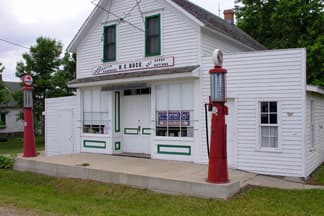
Hanover Historical Village does something rare in Buena Vista County: it lets you see how a rural community actually worked, not just how it looked. Eight miles southwest of Alta, at the junction of M27 and C65, the site brings together a restored country store, farm structures, a blacksmith shop, a barber shop, a home, and working mill buildings in one compact place. That cluster makes the old business of everyday survival tangible, especially for children seeing it for the first time and longtime residents who remember when small towns still depended on nearby trade.
A cluster that explains rural life
The easiest way to understand Hanover is to walk it as a working landscape. The City of Aurelia describes the site as a restored country general store with original furnishings, an old-time barber shop, a two-story machine shed, an old-time home, a working mill house, and a display barn that interprets agriculture from an earlier era. Nothing sits there by accident. Each building tells part of the story of how families bought supplies, repaired equipment, stored feed, and kept a farm economy moving from one season to the next.
Travel Iowa presents Hanover Village as a place where restored buildings display artifacts of rural life from the early 1900s. That matters because the village is not built around one showcase room or a single preserved storefront. It works as a small-scale streetscape of labor and commerce, the kind of setting where children can trace how a loaf of bread, a sack of nails, or a new tool would have moved through the local economy. For adults, the value is in seeing how close together the different parts of daily life once sat.
What the buildings show you
The general store is the anchor. Iowa PBS dates it to 1890 and says it stayed open until 1968, with the post office inside. In its horse-and-buggy-era setup, the store reflects a time when people came in person for groceries, sewing supplies, tools, and candy, because rural households had to gather what they needed themselves instead of ordering deliveries. That detail turns the building from decoration into evidence of how isolated farm families once managed routine errands.
The blacksmith shop, which Iowa PBS says dates to the early 1900s, adds the repair side of the story. The mill house still displays pulleys, shafts, and belts, while the same source says the mill house ground livestock feed, the sawmill turned logs into usable planks, and the windmill pumped water to the house and livestock. Put together, those pieces show a self-sustaining rural system: feed for animals, lumber for building, and water for both home and barn. The display barn extends that lesson into agriculture, while the barber shop, machine shed, and home make clear that Hanover was never just about farming alone. It was also about the services and domestic spaces that kept a community running.
A preservation project built over time
Hanover Historical Village exists because local people chose to rebuild and maintain it piece by piece. The Hanover Historical Society in Iowa formed in 1997, and its first restoration project was the general store, rebuilt with salvaged materials. Over time, the society acquired and restored four other original village buildings, along with additional farm buildings from the area. That growth explains why the site feels layered rather than polished into a single museum block: it was assembled by community effort, donation, and persistence.

The society describes itself as a nonprofit that collects, preserves, and interprets the history of the people who made rural northwest Iowa their home. One Storm Lake Times Pilot article says the group relies on fundraising activities, dues, grants, and donations to pay for restoration and maintenance. That financial reality is part of the story too. The village survives because residents and supporters keep investing in it, year after year, so the buildings, tools, and farm spaces remain open as a public record of local life.
German roots and northwest Iowa identity
Hanover also carries a more specific settlement history. An article notes that Hanover still proudly claims heritage brought by German settlers who came to the area in the late 1800s. That background gives the village an added layer of meaning, because the buildings are not abstract artifacts. They reflect the traditions, labor patterns, and social ties of families who helped shape rural northwest Iowa in a period of settlement and adaptation.
Seen that way, Hanover Historical Village is not simply a reminder of a vanished past. It is a record of how a German-rooted farm community organized work, trade, and household life around a few essential buildings. The general store, blacksmith shop, homes, and farm structures make that history visible in a way that text alone cannot.
When to visit and what to expect
Travel Iowa notes that the family-friendly festival is held the last Sunday of August, and the City of Alta’s 2025 Hanover Fest listing places the event at Hanover Village southwest of Alta at M27 and C65. The two-day schedule includes a cornhole tournament, a BBQ cook-off, live music, exhibits, and demonstrations. Earlier festival coverage adds polka and old-time music, open buildings, games, a petting zoo, and food, which turns the site into a seasonal gathering place as well as a historical one.
Those event days are the easiest time to see the village at its liveliest, but the site’s real strength is that it still reads clearly outside festival hours. The restored store, blacksmith shop, mill house, and farm buildings show exactly how rural Buena Vista County once functioned, from shopping and repair to feed, lumber, and water. Hanover Historical Village keeps that system legible, and that is what makes it one of the county’s most useful history stops.
This article was produced by Prism’s automated news system from verified source data, official records, and press releases, then run through automated quality and moderation checks before publishing. The system is built and supervised by the people who set the standards it runs under. Read our full AI policy.
Did this article answer your question?