Newell’s Allee Mansion offers hands-on look at Victorian life
A three-story Victorian mansion south of Newell lets visitors touch the past while tracing George M. Allee’s corn-testing legacy on a working ISU farm.
A three-story Victorian mansion sits one mile south of Newell on the Iowa State University Demonstration Farm, but the Allee Mansion is more than a preserved house. It links Buena Vista County’s farm wealth, Victorian domestic life, and agricultural experimentation in one stop. Visitors come for the turret, porches, and flower gardens, then leave with a clearer view of how one local family helped shape both community identity and modern crop testing.
A Victorian house built from farm success
Built in 1891, the Allee Mansion is commonly known as the Jesse J. and Mary F. Allee House. Its exterior still shows the details that make it stand out from the surrounding farm landscape: a turret with fish-scale patterns, three porches, flower gardens, and a gazebo. The Newell Historical Society says George M. Allee donated the house to Iowa State University and leased it to the society in 1989, giving the property a second life after its original family era ended.
The mansion’s historic standing was formalized when it was added to the National Register of Historic Places on March 26, 1992, under reference number 92000271. That designation matters because it places the house in the state and national record as a site worth preserving, not just admiring. The society says it has worked for more than 30 years to restore and preserve the mansion, and the result is a house that still reflects the 1891 period rather than a modernized version of it.
What visitors can still see and touch
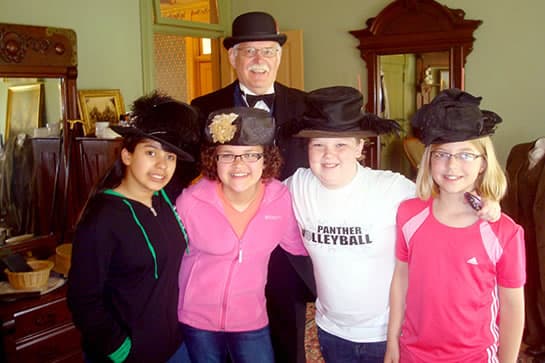
The Newell Historical Society describes the mansion as a living museum, and the phrase fits the experience closely. Visitors can feel and touch items on display, which makes the house different from a look-but-don’t-touch historic room exhibit. Guides dress in Victorian costumes while explaining life at the turn of the 20th century, turning the visit into a close look at how a prosperous rural home functioned when daily comfort depended on hands-on work.
The tour experience includes demonstrations of a pump organ, Victrola, pedal sewing machine, and hand-crank corn sheller. Those objects give the house its practical edge: they connect domestic routines to the labor that sustained farm households. The Newell Historical Society also says the mansion has been restored to the 1891 era of wall coverings and furnishings, so the rooms themselves help tell the story, not just the guides.
Visits are available for groups of 8 or more, and the society’s broader programming includes tours, demonstrations, events, and luncheons. That makes the mansion useful for school outings, family visits, and community groups that want more than a walk-through of old furniture. It is set up to be experienced, not merely observed.
The farm story behind the house
The strongest surprise at the Allee Mansion is how closely the house story is tied to agricultural innovation. George M. Allee’s papers at Iowa State University include awards, corn show records, correspondence, news articles, photographs, planting records, and record books, much of it tied directly to Iowa state corn shows and yield contests. That archive shows a man whose work moved well beyond his own fields and into statewide testing and farm education.
The broader farm site deepens that connection. The Allee Memorial Demonstration Farm began in 1958 when George M. Allee bequeathed 160 acres to Iowa State University. Corn yield test plots were established on the farm in 1959 as part of a network of test sites throughout the state. In practical terms, the mansion sits inside a landscape that helped turn experimentation into a routine part of Iowa agriculture.
Allee’s own public role also extended into farmer education and local organizing. Newell Historical Society materials say he devoted many hours to perfecting the Iowa yield test for small grains, chaired the Newell Corn Shows, and promoted new farming practices while awarding farmers for the best corn and livestock. Those efforts made the home part of a wider civic network, where innovation was not locked in a lab or a university office, but discussed in the county and demonstrated in public.
A local figure with a broader civic profile
Allee’s work was not limited to one crop or one building. Historical materials say he dedicated his life to improving inbred corn that would better withstand Iowa’s climate and feed cattle, which helps explain why the mansion belongs in a story about practical rural progress as much as architecture. A separate family-history account says he also helped organize a local Farmers’ Institute, showing that he used public gatherings to spread new ideas about agriculture.
The Newell Historical Society brochure adds another layer to the family’s place in local memory: Allee was an avid golfer and helped promote one of the first golf courses in the area. That detail broadens the picture of a man often remembered for corn research and yields, but also active in the social and recreational life of the community. It is one reason the mansion still feels tied to Newell rather than isolated from it.
What makes the Allee Mansion compelling now is that it does not force visitors to choose between house museum and farm history. The same site carries both. In one visit, you can stand in a restored Victorian room, handle the kinds of tools families once used every day, and trace how a Buena Vista County farm family helped shape the testing practices that followed.
This article was produced by Prism’s automated news system from verified source data, official records, and press releases, then run through automated quality and moderation checks before publishing. The system is built and supervised by the people who set the standards it runs under. Read our full AI policy.
Did this article answer your question?