Cherokee exhibit ties America250 to Buncombe County's painful history
A Cherokee exhibit is forcing Buncombe County to confront America250 as both celebration and reckoning, pairing survival and sovereignty with removal and loss.
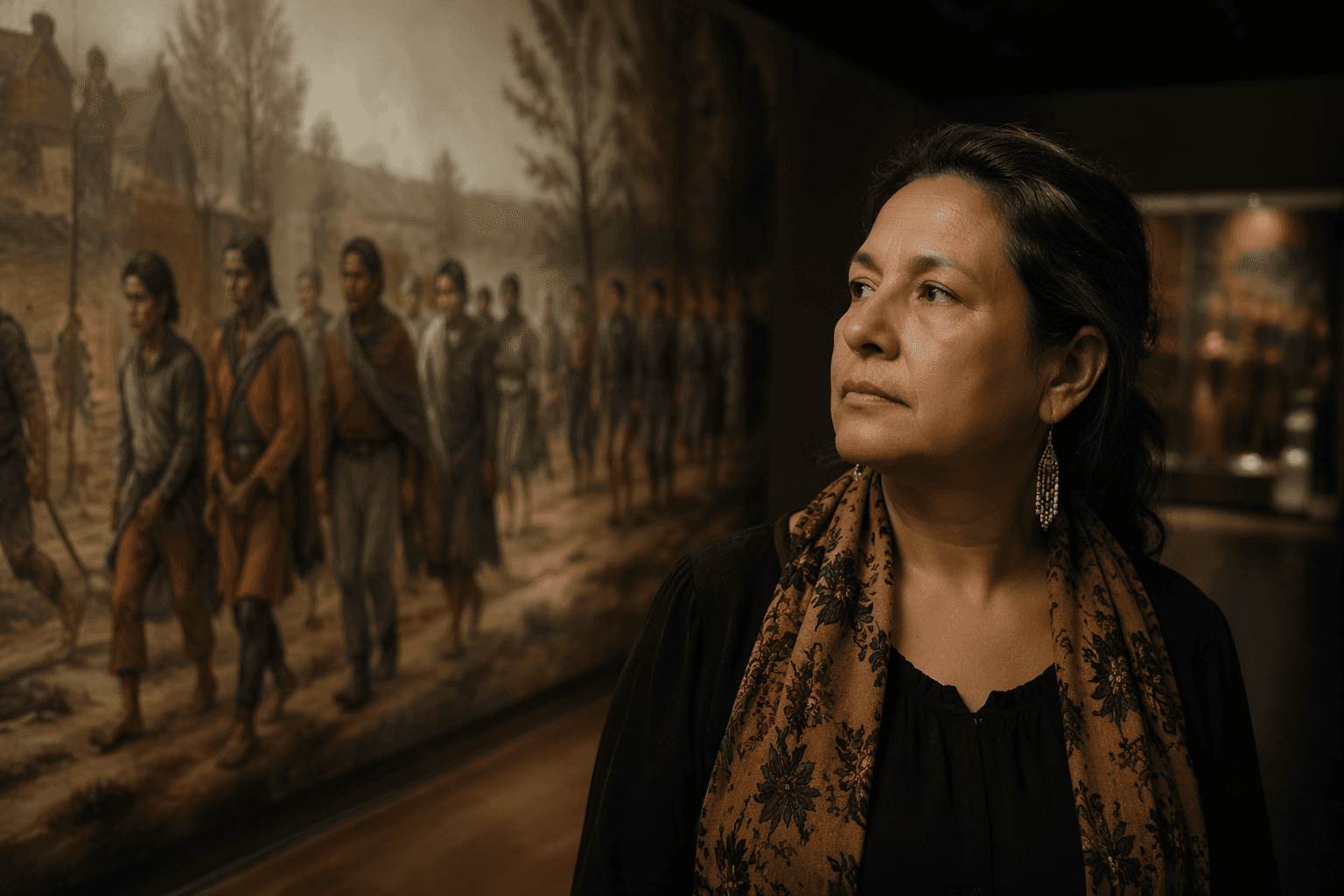
Cherokee pride, survival and cultural continuity sit at the center of a new exhibit that asks Buncombe County visitors to see America250 as more than a patriotic countdown. The display frames the nation’s 250th anniversary against the violence built into Cherokee removal, making the anniversary feel immediate in Western North Carolina instead of distant or ceremonial.
America250 through Cherokee eyes
North Carolina is already organizing for the semiquincentennial through an official committee created by the General Assembly, and America250 events are unfolding across Western North Carolina. The Cherokee exhibit lands in that broader moment with a different purpose: it pushes the region to consider who gets folded into the nation’s story, who is asked to commemorate it, and who has already paid for it.
That shift matters in Buncombe County, where the exhibit’s message meets a local audience that lives with the consequences of land loss, broken treaties and forced removal. The point is not simply to include Cherokee history in a national celebration. It is to question what kind of celebration can honestly coexist with the facts of Cherokee dispossession.
A county formed through Cherokee loss
Buncombe County’s own formation is tied to land cessions and broken treaties, a history documented in a 2021 Asheville Citizen-Times project. That local record gives the exhibit particular force in Asheville and across the county, because it makes the national story legible at the county line. What happened to the Cherokee was not only a distant frontier tragedy. It helped shape the ground under present-day Buncombe County.
The Cherokee homeland once covered parts of what are now western North Carolina, eastern Tennessee, Georgia and South Carolina, according to Britannica. The Eastern Band of Cherokee Indians formed in North Carolina from people who escaped removal or later returned, preserving a living community in the same mountains from which many Cherokee were driven. That history gives Buncombe County residents a direct connection to the region’s Indigenous past, not an abstract one.
The Trail of Tears remains the central wound
The Trail of Tears National Historic Trail commemorates the forced removal of the Cherokee in 1838 and 1839 and the paths followed by 17 detachments westward. Today, the trail spans about 2,200 miles of land and water routes across portions of nine states, a geography that shows how far the consequences of removal reached.
The National Park Service says more than a thousand Cherokee died during the journey west, with many others suffering additional losses. Those losses did not end at the route’s completion. Families were broken apart, communities were displaced and cultural continuity was violently interrupted even as Cherokee people continued to survive and rebuild.
The scale of that history is why the exhibit’s framing matters. America250 is not only about the founding of the United States. For Cherokee people, and for residents of Buncombe County who inherit this history, it is also about what was taken to make the nation expand.
Cherokee identity is not trapped in the past
The exhibit’s insistence on pride alongside pain reflects the reality that Cherokee identity has never been defined solely by removal. The Eastern Band of Cherokee Indians continues to sustain political, cultural and community life in North Carolina, and Cherokee, North Carolina remains one of the clearest centers of that continuity.

That living presence is visible every year in the annual 4th of July Powwow in Cherokee. Visit Cherokee says the 2026 event runs July 3 through July 5 at the Old Acquoni Expo Center in Cherokee. The gathering underscores that this story is not only about trauma and memory. It is also about sovereignty, ceremony and the daily persistence of a people who were meant to disappear.
For Buncombe County readers, that distinction matters. The question is not whether Cherokee history belongs in a semiquincentennial year. It is whether America250 can be framed honestly enough to hold both the nation’s founding narrative and the violence that accompanied it.
What the exhibit asks of Western North Carolina
The exhibit’s strongest argument is structural, not symbolic. By placing Cherokee pride, survival and continuity beside removal and erasure, it challenges the idea that Indigenous communities should merely be represented in the nation’s anniversary. Instead, it asks whether the anniversary itself must be reframed through Cherokee experience.
That is a sharper civic question for Asheville, Buncombe County and the wider Western North Carolina region because the area’s public memory is already braided with Cherokee history. County formation, regional settlement and the modern landscape of cultural life all point back to the same truth: the region’s past cannot be told cleanly without naming displacement. America250, in this telling, becomes a local test of whether public commemoration can handle that truth without sanding it down.
The exhibit also arrives at a moment when state and local America250 planning is picking up speed, giving Cherokee voices an opening to shape how the semiquincentennial is understood in North Carolina. That influence is likely to matter beyond a single display case. In a county marked by the legacy of land cessions and a state preparing for a major anniversary, the exhibit sets a standard for what honest commemoration should look like: not inclusion for appearance’s sake, but a fuller account of how this country was built and who endured its making.
This article was produced by Prism’s automated news system from verified source data, official records, and press releases, then run through automated quality and moderation checks before publishing. The system is built and supervised by the people who set the standards it runs under. Read our full AI policy.
Did this article answer your question?