Leicester farmers market builds rural food resilience in Buncombe County
Leicester’s Wednesday market now acts as rural food infrastructure, linking over 20 vendors, EBT/SNAP access, and post-Helene recovery work across Buncombe.
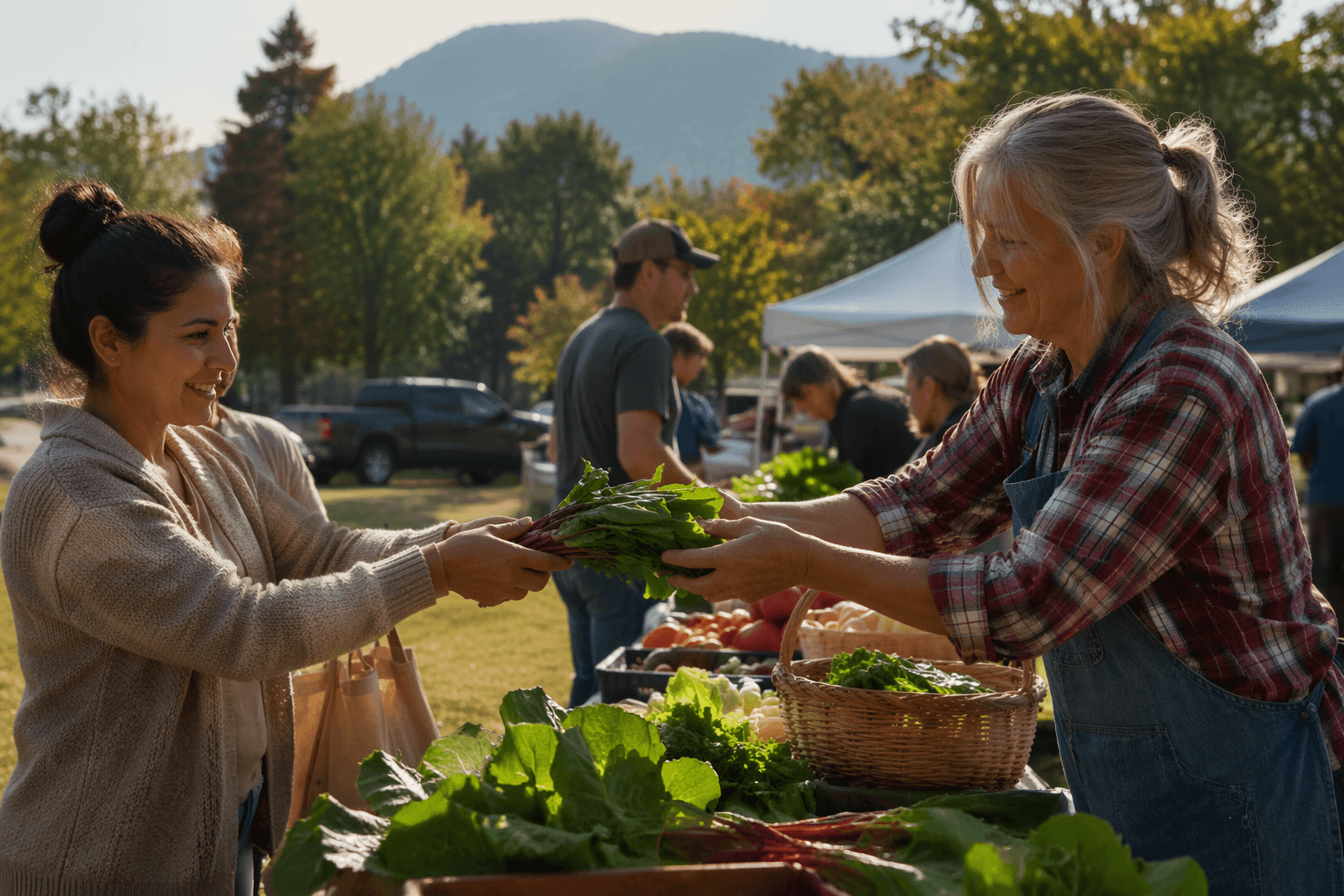
At the Leicester Community Center, a modest Wednesday market is doing more than selling vegetables. It is helping move more Leicester-grown food into local hands, keeping money in rural Buncombe County, and giving small producers a sturdier sales channel when storms or supply shocks hit.
A small market with a larger job
The Leicester Farmers Market is listed as Leicester’s only community-led farmers market, and that matters in a county where food access has become part of the recovery conversation. The market runs every Wednesday from 3:00 p.m. to 7:00 p.m. at the Leicester Community Center, with May and October hours ending at 6:30 p.m. That schedule gives residents a reliable weekly buying option in a rural area where access can be uneven and transportation can shape what ends up on the table.
The market’s role is bigger than convenience. In Buncombe County, local food outlets are part of public health infrastructure because they help determine whether families can buy fresh produce, whether farmers can earn fairly from nearby customers, and whether rural communities can keep food dollars circulating close to home. The latest reporting on Leicester frames the market as a test case for resilience, not a feel-good amenity.
What shoppers can buy, and who benefits
ASAP says the market accepts credit and debit cards as well as EBT and SNAP, which makes the market more useful to households balancing food budgets. That access matters because food resilience is not only about having food somewhere in the region. It is about whether people with limited cash flow can actually buy it in the moment, without being locked out by payment barriers.
The market’s product mix also points to a broader local economy. ASAP lists locally sourced produce, cheese, meats, crafts and more, while Farm Heritage Trail says the market features over 20 local vendors. Those items are grown or produced in Leicester, Dix Creek, Sandy Mush, Newfound, West Buncombe and Marshall, showing that the market reaches beyond a single town limit and into the county’s rural food shed.
That sourcing footprint gives the market real weight. It means the market is not just reselling what comes in from distant distribution channels. It is creating a place where growers and makers from surrounding communities can bring food directly to neighbors, shortening the path between field and fork and reducing dependence on fragile wholesale routes.
Why resilience is the real story
The resilience angle has sharpened since Hurricane Helene disrupted local systems. Buncombe County’s Helene recovery resources remain part of the public record, and the county’s recovery guide was current as of June 9, 2025, a reminder that the effects of the storm did not end quickly. In that context, every stable local market outlet carries more importance because it gives growers another way to stay afloat when conventional distribution breaks down.
That lesson was made plain in Swannanoa, where Carolina Public Press reported that a new county-run market exhausted its food supply in 30 minutes after opening in April 2025. That kind of demand shows how quickly food access needs can surface after a major disruption. It also shows why a network of smaller, distributed food outlets can matter more than a single intervention.
CEFS offered another concrete sign of how storm recovery and farm resilience overlapped in Buncombe County. On January 9, 2025, it distributed $6,234.39 worth of supplies to four Buncombe County farmers after flood damage tied to Helene. That support was modest in dollar terms, but it points to a larger truth: small farms can be knocked off balance by a storm, and even limited aid can help keep local production alive long enough to serve the next market day.
A stronger local-agriculture system is taking shape
The Leicester market is not happening in isolation. Buncombe County Cooperative Extension announced Rachel Douglas as its new Urban Agriculture Agent in a May 29, 2026 post, and the county staff directory lists her role as Extension Agent, Urban Agriculture. That staffing move suggests local government is treating urban and small-scale agriculture as a real program area, not an afterthought.
That matters because food resilience depends on more than one market stall or one recovery grant. It depends on technical assistance, planning support, crop knowledge, and the ability to help growers navigate everything from land access to sales channels. When Extension adds capacity in urban agriculture while a rural market like Leicester expands its reach, the county is building pieces of the same system.
The surrounding reporting also points to an ecosystem rather than a single event. A recent ASAP report on farmers market prices, the new urban agriculture role at Extension, and pollinator celebration events all sit in the same local-agriculture moment. Together, they show Buncombe County trying to strengthen the links between production, retail access, and environmental health.
What Leicester adds to food security in rural Buncombe
The practical value of the Leicester Farmers Market is straightforward: it gives local producers another place to sell, gives shoppers another place to buy, and keeps more food dollars in the county. In a rural community, that can mean better access to fresh food during a week when supply chains are shaky, roads are disrupted, or grocery costs climb.
It also helps with social equity. Accepting EBT and SNAP means the market can serve households that are often left out of higher-priced local food channels. A market with over 20 vendors, local sourcing across several rural communities, and a consistent weekly schedule is not a complete solution to food insecurity, but it is a tangible form of capacity.
That is why the Leicester market deserves to be understood as infrastructure. In post-Helene Buncombe County, resilience is not abstract. It is a Wednesday market at the Leicester Community Center, local produce from nearby communities, payment options that widen access, and a growing network of agricultural support that may help rural households stay fed when the next shock arrives.
This article was produced by Prism’s automated news system from verified source data, official records, and press releases, then run through automated quality and moderation checks before publishing. The system is built and supervised by the people who set the standards it runs under. Read our full AI policy.
Did this article answer your question?