River Arts District exhibit confronts polarization, war and climate change
A River Arts District show turns the gallery into a place to wrestle with war, climate change and division while Asheville keeps rebuilding.
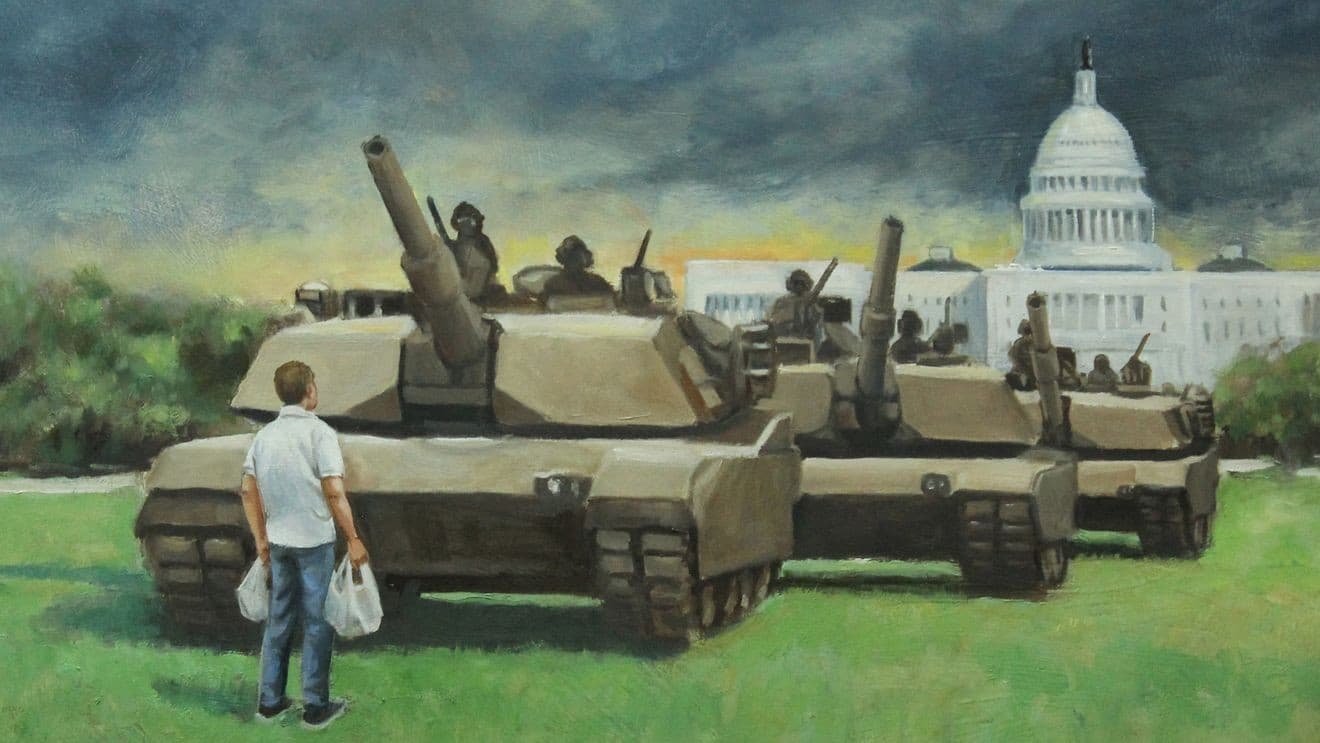
Common Ground Rising turns Pink Dog Creative into a place for civic friction as much as art. The River Arts District exhibition pulls Western North Carolina artists into the biggest arguments of the moment, then asks Buncombe County viewers to sit with that unease in a neighborhood still shaped by Hurricane Helene’s damage and recovery.
Why this show lands now
The exhibition runs July 20 through September 20 at Pink Dog Creative, 348 Depot Street, with an opening reception Friday, July 24, from 5 to 7 p.m. It is part of the national Fall of Freedom project, a call to creative resistance against censorship and repression, which gives the show a larger frame than a single gallery in Asheville. The point is not escape. It is to use art to process polarization, war, climate change and authoritarian pressure in a way that feels immediate to the city around it.
Asheville artist and curator Skip Rohde puts the intent plainly: “artists have a lot to say about the world and many ways to say it.” In this show, that becomes a curatorial method. The works are meant to move from subtle and reflective to confrontational and urgent, while still leaving room for resilience and hope.
What visitors will find at Pink Dog Creative
Pink Dog Creative describes itself as a collective of studio and retail spaces in the River Arts District, housed at 342 to 348 Depot Street in a building that once served as a textile manufacturing and warehouse site. The complex now brings together artists’ studios, retail space and food businesses, and Pink Dog Creative says 35 artists are working in its studios.
That setting matters. The building is not a neutral white cube separated from neighborhood life. It is part of a dense arts corridor where people make, sell and gather around creative work every day. In that environment, Common Ground Rising is less like a distant museum statement and more like a conversation happening inside the district’s working ecosystem.
The show’s subject matter also signals range. Political polarization, war, climate change, censorship, authoritarianism and the search for shared humanity can land as very different kinds of art, and the exhibition makes room for that. Some pieces are likely to press directly on public anger or grief, while others may approach the same questions through restraint, symbolism or memory.
Why the River Arts District gives the exhibition extra weight
The River Arts District is still recovering from Hurricane Helene, which devastated up to 80 percent of the area. Post-storm reporting says more than 300 artist studios were damaged or destroyed, and more than 750 working artists were affected. That scale of loss turned a neighborhood known for production and open studios into one of the clearest symbols of Asheville’s recovery.
River Arts District Artists says the association represents a vibrant community of more than 500 active artists working and showing art in the district, and that local network helps explain why a show like this can draw on such a wide range of voices. Common Ground Rising is not arriving in an arts desert. It is entering a place where creative work has long been part of the district’s identity, and where that identity has had to be rebuilt under pressure.
Pink Dog Creative says its own building sustained only minimal damage from Helene, which adds another layer to the story. A space that remained usable while much of the district suffered damage now becomes a venue for making sense of the broader damage around it. That contrast gives the exhibition a practical and emotional charge.
The recovery backdrop behind the gallery walls
The art show also sits inside a wider rebuilding effort that is still unfolding across Asheville and Buncombe County. ArtsAVL awarded $665,000 in recovery grants to 65 nonprofit arts and cultural organizations across Western North Carolina in its first recovery grant cycle. That funding is part of a broader $1.2 million nonprofit arts recovery program supported by the North Carolina Community Foundation’s Disaster Relief Fund and Dogwood Health Trust.
ArtsAVL has also released a draft Asheville-Buncombe Arts Recovery Framework for public review, a sign that the local arts sector is still planning not just for repair, but for what a more resilient future looks like. In that context, Common Ground Rising is not separate from the recovery story. It is one of the ways the arts community is defining what recovery should feel like, who it should serve and how public spaces should function after a disaster.
The national Fall of Freedom frame sharpens that message. By tying local work to a broader campaign for creative resistance, the exhibition places Asheville artists inside a larger debate about free expression and democratic pressure. That is a meaningful fit for a city where questions about identity, belonging and power keep surfacing in public life.
What Buncombe County residents are meant to do with the discomfort
Common Ground Rising is built to leave people with more than appreciation for technique. It wants viewers to think, argue, reflect and stay with the tension long enough to notice what it reveals. In a community still shaped by storm recovery and still arguing over what kind of place Asheville should be, that discomfort becomes the point.
For Buncombe County residents, the exhibition offers a way to see national anxieties through a distinctly local lens. The River Arts District has always linked creativity to community, but this summer it is also linking creativity to recovery, political speech and civic repair. That makes Common Ground Rising feel less like a temporary show and more like a public test of how art can hold division without pretending it has already resolved it.
This article was produced by Prism’s automated news system from verified source data, official records, and press releases, then run through automated quality and moderation checks before publishing. The system is built and supervised by the people who set the standards it runs under. Read our full AI policy.
Did this article answer your question?